In Just a Minute

3%

Review and Herald Publishing Assn. · Takoma Park Station, Washington, D. C. · Dec 18, 1917

FromThe Youth’s Instructor, Vol. 65, No. 51.

Read the full edition
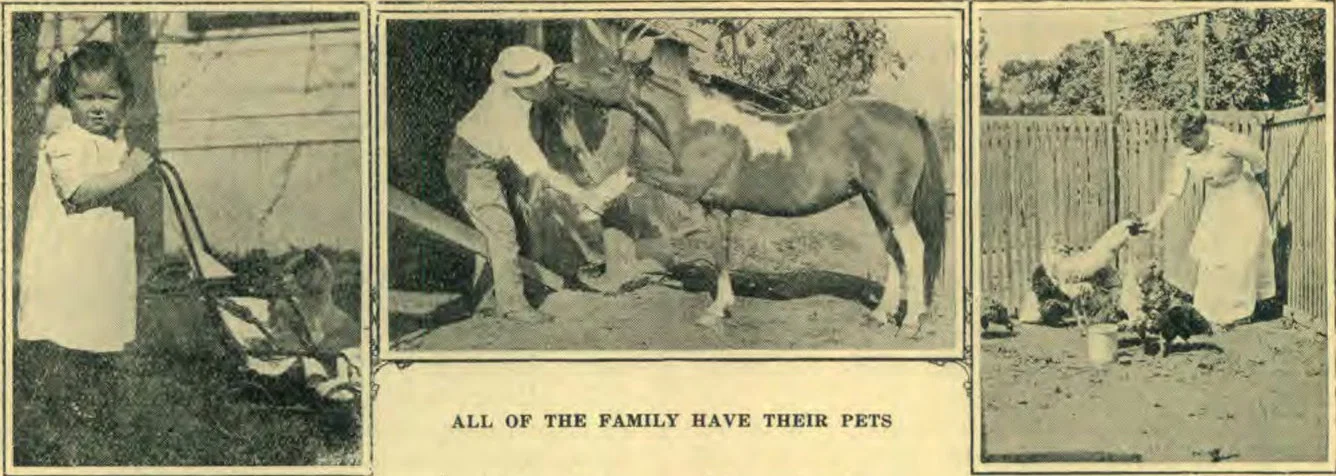
ALL OF THE FAMILY HAVE THEIR PETS

“In Just a Minute”

LOULA B. FREEMAN
Carl, a bright, freckle-faced boy of ten, swung listlessly back and forth on the pasture gate, as he basked in the sunshine of an early July morning. There was a three-cornered tear in his blue overalls, and his bare, chubby toes wriggled over the edge of the lower board of the gate. His light-brown hair stood in shocks over his forehead, and his big blue eyes wandered searchingly over the pasture. Soon a rabbit hopped from one cabbage to another in the neighboring patch. Carl had been reading “The Bed-time Stories.”
“Hello, Peter Rabbit! You’d better get out of that cabbage patch. I’m Farmer Brown’s boy, and I’ll get you!” he cried as he jumped from the gate and ran along the path to the garden.
Just then mother’s familiar voice called from the kitchen door, “Carl, where have you been? Come, and mind the baby.”
There was a note of irritation in the voice. Already the kitchen was close and heated, though it was only eight-thirty, and mother had a big day’s work of canning to do. Baby was cross, and wanted some “be’ies.” He was continually getting into the ripe fruit.
“In just a minute, mother,” answered Carl carelessly, as he neared the cabbage patch.
The rabbit, startled, hopped along the rows and hid beneath some big green leaves.
“Oh, don’t think you’ll hide so easy, Peter. I’m coming,” said Carl.
The rabbit jumped out from beneath the cabbages, and went lipperty-lipperty-lip down a long row, under the wire fence, and into the tall grass of the pasture. Carl pursued him until he darted past a clump of currant bushes. The ripe currants, like so many rubies, caught Carl’s eye. His mouth watered as he tasted some, gathering more meanwhile. Soon he had eaten several handfuls and had wandered on into the pasture, spying better bushes, until an hour had passed.
“Guess Baby John’d like some of these,” he thought.
A quarter of an hour later Carl arrived at the dining-room porch, where the baby was contentedly playing with the cat, and an improvised rag doll, which his eighteen-year-old sister, Maggie, had given him.
“Carl, you’re about an hour behind time, as usual,” said Maggie. “Now run down to the mail box, please, and hurry back, for there must be some letters.” Maggie resumed her task of washing berries.
Carl started off down the driveway toward the road. Just then Uncle Walter called to him and said, “After you’ve given the mail to Maggie, Carl, come here. I’ve something for you to do.”
Uncle Walter was watering Old Ben, the pet horse, at the big trough, and Carl sighed, “O dear, seems as if they try to keep a fellow busy!” But he answered, “In just a minute, Uncle Walter.”
When he reached the mail box, the mail wagon, late this morning as it happened, was just approaching. Carl’s attention was attracted by a group of covered wagons about half a mile down the road. Smoke was ascending from a camp fire in the shade by the roadside, and five or six men and women were moving about. Unharnessed horses outnumbered the wagons.
“Gypsies,” thought Carl. “Mr. Postman, will you please give me a ride?”
“Jump in,” said the carrier, “if you’ll take this mail and give it to your folks when you come back.”
Carl took the three letters and the newspaper and held them carelessly in his hand, saying, “Guess those must be gypsies up the road, aren’t they? Did you ever visit any gypsies, Mr. Postman?”
“No, and perhaps it wouldn’t be well for you to do so either, sonny,” replied the latter. “Sometimes you know gypsies run away with small boys like you.”
When they had come within a short distance of the interesting scene, the postman turned his horse, as was his custom, onto the crossroad, leading in the direction parallel with the length of Mr. Davis’s farm. So Carl, fearing the gypsies just a little, continued to ride with the postman until they came to the grove along the edge of the roadside near the barnyard.
“Perhaps I’d better get off now; it’s most dinner time, and I’m hungry. Thank you for the ride. I’ll go with you again some day.”
As Carl waded through the tall grass by the side of the road, he picked some daisies for mother, and accidentally dropped two of the letters, one addressed to “Miss Margaret Davis,” and the other in typewriting to “Mr. George Davis.”
Carl reached the kitchen door just as dinner was being taken up. “Was there any mail, Carl?” asked Maggie.
“Yes’m, three letters and a paper, I think. Why, there’s only one here!”
Just then Carl’s father spoke. “There must have been one for me, Carl, an important business letter.”
“Why, I think one did have your name on it, father. What could have happened to those two?”
“Where did you pick those daisies, son? Very likely you dropped the letters when you picked them. You run back and hunt for the letters; and mind, no dinner until you find them.”
With a sigh, Carl retraced his steps to the side of the road, where, after a little searching, the lost letters turned up in the tall grass. He ran back to the house.
“Here they are, father!”
Carl’s father and Maggie accepted the letters with satisfaction. Carl washed for dinner and took his place at the table.
“Where’s Uncle Walter?” he asked.
Mother looked up with a tired expression on her face. She remembered the number of times Carl had been behindhand that morning.
“He went out to the Big Red River for a fishing trip,” she said.
“Oh, I wish I could have gone,” said Carl with disappointment.
“You could have,” said mother, “if you had come back in time; Uncle Walter said he would have taken you.”
Carl remembered how he had said as usual, “In just a minute,” and resolved hereafter to “do it now,” and not “in just a minute.”