First Flights
One of the best ways to prepare for a long journey is to make a short one. So we find that many birds, before they embark on their great air voyage which is to take them from their summer to their winter home, first make daily trips between their sleeping quarters and their feeding grounds.
This is the habit of our robin. Robins raise two and sometimes three families in one season. When the first family leaves the nest, early in June, it is taken by the father robin to some dense, leafy growth of young trees to pass the night. To this place they return every night. Many other robins, sometimes thousands of them, come to the same woods. Such resorts are known as robin roosts. In flying to and from them the young birds learn to find their way.
Meanwhile, mother robin is patiently sitting on her blue eggs, from which in about two weeks’ time another little family will appear. In two weeks more they also will be large enough to leave the nest, and can join their brothers and sisters in the roost.
Grackles, or crow blackbirds, have the same habit. But since they have only one family, or brood, both the parent birds go to the roost with their young.
Sometimes the robins are joined by the grackles, and both by the European starlings, which, brought to this country and released in Central Park in 1890, have since become one of the most abundant birds in our Middle Atlantic States. Such a roost is visited nightly by many thousands of birds.
It is very interesting to watch them at sunset come streaming in from every point of the compass, and to hear their good-night chorus before they all go to sleep.
In the morning they begin to leave soon after day-break, and by sunrise few are left. The place which was thronged by myriads is deserted. Late in the afternoon they begin to return, and erelong the roost is again teeming with feathered forms.
The little journeys of swallows from their sleeping resorts to their hunting grounds begin in July and do not end until late September or early October. Swallows sleep in the reeds or cat-tails which grow in vast marshes. They are so hidden that you might pass very near them without seeing a bird. But suddenly, like exploding fireworks which fill the air with sparks, they burst from their roost, and there is a swarm of happy, twittering birds above you. A moment later they have gone, each one to hunt its breakfast.
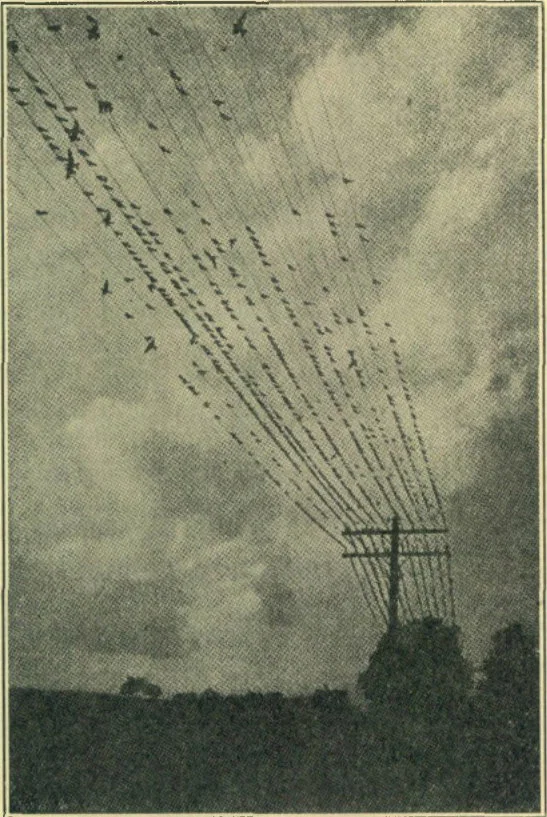
At midday and in the early afternoon one may see them resting in long rows on the electric wires. Late in the afternoon they begin to return to the marshes, darting for mosquitoes and other insects as they go. During the day they have flown far. Thus they gain the practice which makes them ready for the great journey to the South.
How they know when it is time to start, who can say? But that they all know it, is certain. On that day all the swallows which have been roosting within miles of one another rise up in the air together. From a distance they look like a snowstorm of large black flakes. There seems to be much excitement. The great day has come! Soon they leave the marsh, not to return until the following spring.
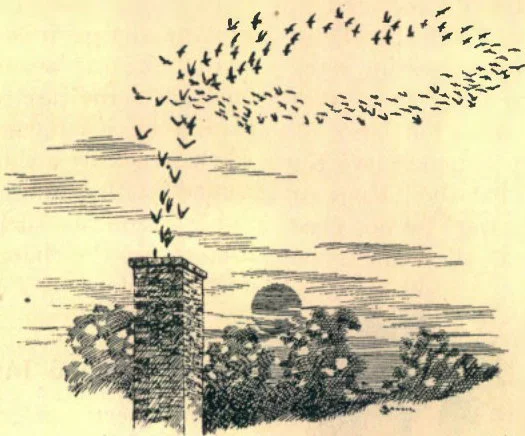
Chimney swifts, in their daily journeys, scatter far and wide over the country. One may see a swift coursing through the air here, and another there. But in the evening they all come racing in toward the chimney in which they are to pass the night. Before this country was settled, the swifts nested and roosted in hollow trees. Now, as we all know, they use chimneys, and the roosting chimney is usually a large one.
The early arrivals do not enter the chimney at once. In fact, no swifts go to bed until practically all have come, when they fly in a great irregular spiral around and around in the air over the chimney. Then, like a whirling column, a part of them pour into the chimney. The others go flying madly onward. Again they approach the chimney, and another group of birds darts spirally into it. This performance is repeated until not a swift remains outside. What a singular appearance the walls of the chimney must present at this time, with hundreds, and often thousands, of soot-colored birds clinging to it!
In the morning the swifts leave in small parties, and at once separate widely over the country in search of food.
In southwestern Minnesota there is a small lake, about five miles long and three wide, called Heron Lake. It is the favorite resort in the autumn of the beautiful Franklin’s or prairie gull. There are many thousands of them there, and their daily journey from the lake to gather food out in the prairies is one of the most beautiful sights I have ever seen in bird life.
The gulls sleep near the center of the lake, all crowded closely together. They leave before sunrise. All rise at once, and the air is then so filled with birds that one can scarcely see the lake. Many drop back to the water; the others begin their day’s wanderings. Again they all rise; a part take leave, while those remaining return to the water. Within half an hour all have gone.
Some mornings they fly in one direction, on others in another direction. I think they are apt to fly toward the point from which the wind blows. Their favoritep. 9 feeding grounds are freshly plowed fields. Often they follow directly behind the plow, when it is a charming sight to see the snowy-plumaged birds hover over the plowman and alight in furrows to pick up grubs lying in the black earth. In this way they destroy many harmful insects.
The return to the lake begins late in the afternoon. At times they fly in even rows,—perhaps half a mile in width,—but not more than three or four gulls deep. Or they may come home in V-shaped flocks with as many as sixty-five gulls in each arm of the V. But whether in long, billowy lines or low-flying wedges, the flights of the gulls teach us in what an orderly manner birds perform these little journeys.
With the robins, grackles, swallows, swifts, and gulls, these daily trips to and from their sleeping quarters precede the real migration to their winter homes, where, in some cases, new flocks may be formed and new roosting places found.
There are other birds which gather nightly in certain roosting places, but which migrate little if at all. Among these are herons, which every evening gather in some marshy woods or thicket that perhaps has been used as roosts for many years.
Crows flock together in great roosts in the winter. Some crow roosts have as many as two or three hundred thousand tenants nightly. When the birds leave in the morning, they fly low and search for food. When they return in the afternoon, they fly high, heading straight for the roost. Hence the expression “As the crow flies.”
Like the chimney swifts, crows do not enter their sleeping place until practically the last bird has arrived. In the meantime, they alight on the ground in near-by fields. As bird after bird returns and drops down among the others, the ground becomes black with crows. I have seen several acres covered with them. They seem to have very little to say about the day’s experience.
It is almost dark before they go to bed. Then they rise from the ground, and in orderly procession silently fly to their roost in the woods.
Besides these daily journeys to and from their sleeping places, some birds wander about during the winter over land and sea. Their chief object in life at this time is the search for food, and they go almost anywhere that it is likely to be found.
So in the winter we may have visits from crossbills or pine grosbeaks. These birds feed on the seeds of cone-bearing trees. When there is an abundant supply of this kind of food in the far north, we see very few or none of them. But when the pines and spruces produce a small crop, then the crossbills and grosbeaks come to us in unusual numbers.
It is said that herring gulls have been known to follow a steamer across the Atlantic. They were not attracted by the steamer, we may be sure, but by the food which was thrown overboard from it.
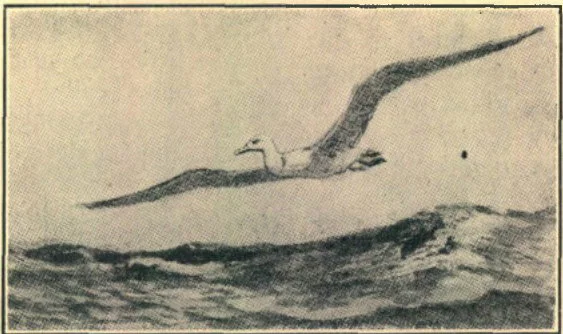
The great albatross ranges so far over the southern seas that it is called the wandering albatross. In the museum of Brown University there is a mounted specimen of a wandering albatross which shows how well this name is deserved. When captured off the coast of Chile, on Dec. 20, 1847, the bird had a small vial hung on a string about its neck. This vial contained a piece of paper, from which it was learned the bottle had been attached to the bird Dec. 12, 1847, by the captain of a whaling vessel when it was about eight hundred miles off the coast of New Zealand. The bird therefore had traveled at least thirty-four hundred miles in eight days. But if a bird be a migrant, its wanderings, or daily trips to and from the roost, will end when the call comes for the great journey.—Frank M. Chapman, in St. Nicholas.