Submarine Mines

6%

Review and Herald Publishing Assn. · Takoma Park Station, Washington, D. C. · Feb 22, 1916

FromThe Youth’s Instructor, Vol. 64, No. 8.

Read the full edition

Submarine Mines

ORIGINALLY all forms of apparatus designed to explode under water to destroy ships were called torpedoes, but this term is now applied only to the well-known naval weapon. Submarine mines may be divided into three groups:—
  1. Buoyant mines, having a constant depth of immersion.
  2. Ground mines, which are used in shallow waters and rest on the bottom.
  3. Floating mines.
The mines belonging to the first and second groups may be exploded either from land by an electric current or by automatic contact with a ship.
Electrically controlled mines are employed only for the protection of harbors and channels, and may be divided into two classes: those which are entirely and those which are partially controlled from land. A mine consists generally of two perfectly water-tight metal casings made of suitable shape. One of them is hollow, and is intended to act as a float to maintain the mine at a required depth below the surface; while the other one is filled with the charge, which may be guncotton trinitrotoluene, or any other suitable explosive, and the detonator for firing the charge. In coast defense work where electric control is employed, mines are anchored permanently in suitable positions, where hostile vessels are likely to pass over them, and are connected by means of electric cables to the shore. Where mines are entirely controlled from shore, an observer on land can fire any mine or group of mines by closing the electric circuit the moment his optical instruments inform him that the enemy’s ship is over a mine.

Firing an Electrical Mine

Mines which are partially controlled from land are anchored only a few feet below the surface of the water. When a ship strikes such a mine, an electric contact is made which sends a signal to the shore station. The observer can then decide whether to fire the mine or not. An advantage of electrically controlled mines is that neutral ships can be allowed to pass over such mine fields in perfect safety. The use of such mines has, however, been considerably reduced, chiefly because salt water is one of the greatest enemies of electrical apparatus, and makes it very difficult to maintain the electrical connections with the mine, and also because the permanent location of such mines could be discovered by spies.
The mines which have been chiefly used in the present war are automatic and mechanical, and are fired when the ship strikes against them.
It is by no means easy to design a satisfactory mine which shall have its firing gear carefully adjusted so as to insure explosion of the charge from the slightest shock produced by contact with the passing ship. At the same time provision must be made to prevent the premature firing of the mine, either on land, on the mine-laying ship, or when being launched into the mine field. Again, it is important that should one or two mines be exploded, the adjacent ones be not fired accidentally—a difficult problem, as the concussion of the water produced by the explosion tends to disturb other mines. Another essential condition is that the depth of immersion under the surface should be constant so far as the rise and fall of tides allows.
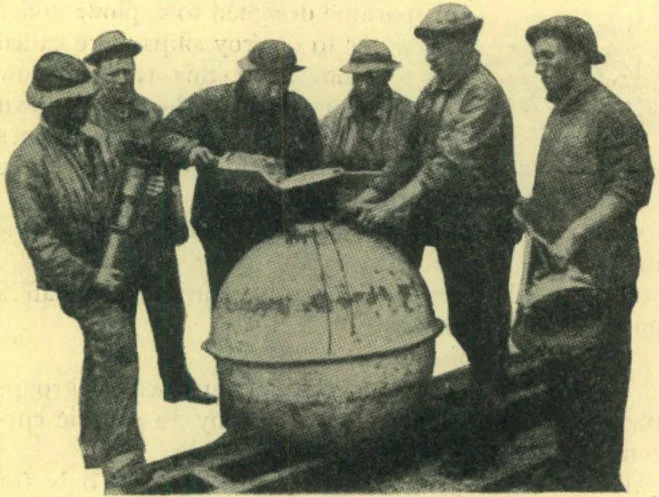
LOADING AN AMERICAN MINE

Parts of a Mine

A mine consists of three parts: (1) The chamber containing the firing mechanism, the detonator and explosive charge; (2) the flotation chamber to give buoyancy to the mine; and (3) a detachable anchoring chamber provided with a winch having a paying-out cable.
A mine is maintained at the desired depth in the water by means of an anchor in which the cable, one end of which is connected to the mine, is unwound from a drum suitably braked and mounted in the anchor casing. The rotation of the drum is controlled by a plumb weight attached to a short sounding line. When the plumb weight reaches the bottom of the sea, the rotation of the drum is stopped, and the mine is pulled down to the required depth. It is only necessary to determine at what depth below the surface it is desired to anchor the mine and to throw into the water the complete apparatus, namely the mine and anchor, whereupon the whole apparatus will take up its proper position, the depth of submersion being determined by the length of the sounding line.
In order to make a mine field as effective as possible loose ropes are sometimes connected between different mines, with the object of getting the ship’s propeller entangled in the rope, and thereby drawing the mine toward the ship and exploding it.

Mines Which Become Ineffective After a Certain Period

Unanchored automatic or floating mines must be dead in an hour. They are used to some extent in naval battles, and are very cheap in construction. In some mines of this type, clockwork is used which after an hour throws the firing gear out of action, while in another type delay-action devices for opening valves to admit water are employed so that the mine is sunk after a definite time interval.
To some extent chemical methods are employed to fire the charge in floating mines, but a disadvantage is that the explosion does not take place instantaneously, as is the case with a mechanically fired mine. A glass tube is attached to the mine, which is broken when struck by a ship; water enters, and by coming in contact with sodium or potassium, fires the charge. Other chemicals, such as sulphuric acid, have also been used to fire the charges in floating mines.—John Randolph Rexford, in Popular Science Monthly.