A Trip in Java

3%

Review and Herald Publishing Assn. · Takoma Park Station, Washington, D. C. · Oct 17, 1916

FromThe Youth’s Instructor, Vol. 64, No. 42.

Read the full edition

A Trip in Java

(Continued from last week)
K. M. ADAMS
The railway equipment in Java is more like that of America than one sees anywhere else in the East. The toy engines and coaches that are used in Japan, China, and the Federated Malay States do not compare with those of Java.
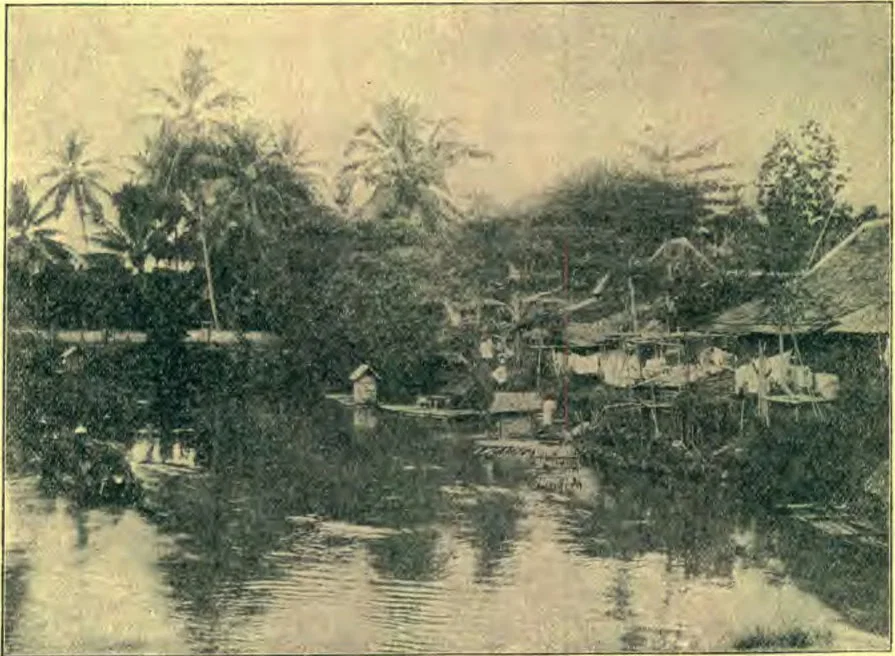
A SCENE IN JAVA
A SCENE IN JAVA
At the station in Weltevreden our things were transferred to a two-wheeled cart drawn by a small pony. There are no bullock carts in Batavia, as in Singapore, and one misses them. We boarded another two-wheeled cart called a sado. It is made especially for passenger traffic, and has springs and upholstered seats. Four persons, including the driver, can ride in one cart, two facing forward and two facing the rear. The little pony starts, the cart tilts back to an angle of about twenty degrees, and those in the rear brace themselves to keep from going out over the tailboard. There are no backs to the seats, so one is lucky to have someone behind to lean against.
These carriages charge twenty-four cents an hour and are cheaper to use than the jinrikishas in Singapore. The ponies do not weigh much more than three hundred pounds, but they go at a surprising rate. They are the only horse that can stand the heat. Australian horses are imported into Java, but they soon die.
These carriages are driven by Javanese or Malays.
The way of harnessing the ponies to the sados is unique. The shafts are not fastened tight to the sides of the pony, but are arranged by straps to have a good deal of play. As a result, when the cart is traveling, the ends of the shafts are generally well above the pony’s back, and one always fears that the little creature will be lifted clear off his feet.
There are also four-wheeled carriages to be had. They are more steady than the sados, but are as dilapidated. There are automobiles, of course, and an electric line and a steam tram. The steam tram is hauled by a locomotive that stores its steam at each end of the trip and carries no fire with it. The fare is about the same as in America.
On the way to our stopping place we passed a street sprinkler, and it was a novelty indeed. A man was walking slowly along the street with a pole across his shoulders, and a huge garden sprinkler at each end. When the sprinklers were empty, he would replenish them at wells along the roadside. Practically the only way to get water in Batavia is from wells. Most of them are surface wells only about twenty feet deep.
There are a few Artesian wells. This lack of good water must be a great drawback to health in such a large city.
We were glad to reach our destination, and after a good bath, taken Eastern style, we felt ready for anything. Bathing is done several times a day by everybody. The natives resort to the canals that flow through the city; the European to his bathroom. But there is no tub there. The Eastern way of bathing is to dip water from a huge jar or tank with a dipper, and pour it over the body in refreshing streams. One who has practiced this way for some time will aver that it is the best way in the world. After a hot, sweaty, dusty day, to step into the cool, damp room, and pour dipperful after dipperful of cool, fresh water over one’s tired, heated body, washing away fatigue and brain weariness as well as dust and perspiration, is a delight that is known and appreciated only by those of the tropics.
Weltevreden is well lighted by gas street lamps. All trains and tram cars throughout Java stop in the evening at about seven. One wonders why this is so. Cannot their native engine drivers be trusted at night, or is it feared that natives bent on mischief will place obstructions on the tracks to wreck trains? Everywhere there is profound mistrust of the native.
The rent of an ordinary dwelling house in Weltevreden is prohibitive. Forty dollars a month for a five-room house with a bathroom and servants’ quarters is an ordinary rental. Building materials, with everything else, is expensive in Java. Most of the Hollanders who come to the island receive large salaries, and they spend it all in living. Then, too, the government takes its share. There is an income tax, a tax on the rent paid, an automobile tax, and even a bicycle tax. The Netherlands government knows how to make its colonies pay.
The residence district of Weltevreden, in fact most of the city, is beautiful, far prettier than Singapore. The houses are kept apart, there is an abundance of trees and grass, and the streets are wide and well kept. All the houses are brick, the roofs are tiled, and the floors are covered with smooth floor tiles. There are very few two-story houses in Weltevreden.
There are several interesting sights in the old town of Batavia. The steam tram rattles along the streets, past canals and Chinese shops. Batavia reminds one of Singapore. The houses are close together and there is no lawn and very few trees. But Batavia is a death trap, and no Europeans live there. They go there in the morning to their office work, but in the evening they all return to Weltevreden, where there is comparative freedom from sickness on account of the openness of the city.
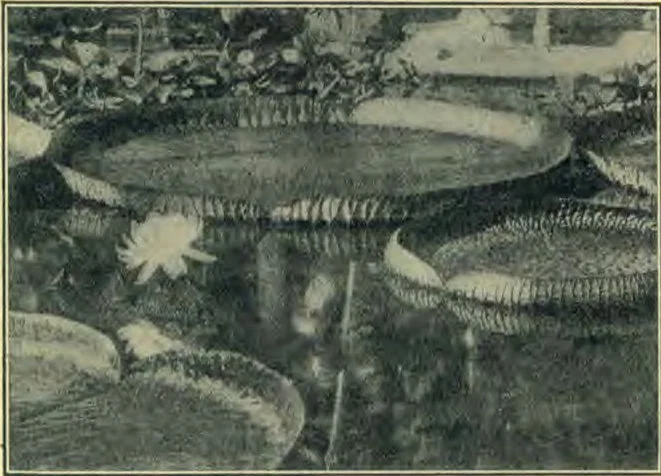
THE VICTORIA REGIA, OR GREAT WATER LILY
At the end of the steam tram line is a sacred cannon. It is not much to see, twelve feet of iron lying partly buried in the mud, but it is held in superstitious awe. There are numerous offerings made of paper with a piece of incense burning at one end, stuck in the mud about the breech of the cannon. It is claimed that this cannon was once used against the natives, killing great numbers. Therefore it has a “very bad spirit,” and if it is not worshiped it may kill many more. A woman who was selling paper offerings asked us to buy one and put it by the cannon; but we told her that we did not worship such things.
One of our friends had some business to attend to in Buitenzorg, and suggested that we accompany him in the automobile. His invitation was gladly accepted. Buitenzorg is a small city about forty miles from Batavia, up a short distance in the mountains. It is the residence place of the governor-general of the Netherlands Indies, and is also the location of the most interesting gardens in the world. These gardens are really part of the grounds of the palace of the governor-general.
The start was made in the early hours of the morning while the air was still cool. We flitted past the beautiful houses in Weltevreden, and were soon in Meester Cornelis, another residence section where many of the business men and officials live. The main roads of Java are well kept. The surface is smooth and hard, and fitted for fast automobiling, as our driver soon showed us. I thought that I had ridden behind cool, daring drivers before, but this native went beyond them all. Many a time at the speed of thirty miles an hour we whizzed past a native cart, just missing it. Otherwise the ride was delightful; the air was cool from a light fall of rain, and the sun shone brightly through the clouds that partly veiled the sky. On we went through coconut groves, past rice fields, in all stages from that ready to transplant to that brown on the stalk and ready to reap. Tapioca was growing in patches here and there also.
There were glimpses of villages, native workmen, the ever-present market, and fat, naked babies playing about. On, on we rushed, overtaking the diminutive two-wheeled carts drawn by the still smaller Sumatran ponies, and sometimes meeting another motor car that scudded past with a swish. Now the fields were open, and we saw crowds of people reaping rice, and men plowing with wooden plows drawn by ungainly water bullocks. Sometimes both sides of the road were arched with tamarind trees, and sometimes thickets of bamboo hid the fields from sight.
We passed several bodies of native soldiers, with Dutch officers. Some were on horses, some on bicycles, and still others were afoot. Some of the villagers near Batavia refused to pay their taxes and had rebelled. They were Mohammedans, as are nearly all the natives of Java, and they had put on the white robe, signifying that they would fight to the last. But the disturbance was easily quelled by the soldiers.
These soldiers are recruited from the other islands, as the Javanese cannot be trusted. A great many of the inhabitants of other islands are Protestant, and most of the natives working in more responsible positions in any enterprise are drawn from their ranks.
The road rises in a steady grade to Buitenzorg, an altitude of eight hundred feet. It follows a stream which at intervals has dams and gates, which force the water into ditches. These ditches are led into the surrounding fields for the purpose of irrigation. The dams are made of concrete and iron, and are undoubtedly supplied by the government. Where the ground is more uneven, terraces are built, and rice is raised on them. In places these terraces can be seen far up a mountain side.
Soon houses began to line the road, and our machine slackened its headlong pace and we knew that we were approaching Buitenzorg, the city “free from sorrow.” If sorrow is absent, rains are not, for according to the statements of the inhabitants, rain falls 325 days in the year.
The white walls of the governor’s mansion glistened through the trees under which were bands of deer, dozens of them, feeding peacefully like goats. The governor-general of the Netherlands Indies resides in Buitenzorg and goes to Batavia only when duty calls. The governor-general is chosen every five years, and a new one is chosen each time. His salary is £60,000, or $300,000 a year. The Netherlands Indies is divided into counties, over each of which is a resident. Upon these residents fall the burdens of the government.
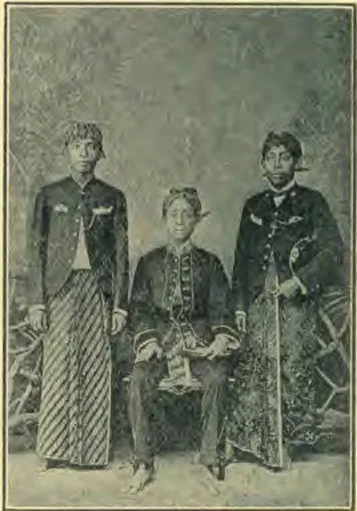
A GROUP OF JAVANESE
A GROUP OF JAVANESE
On reaching the main gate of the botanical garden, a park policeman offered his services in showing us about. We saw a great pond with the queen of water lilies, the Victoria regia, whose ponderous leaves cover nearly twenty square feet of surface; a garden of orchids, with 1,770 different kinds; palms, oaks, and evergreens were there in countless numbers and varieties, together with rubber, coffee, tea, cocoa, nutmeg, and cinchona trees. Quinine is made from the last-named tree.
The garden serves a practical use as well as a scientific one, for a great many experiments have been carried on there in acclimatizing various commercial trees and plants. Many trees and many plantations in Java owe their start to the experiments conducted in that garden. Quinine is being raised and manufactured in Java, which is as it should be, for most of the quinine is used in the tropics to combat the dreaded malaria.
There is there a poisonous species of bamboo which has long thorns, a scratch from one of which is said to make a sore that will not heal for three months. We stayed at a respectful distance from this shrub.
THE LEAF INSECT
THE LEAF INSECT
A hedge of this species growing about orchards in America might be useful. The garden is divided into plots, the trees are all numbered, and a stake by each bears its name in Latin to facilitate study by botanists. There are many greenhouses with species of smaller plants. There is also an aquarium where species of reeds and other water plants grow. There is little wonder that this garden is called the best in the world. There are one hundred and thirty-six native gardeners. Five doctors of botany supervise the work. Plants are being studied continually, new species are being brought in and planted in the garden. Students come from Europe just for the great privilege of study that the garden affords.
There is a small museum connected with the garden. We saw there a monstrous pair of horns, the spread of which was at least eleven feet. They looked more like a pair of elephant’s tusks than horns. There also we saw the live-leaf insects. They were feeding on bunches of green leaves, and were so nearly the same color and shape as the leaves that it was practically impossible to distinguish the leaf from the insect. We would pick out the quiet-looking object and make sure it was a leaf, and then it would walk away to feed elsewhere. Their wings were a living green, with veinings like leaves, and even holes in the wings, like leaves that had been partially devoured. We wondered if the insects sometimes did not mistake one another for leaves, and absent-mindedly lunch off each other’s wings!
A snake in a glass cage was shedding his skin. We watched him for some time as he rubbed against the dry branches in his den. He had removed half of his dead covering before we were obliged to leave.
A short trip about town showed us that in most respects this city was like Weltevreden. It is cooler on account of its altitude, and many people from the warmer towns spend several weeks here each year by way of recuperation. A mountain stream dashes through the town in a cañon one hundred feet deep. Its waters are muddy, as are all the streams we have seen. The reason must be that practically every stream in Java is used for irrigation, and the water that flows off from the fields finds its way back into the stream again.
(To be continued)