F. E. STAFFORD
On the morning of Jan. 29, 1891, the sun rose in Honolulu upon a scene of splendor. The air was balmy in that land of eternal summer, and the soft waving of the coconut fronds along the beach gave promise of an ideal day. The city was in gala attire. Flags waved in the breeze and a general air of festivity prevailed as the people, dressed in their best, made their way happily toward the wharf. Why should they not be happy? Was not their king coming back that day? Yes, their beloved Kalakaua, the “jolly king,” was returning to them that day, renewed in strength, from a trip to San Francisco where he had gone a few months before to recuperate his failing health.
Princess Liliuokalani, heir apparent, and regent in her brother’s absence, had come in all her royal splendor that morning to welcome the king back in person, and now as the United States cruiser “Charleston” is seen rounding Diamond Head, a cheer breaks from every lip, “Long live the king!”
But look! What does it mean? The ship is making signals. Can it be possible? Yes, sad but true, as the good ship came to anchor there was borne ashore the dead body of their beloved king, and the day of gladness was suddenly changed into a day of mourning. The king had died in San Francisco, and as there was no transpacific cable in those days, the news could not reach them before.
On the afternoon of the same day Mrs. Lydia Dominis, Princess Liliuokalani, took the oath to support the constitution, and was proclaimed ruler of the Hawaiian Islands under the title of Her Majesty, Queen Liliuokalani.
Queen Liliuokalani immediately entered actively into the affairs of the government, but her short, troubled reign of two years had a sorrowful beginning and a tragic ending. Hardly had she recovered from the loss of her brother when she was called upon to mourn the loss of her husband, John O. Dominis. Besides being governor of Oahu Island, Dominis had held positions of importance during the reigns of Kings Lunalilo and Kalakaua, and at the time of his death was lieutenant general of the kingdom with the rank of His Royal Highness, Prince Consort. His experience in the affairs of the government was sorely missed by the queen, and in her own words, “He was taken away from me at precisely the time when I felt that I most needed his counsel and companionship.”
Political affairs, however, claimed the attention of the queen. She had always resented the fact that Kalakaua had agreed to the constitution of 1887, which she termed “The Bayonet Constitution,” as she felt that the power and authority of the Hawaiian monarchs was gradually being usurped by “foreigners.” Therefore, as soon as she ascended the throne she began a sympathetic campaign against the constitution and its supporters. In this she was partially successful, being enabled by a decision of the supreme court to make new appointments of all the cabinet officers, and in that way gain control of all appointments.
The stage was thus set, and the actors prepared to carry into effect the coup which the queen had been carefully planning during the first year of her reign. Having secretly prepared a new constitution which would strike three direct blows at the heart of constitutional government and the rights of non-Hawaiian residents, and having, as she believed, enough appointees in office to secure the necessary votes to adopt this constitution,p. 4 the queen prepared to proclaim the new constitution at the palace, Jan. 14, 1893. The government troops were drawn up, and a large crowd of sympathizers assembled around the palace to hear the proclamation.
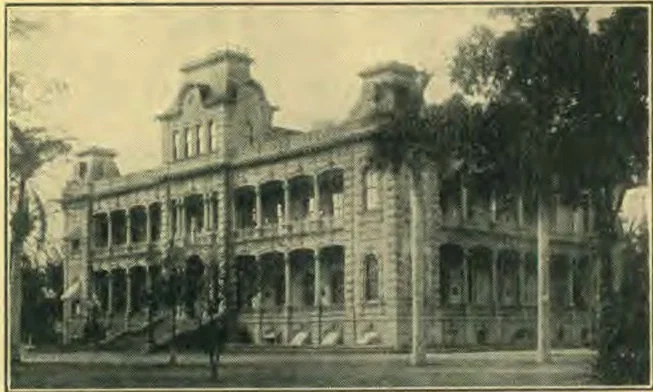
At the critical moment the cabinet refused to sign the constitution, and the queen was compelled to relinquish her plan. As a direct result of this attempt of the queen to regain the unlimited power of an absolute monarchy, she was forced, just three days later, to abdicate the throne, and left the palace, never to return again until she was carried in in her casket on the night of Nov. 17, 1917, just twenty-five years later, lacking two months.
Dethroned
The same day on which Queen Liliuokalani attempted and failed to proclaim the new constitution, a public mass meeting was called by the business men of the community to consider the situation. It was the consensus of opinion that some drastic steps must be taken to stop the never-ceasing attempts of the royal family to acquire power at the expense of popular rights.
A committee of safety of thirteen members was named to devise ways and means to adequately meet the situation. They immediately proceeded to form a provisional government, drew up a constitution, and called for a mass meeting on the afternoon of the sixteenth, two days later.
On the morning of the same day the queen, becoming alarmed at the situation, endeavored to pacify the revolutionists by issuing a declaration that henceforth changes in the constitution would be sought only by methods provided for in the constitution.
The populace, however, ignoring the queen’s proclamation, ratified the action of the Committee of Safety, and authorized it to take all necessary steps to put its plan into operation.
The United States steamship “Boston” being in the harbor, she was requested by United States Minister J. L. Stevens to land a force of marines to protect the lives of American citizens in case of rioting. On the next day, January 17, the organization of the provisional government was completed by the appointment of an executive council of four members and an advisory council of fourteen members with general legislative authority.
In the meantime two companies of volunteer troops had arrived, and occupied the government grounds outside the palace. Escorted by these soldiers, the two councils proceeded to take possession of the government offices, and immediately issued a proclamation declaring the monarchical government to be abrogated, and announcing the establishment of a provisional government to exist “until terms of union with the United States of America shall have been negotiated and agreed upon.”
Queen Liliuokalani, being informed of the action of the provisional government, consulted with her ministers, and quickly decided to surrender her authority, to avoid bloodshed, and thereupon, by her order, the police station and the barracks were given over to the provisional government. The queen’s surrender was under protest and qualified as having been forced to abdicate by the landing of the United States Marines, therefore she immediately appealed to the United States Government for reinstatement.
On July 4, 1894, a republic was proclaimed. Late in the same year a company of royalists planned to overthrow the republic and restore the monarchy, which plot was attempted in January, 1895. The participants were unsuccessful, however, and, with the ex-queen, were imprisoned in her former palace.
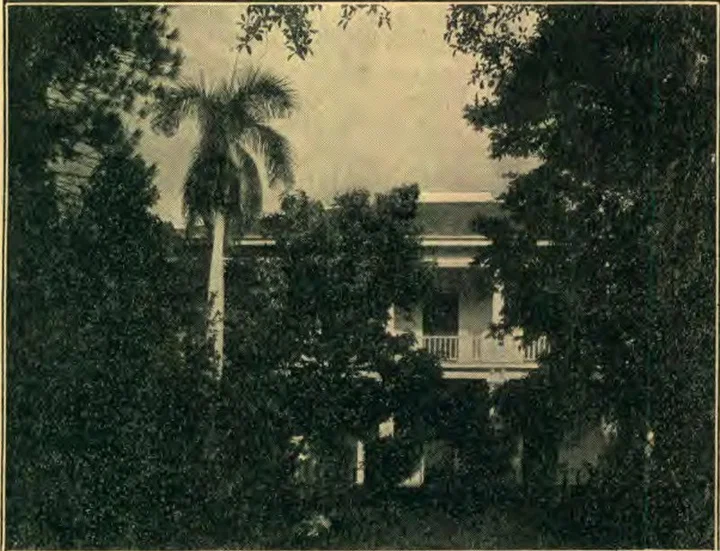
Liliuokalani, eight days after her arrest, formally renounced all claim to the throne, and took the oath of allegiance to the republic. After nine months, with forty-eight of her retainers she was granted a conditional pardon and allowed to move to her home called Washington Place, where she lived until her death.
In her document of abdication she said: “It is my sincere desire henceforth to live in absolute privacy and retirement from all publicity and even appearance of being concerned in the public affairs of the Hawaiian Islands, further than to express, as I now do and shall always continue to do, my most sincere hope for the welfare and prosperity of Hawaii and its people.”
During the next few years Queen Liliuokalani made frequent trips to the United States in connection with her claims upon the United States Government, and was soon almost as well known in Washington as in Honolulu, reports of her social functions being sent out by the Associated Press, as of a person of international note, and the American people as a whole generally acknowledged that she was a remarkable woman.
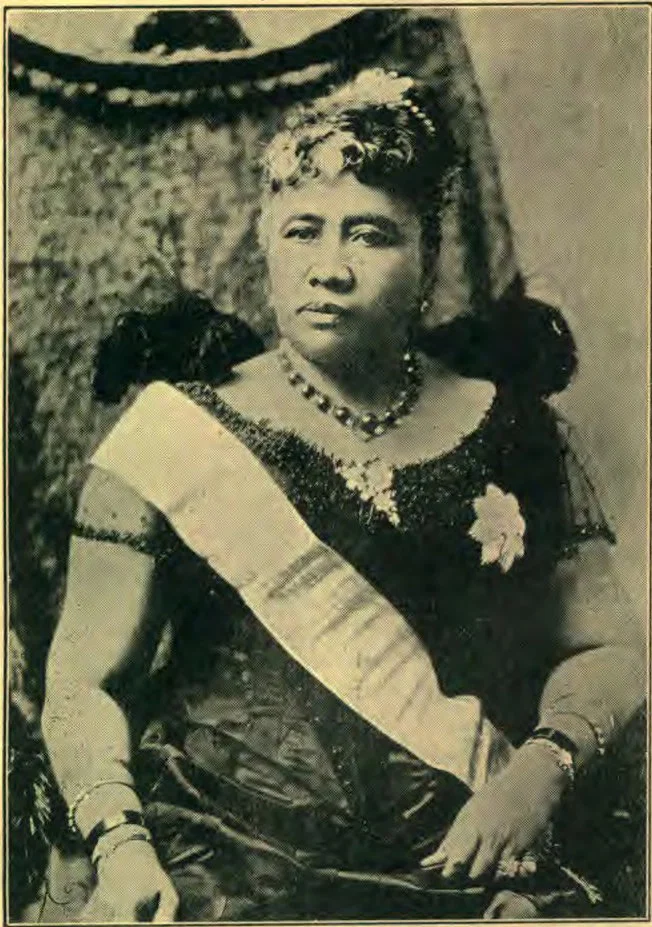
p. 5
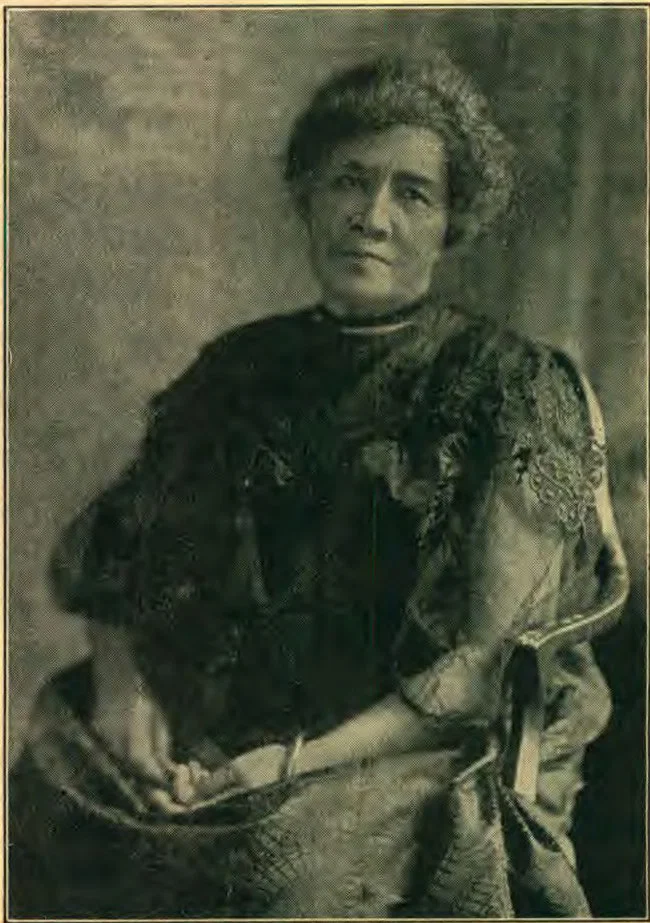
To the Hawaiian people she has ever been their queen, and the last years of her life were marked with many loving ministrations. She lived to bless, and her motto, “Onipaa” (be steadfast) was the ideal of her life to the very last breath. One of the last things she did was to send a check for one hundred dollars to Washington for the Red Cross, and by her special request, the ladies of the Honolulu Red Cross Society have been meeting in the throne room of the palace, and there in front of the throne where Queen Liliuokalani once proudly held the scepter, they are now making comforts for our boys at the front. Thus is democracy leveling all thrones today.
Enshrined
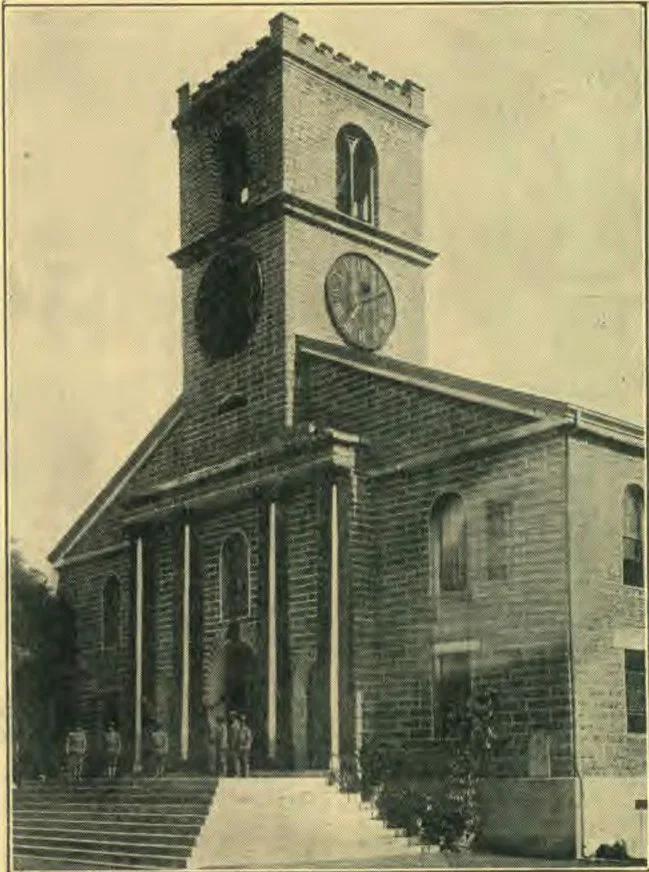
Sunday morning, Nov. 11, 1917, at half past eight o’clock, the tolling of the bell in the belfry of the historic old Kawaiahao Church, announced the death of the queen. The news was caught up by cable and radiograph, and in a short time had encircled the world. “The queen is dead!” The passing of America’s first and last and only queen closed forever the history of the Hawaiian monarchy. The last of eight royal rulers of the Hawaiian Islands, at her death the world joined hands to pay her final honor, not only as a former queen, but as a woman who, deprived of crown and scepter, reigned still in the hearts of her people.
Reviving the customs of the ancient Hawaiian monarchs, the body of the queen was removed to Kawaiahao Church at midnight, Monday, November 12. It formed a weird pageant guided by the glare of kukui-nut torches, as the bearers of the royal kahilis, and the old chiefs wearing their brilliant feather ahuulas, symbols of their rank, carried the body of their dead queen to the church, there to lie in state until the royal funeral.
The scene in the church was a brilliant one. The queen, crowned once more with the diadem she had worn as reigning monarch, and wearing the jewels she had loved best while living, lay on her gold-covered couch, beautiful in the majesty of death. Besides the two tabu-sticks that guarded the head of the queen, the great golden globe which was the tabu-stick of Kalakaua was placed at the foot of the pall, and within the lines marked by these tabu-sticks not even the kahili bearers could pass. On either side of the pall were the royal watchers waving the royal kahilis in a slow rhythmic motion which, according to custom, must never cease for an instant from the time of the queen’s death until she is buried.
Singers who had charmed her living ear chanted the glories of the dead monarch to the silent, listening multitude. The Royal Hawaiian Band played softly “The Liliuokalani Funeral March,” composed by Captain Henry Berger, for forty-four years leader of the Royal Hawaiian Band.
The king’s singing girls, now grown old and tremulous, once more lifted their voices, and for the last time sang in sweet cadence before their queen.
All day long and far into the night a silent procession of people wended its silent way under the great multicolored kahilis around the uncoffined form of the queen, and out again.
The procession was one that could hardly be matched anywhere else in the world. Every kind and condition of men, every color and almost every division of the human race, was represented. Old men and women whose time on earth is short, hobbled slowly up the aisles, followed by school children whose eyes, big with wonder, looked at something they could not comprehend. Laborers fresh from their toil walked side by side with professional men. Oriental fathers with babies in their arms were followed by society matrons and débutantes in filmy crêpe de Chine. A priest walked side by side with a captain of the Salvation Army, and a small boy, his blue-denim overalls kept up by a single suspender, marched solemnly beside a tourist wearing the latest creation in millinery. Japanesep. 6 women in kimonas, Chinese women in trousers, Filipino women in big bouffante sleeves, and Korean women in the white, slim costume of their land,—all in a silent procession, followed each other around the bier.
Among the notable visitors who called to pay their respects to the departed queen was Viscount K. Ishii, who called at Honolulu upon his return from the war mission to the United States.
The party of United States Congressmen who were at the time touring the islands, cut short their visit on the island of Hawaii to return to Honolulu in time to pay their respects to the departed queen and to take part in the funeral procession.
On the following Saturday night the body of the queen was removed from the church to the throne room of the Iolani Palace where once she reigned in splendor. Although at night, an immense crowd gathered along the streets, and as the solemn pageant wended its way slowly along by the light of the kukui-nut torches, a hush fell upon all, and not a sound broke the stillness of the night, save only the rhythmic tramp of the kahili bearers and pallbearers, escorted by a guard of soldiers.
As the cortège neared the palace, groups of black-clad women who had been constant in their devotion to their queen, burst forth into wailing, and chanting the Hawaiian meles.
The throne roof, with its brilliant lights, seemed ready for a royal reception, but the mute casket in the center of the room upon the bier of black, told the tale of departed glory, and of fallen crowns and broken scepters.
In the presence of only a few of the immediate relatives and retainers of the queen, the steel coffin was placed within the beautifully carved koa-wood casket, which was beautifully ornamented with kou wood, which is now so rare that it is beyond the reach of ordinary persons even in small quantities, thus sealing forever the queen from mortal view.
The Funeral 1
Again it is Sunday morning. At an early hour the city is already astir. People can be seen coming from the outlying districts and villages. Hundreds have already arrived from the other island, and although the funeral procession will not move until eleven o’clock, yet as early as nine o’clock every seat is taken upon the large bleachers erected just outside the palace gates, and every vantage point along the two-mile route to the cemetery is crowded with people eagerly waiting to catch a glimpse of the royal procession.
This is no ordinary occasion. A royal funeral in Hawaii is a wonderful sight at any time, but preparations had been made to make this one the greatest and grandest ever held, for—it is on every lip—“there will never be another.”
It was the consensus of opinion that those who were fortunate enough to witness the procession, that it fully exceeded all expectations. In military pomp, in colorful beauty, and in the devotion manifested by the hundreds of Hawaiian men and women, many of them old and feeble, who marched unfalteringly beneath the tropical sun, it doubtless has never before been equaled.
Besides the many military bodies in the parade, organizations and societies representing every social and official body in the territory, with representatives of the world powers, were all in line.
Rank upon rank of the forces from the regular army swung along—cavalry, field artillery, in double line and infantry, and after them were the marines and a naval attachment and the guard of honor.
In the groups near the catafalque were the consular representatives. Prominent among them in uniforms of gold and blue, was Lieutenant Oku, a Japanese naval officer, who bore in his hands the Order of the Crown that had been conferred upon Liliuokalani while she was still queen, by the late emperor Mutsuhito.
Following the catafalque were the conveyances of the close relatives of the queen, members of Hawaiian royalty, and after them the governor and his aides, the commanding officers of the Hawaiian Department and other military and navy officials, and the party of visiting Congressmen.
At the Royal Mausoleum grounds the regular army units halted and swung into lines paralleling the street. The honor guard of national guardsmen marched through the gates and formed into line.
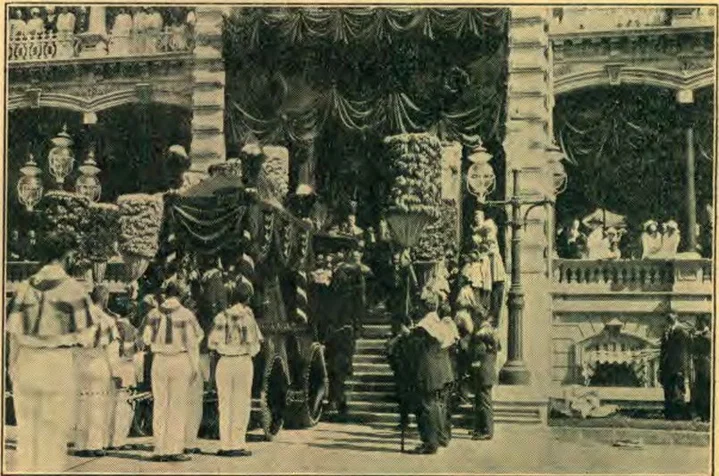
As the catafalque was brought to a stop and the casket lowered to its resting place in the crypt by the side of former King Kalakaua, the wails of the mourners rose shrilly under the palms. The Royal Hawaiian Band played “Hawaii Ponoi,” the national hymn, composed by Liliuokalani, and the United States artillery fired a volley and sounded taps, and the scene was ended, and with it the day of Hawaiian greatness.
No. Not yet. One scene, not on the program, was destined to put a fitting end to the significant events of the day.
As the empty catafalque was drawn away from the crypt it passed beneath one of the great palms, and the crown surmounting it became entangled in an overhanging branch, and, swept away from its fastenings, fell to the ground, while the Hawaiian color bearer of the royal guard, with the Stars and Stripes flung to the breeze, marched steadily on with his troops past the fallen symbol.
The monarchy is ended, the crown has fallen, but the future welfare of young Hawaii is linked forever with the future progress of the Stars and Stripes. The queen is dead, but Hawaii lives, and the memory of faithful Queen Liliuokalani is forever enshrined in the hearts of all who knew her.