Nobody Loves a Camel

14%

Review and Herald Publishing Assn. · Takoma Park Station, Washington, D. C. · Apr 9, 1918

FromThe Youth’s Instructor, Vol. 66, No. 15.

Read the full edition

Nobody Loves a Camel

BEARING an innate grudge against all restraint and all who restrain him, the camel will use the great strength of his long legs to kick his keepers, or the dogs that guard him in the waste places. But in the presence of enemies—among wolves or other beasts of prey—he is a coward, forgets the very use of his legs, and proves his erratic temper by screaming and spitting in terror. No camel wants to be loved, and no one familiar with camels ever entertains the least affection for them.
The Arabs and Egyptians of the Near East speak proverbially of the malice and vindictiveness of the camel. The Mongols, Chinese, and Turks of the Far East say that the camel is too stupid to be either malicious or vindictive.
The poison of all other beasts is his food. He pines and wastes in fat meadows, but grows fat, powerful, and savagely independent among alkali-crusted sands.
Panic is the greatest failing of camels under all circumstances. The stupidest and laziest camel will show all the silly coyness of a thoroughbred colt in the presence of a white stone, a heap of bones, or some sprightly little animal that darts about his feet.
The slightest cold carries him off, and when one camel dies, all are likely to die. If a camel sinks in the mud, he strains his long legs and is never good again as a carrier. On ice they are hopeless. Mongols traveling in winter are forced to carry bags of sand wherever they go, which they must scatter upon every little patch of ice they approach.—Rodney Gilbert.
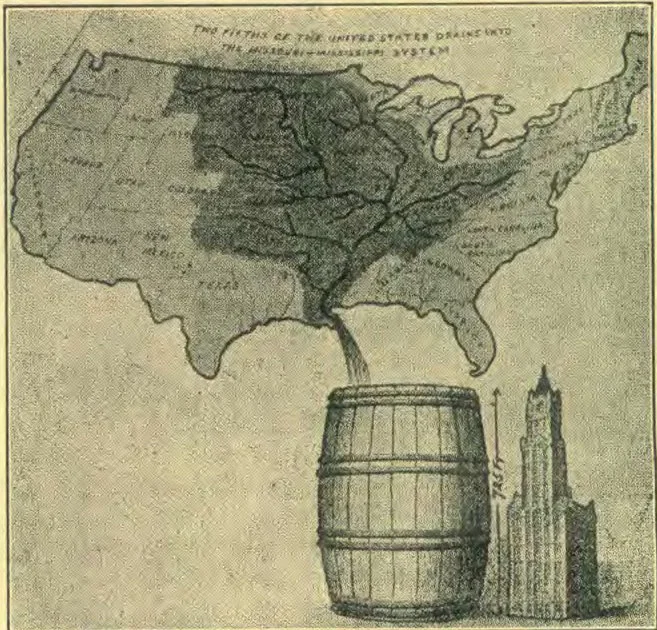
This illustration represents the Mississippi River as flowing into a huge water barrel. In order to hold a single minute's discharge this barrel must have a capacity of 138,000,000 cubic feet, which would make it something like 725 feet high, or a little short of the height of the Woolworth Building. If the river entered into a lake the size of New Jersey, it would raise it one foot in ten hours.—Scientific American.