The year 1917 is destined to have a prominent place in missionary history, due to the celebration by the entire Protestant world of the four hundredth anniversary of the beginning of the great Reformation. Protestantism is, in a sense, under fire this year, from those who do not wish to tolerate reforms of so liberal a character; and it is a good time for Protestants to learn anew the reasons for the faith that is in them, and to study the life and character of the great man who has perhaps wielded a deeper and more lasting influence upon the religious, the political, and the social life and thinking of the world than any other since the apostle Paul fought his great and good fight. It is well to stop and consider that the great blessing of freedom of thought and speech and action which we today enjoy to so great an extent, is the fruit of the tree planted by Martin Luther. As one writer states: “The priceless blessings of liberty and the rights of conscience recognized, enjoyed, and guaranteed in our own great Republic, and working like a leaven among all people who do not enjoy them, are, directly and indirectly, the result of the truths and principles so clearly and so forcibly proclaimed by Martin Luther four hundred years ago.”
A Great Event
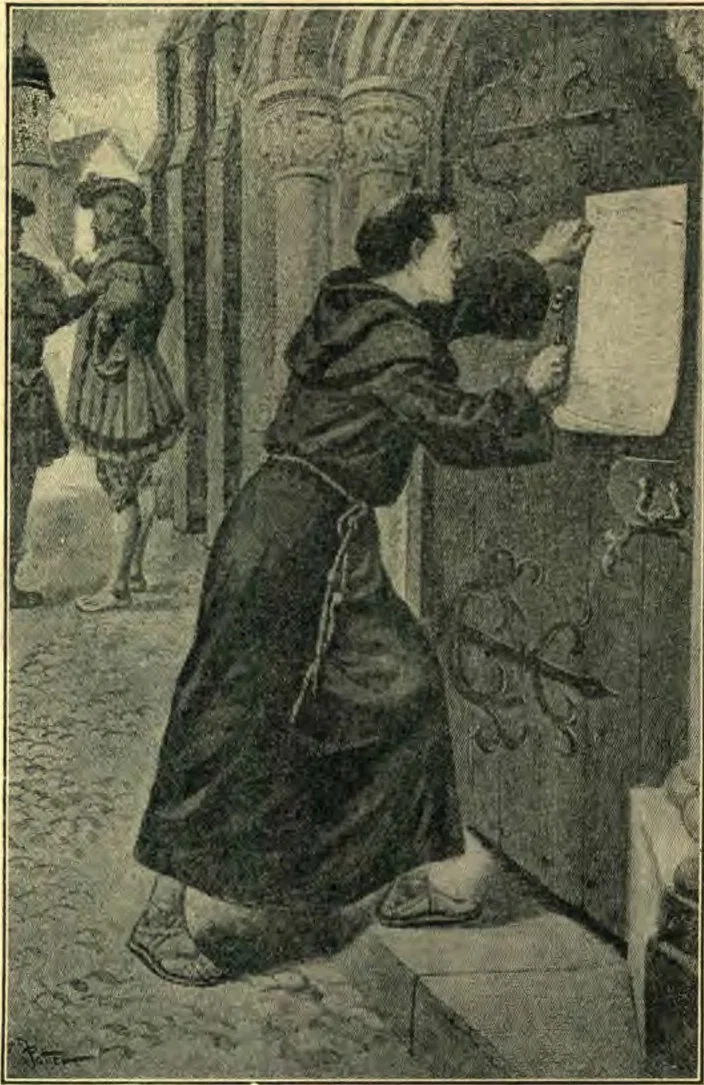
At high noon, Oct. 31, 1517, in the village of Wittenberg, Saxony, occurred an event which culminated in the Reformation. Martin Luther, an Augustinian monk and professor of theology at the university at Wittenberg, quietly proceeded down the streets of the village to the castle church, and posted upon the door of the church a list of ninety-five theses, or statements, boldly protesting against the sale of indulgences by the Catholic Church, and declaring that forgiveness of sin can be gained only by true repentance and following Christ. The hour had come for deliverance from the darkness of superstition and error and for the Word of God to be placed in the hands of the people, and Martin Luther was the instrument used of God for the accomplishment of his purpose.
The Need of Reformation
The Christian church had lost her original purity. She had left the moorings of the gospel. The Bible was no longer the sole authority in matters of faith and conduct. By gradual compromise with heathen rites and customs, the church had become so deformed as to be almost beyond recognition. The period of reformation gave place to a period of de-formation, and there was great need of a re-formation. So the movement in the sixteenth century, headed by Luther, bears properly the name “Reformation.” It was a re-formation, a restoration, a reëstablishment of the church, a ridding of deformities, a return to the Bible as the ground of faith and the only guiding light to heaven; illuminating the foundation principle of Paul's teaching, “The just shall live by faith,” and, “By the deeds of the law there shall no flesh be justified.”
Martin Luther's Surprise
It must not be thought that Martin Luther posed as a leader, or assumed the rôle of a reformer. Probably no one was more surprised than he when his ninety-five theses received such immediate publicity, not only in Germany, but throughout Europe. They were written in Latin, the language of the educated at that time, and displayed where public announcements were customarily made. There were many people at Wittenberg on Oct. 31, 1517; for it was the eve of All Saints' Day, and special indulgences were granted on that day by the false shepherds of the church, to all who came to venerate the “five thousand and five” relics collected there, and to contribute freely to the treasury. Some copied the theses; others held the chief points in memory; and still others translated them into German, hastened them to the printer, and thousands of copies were made. “In fourteen days,” says Luther, “they flew all over Germany.” “In four weeks,” states Mycenius, “they were diffused through Christendom, as though angels were the postmen.”4
The Childhood of Luther
On Nov. 10, 1483, in the village of Eisleben, Germany, Martin Luther was born. As to his early life we read in “The Great Controversy,” by Mrs. E. G. White:
“Like the first heralds of the gospel, Luther sprung from the ranks of poverty. His early years were spent in the humble home of a German peasant. By daily toil, as a miner, his father earned the means for his education. He intended him for a lawyer; but God purposed to make him a builder in the great temple that was rising so slowly through the centuries. Hardship, privation, and severe discipline were the school in which Infinite Wisdom prepared Luther for the important mission of his life.
“Luther's father was a man of strong and active mind and great force of character, honest, resolute, and straightforward. He was true to his convictions of duty, let the consequences be what they might. His sterling good sense led him to regard the monastic system with distrust. He was highly displeased when Luther, without his consent, entered a monastery; and it was two years before the father was reconciled to his son, and even then his opinions remained the same.
“Luther's parents bestowed great care upon the education and training of their children. They endeavored to instruct them in the knowledge of God and the practice of Christian virtues. The father's prayer often ascended in the hearing of his son, that the child might remember the name of the Lord, and one day aid in the advancement of his truth. Every advantage for moral or intellectual culture which their life of toil permitted them to enjoy, was eagerly improved by these parents. . . .
“At school, where he was sent at an early age, Luther was treated with harshness and even violence.” This was in the village of Mansfeld, to which Luther's parents moved when he was six months old. When he was fourteen years old he was sent to the Franciscan school at Magdeburg, and a year later was placed in a famous school at Eisenach. At both these places he endured many hardships, and because of his poverty he was compelled to beg for his daily bread. No scholarship plan was open to Martin Luther, and many a young man of this day might consider himself justified in failing to pursue an education under such conditions. But the guiding hand of Providence kept Luther in the path of duty and helped him in his dire extremity. It is said that one day, after having been repulsed from three houses, while begging in the customary manner of that time,—singing on the street,—he paused in melancholy reflection before the house of a worthy citizen. The mistress of this home, Madame Ursula Cotta, wife of a leading merchant of the place, attracted by Luther's open countenance and sweet voice, invited him into her house, and later gave him a home during the rest of his stay in Eisenach.
Luther Finds a Wonderful Treasure
At the age of eighteen Luther entered the University of Erfurt, with the intention of becoming a lawyer, in obedience to his father's wishes. He is said to have been a brilliant student, and his progress was very rapid. He received the degree of Master of Arts in 1505. He began the work of each day with prayer, and his motto was, “To pray well is to study well.”
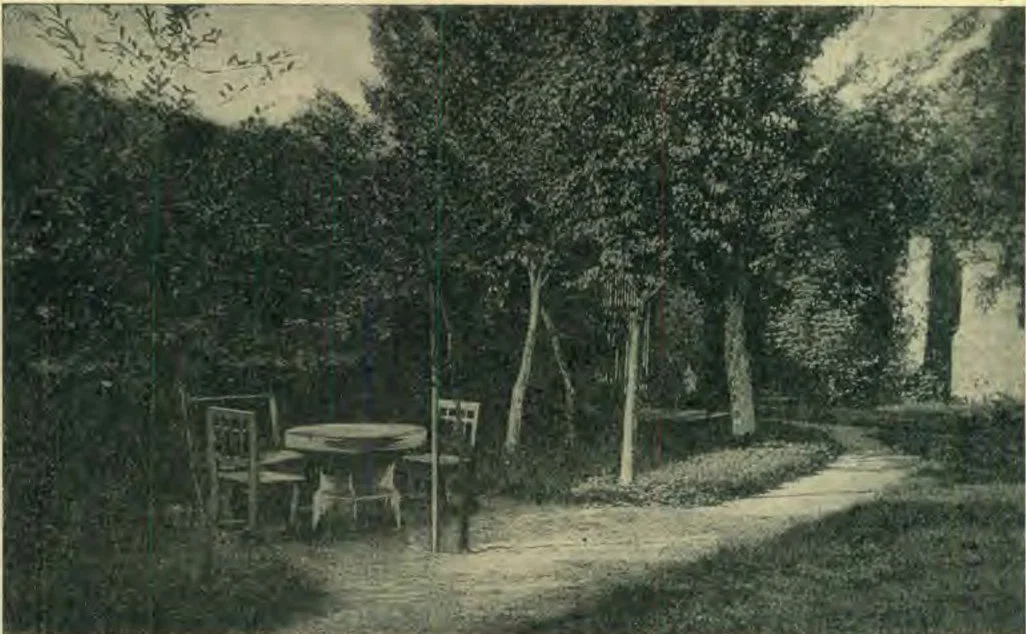
THE TABLE IN LUTHER'S GARDEN AT WITTENBERG, GERMANY, AROUND WHICH LUTHER AND MELANCHTHON DISCUSSED QUESTIONS RELATING TO THE REFORMATION
“While one day examining the books in the library of the university, Luther discovered a Latin Bible. Such a book he had never before seen. He was ignorant even of its existence. He had heard portions of the Gospels and the Epistles which were read to the people at public worship, and he supposed that these were the entire Bible. Now, for the first time, he looked upon the whole of God's Word. With mingled awe and wonder he turned the sacred pages; with quickened pulse and throbbing heart he read for himself the words of life, pausing now and then to exclaim, ‘O that God would give me such a book for myself!’” Every spare moment was devoted to earnest study of the Bible, and a deep conviction of his condition as a sinner took hold of him, and he almost reached the stage of despair, when God sent him a friend and helper, the pious Staupitz, who opened up the beauty and comfort of the Scripture and enabled him to find peace for his troubled soul. It was this experience of his early manhood that produced the germ of the Reformation, which lay dormant until the time came for it to break forth in power.
The Turning Point in Luther's Life
As previously stated, Luther's intention was to practice law. But about this time several providential happenings caused him to decide to devote his life to religion. The circumstances were as follows: First, he had a severe illness, owing to hard study, which brought him to the very gates of death. Second, while he was on his way to visit his parents at the time of the Easter holidays, 1503, he accidentally severed an artery with a sword which he carried, after the manner of students of that time, and came near bleeding to death. Third, a student friend, named Alexis, with whom he lived in closest intimacy, met a violent death. Alexis and he had been to see Luther's people at Mansfeld, and returning were caught in a thunderstorm5. A bolt of lightning struck Alexis, and he fell dead at Luther's feet. Encompassed with the anguish and terror of death, Luther then and there made a vow that if the Lord would deliver him from the storm, he would abandon the world and devote himself entirely to God. In spite of all dissuasions from his father and others, he became a monk in the Erfurt Convent of the Augustinian Eremites.
Luther made steady and rapid advancement in his career, being ordained to the priesthood in 1507, and receiving the degree of Doctor of Divinity in 1512. He had wonderful power as a preacher, and great crowds attended his lectures at the university.
A True and Tried Friend
Philipp Melanchthon, a man of great piety and profound learning, also a professor at Wittenberg, was Luther's most confidential friend and his chief assistant in the work of the Reformation. This friendship extended over a period of twenty-eight years, broken only by the death of Luther. They spent much time together in the garden adjoining Luther's home, discussing the grave situations confronting them. The illustration on the preceding page shows this favorite spot, and the table around which Luther and his friend often met. In the garden one evening at sunset, Luther observed a little bird perched for the night, and the beauty and repose of the scene led to the following utterance, revealing his trust in God: “That little bird—above it are the stars and deep heaven of worlds, yet it has folded its little wings, gone trustfully to rest there as in its home; the Maker of it has given it, too, a home.”
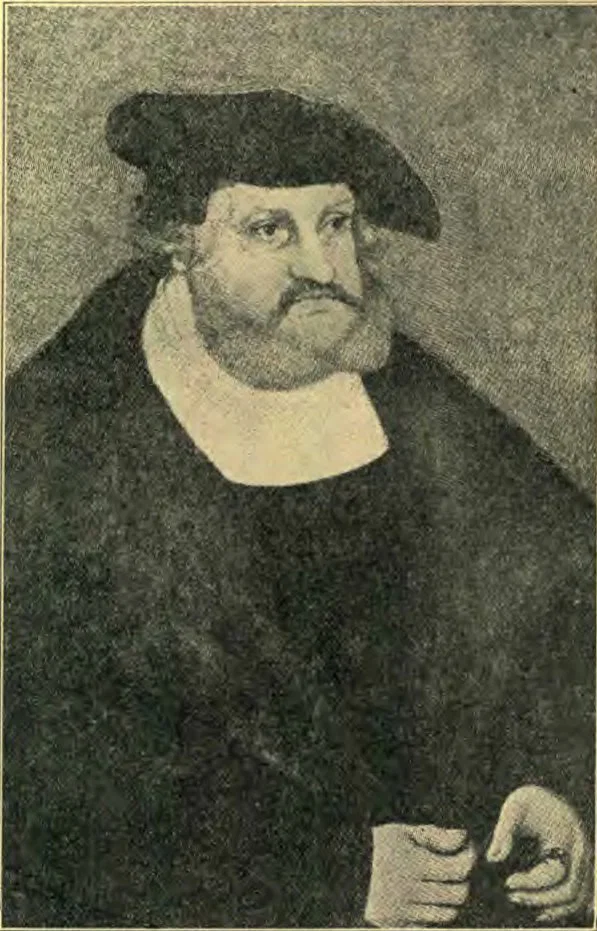
FREDERICK THE WISE
An Interesting Journey
During all these years, Martin Luther was a stanch supporter of the Catholic Church, which he had been taught in childhood to revere; but the many inconsistencies and false theories that were so apparent to his candid mind were a cause of much distress and perplexity to him. While professor in Wittenberg University, he was commissioned to go to Rome, and consult the Pope on official business. This was his first visit to the Holy City, and to be intrusted with such an important matter as an interview with the Pope, caused this trip to be of very great interest to Luther. While in Rome, he observed many things which tended to strengthen his growing conviction that the entire system of penances and indulgences was unbiblical and wrong. It was on this visit to Rome, while religiously following out the requirements of the church in ascending Pilate's staircase on his knees, that he heard a voice,—inaudible, and yet to his conscience, of thunder tone,—“The just shall live by faith.” Luther returned to Wittenberg with a burdened heart—the burden of an honest conviction of an unpopular truth and the responsibility of making it known.
The Storm of Censure Gathers
Shortly after this came the publicity of Luther's conviction in the theses, to which reference has already been made, quickly followed by orders from the Pope that he be called to answer for heresy. He was entreated, threatened, and offered high distinctions if he would recant, but nothing in the power of the Romish Church could make him deny what he believed to be truth, unless shown that it was at variance with the Word of God.
Luther's three successive books—“Address to the German Nobility,” “The Babylonian Captivity of the Church,” and “The Freedom of a Christian Man”—are known as his chief reformatory writings, and so powerful were their effect that in 1520 the Pope issued a bull, or decree, against him, condemning his writings as heretical, and excommunicating him from the church. So confident was Luther of the right and justice of his position, and so fearless was he of wrong, that he denounced the Pope as the Antichrist of Revelation, and publicly burned the papal bull.
The Pope now solicited the aid of the emperor Charles V, in crushing Luther, and a summons was issued that Luther appear before the Diet of Worms, an assembly of princes, nobles, and clergy convened at the city of Worms to deliberate upon the affairs of the German nation. Luther's friends were much alarmed, as they had reason to be, for they knew of cases where men had never returned from this august assembly, but had sealed their testimony with their blood. Nothing could detain Luther, however. His characteristic reply to entreaties was: “Even should there be as many devils in Worms as tiles on the roofs of the houses, still I would enter it.” His reply to the emperor when asked to recant, was: “I cannot and will not retract; for it is unsafe for a Christian to speak against his conscience.” This reply should sink deeply into the hearts of all young people today, and serve to inspire courage when in time of crisis.
Luther Kidnapped by His Friends
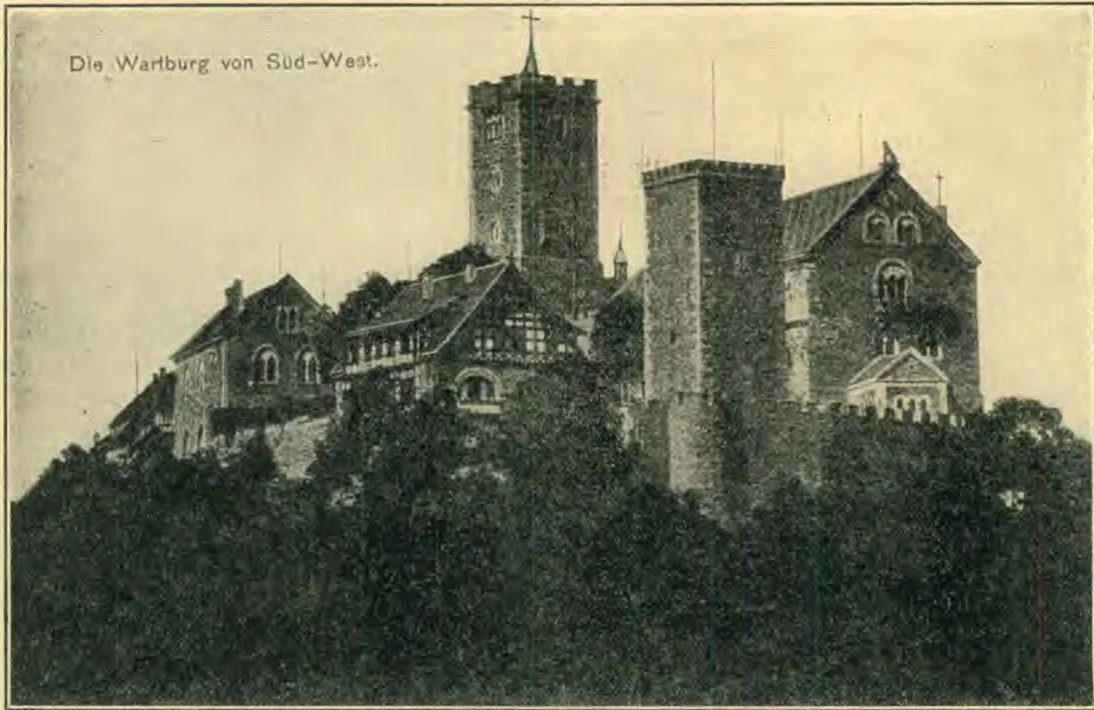
Luther was permitted to depart in safety from Worms, but under pronouncement of a heretic and an outlaw. God provided for him powerful friends among the princes of Germany. One of these princes was Frederick the Wise. But for him, Protestantism would in all human probability have perished in its infancy. To this prince belonged a spacious old mansion known as Wartburg Castle. It towered high above the city of Eisenach, its windows commanding a view of miles of Thirringian forest. Knowing that Luther's life was in danger, he arranged that a band of masked horsemen should waylay Luther on his way from the diet, seize him, and carry him to the6deserted castle. The plan worked to perfection, and Luther found himself a prisoner in the castle, where he was retained for ten months, in 1521 and 1522, his hiding place known only to a few of his friends, who amply provided for his comfort.
WARTBURG CASTLE, “BEAUTIFUL FOR SITUATION”
In writing to his friends from the castle, Luther headed his letters, “The Land of the Birds,” “The Region of the Air,” “My Wilderness,” but most often “My Patmos.”
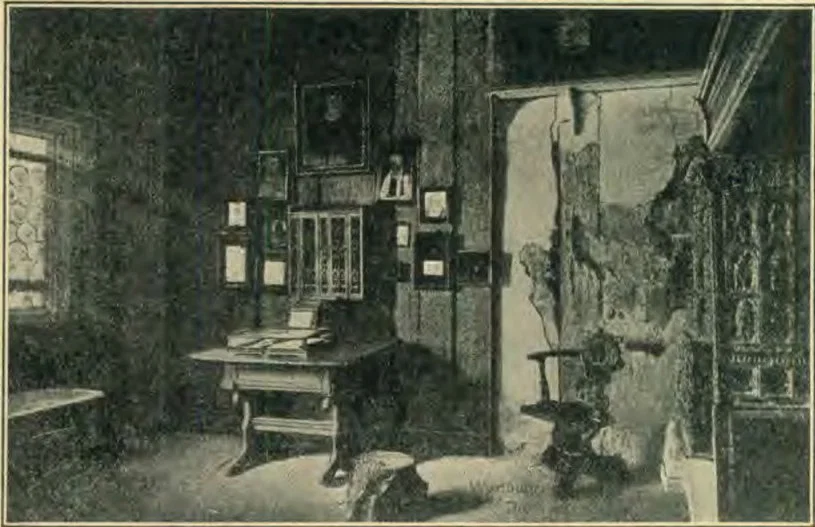
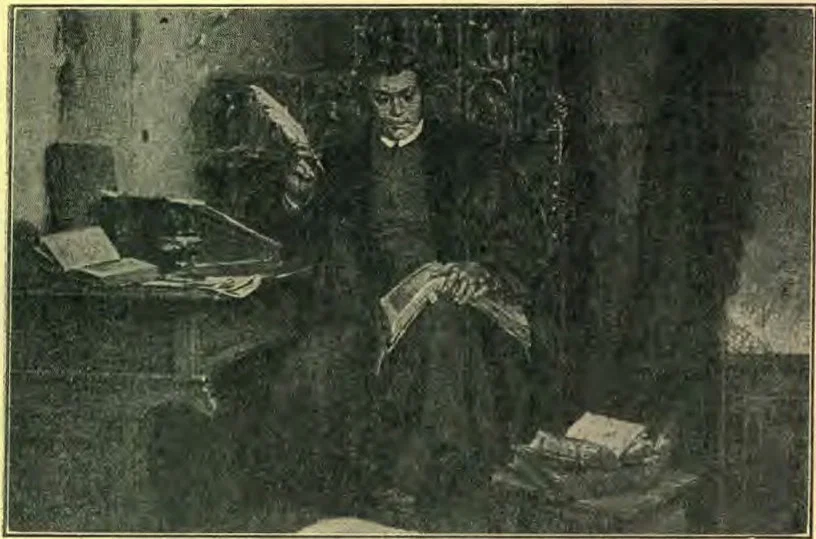
Luther was by no means idle during this period of forced confinement. During these ten months he translated the New Testament from Greek into German, a work of such magnitude as has seldom been done in so short a time; and yet Luther at times complained that he had not enough to do. The room he occupied in the castle was a combination sleeping-room and study; severely simple to the modern eye, but comfortable as comfort went in 1521.
His Crowning Work
Luther later translated the entire Bible into the language of the common people, and this is considered the crowning work of his life. “His translation of the Bible is a classic, the idol of scholars to this day.” The open Bible in the hands of the people was one of the main reasons for the success of the Reformation. Luther wrote thirty-six hymns, to some of which he fitted his own music, for he was a musician and singer as well as an eloquent preacher. It has been said that “he did as much for the Reformation by his hymns as he did by his translation of the Bible.”
Origin of the Term “Protestant”
“Notwithstanding all the efforts that were made to suppress the doctrines of Luther, they gained ground rapidly, and in the year 1529 another assembly, known as the second Diet of Spires, was called to consider the matter. This body issued an edict forbidding all persons from doing anything to promote the spread of the new doctrines until a general council of the church should have investigated them and pronounced authoritatively upon them. Seven of the princes of Germany, and a large number of the cities of the empire, issued a formal protest against the action of the diet, denying its power and authority to bind men's judgment and conscience. Because of this protest, the Reformers from this time began to be known as Protestants,” a name ever since borne by all who have opposed Rome.
Later Events of the Reformation
In 1546, while in Eisleben, his birthplace, Luther was suddenly stricken with apoplexy and died. From this time on the cause of the Reformation suffered many reverses. Repeated attempts were made to stamp out the work of Luther and the Reformers. The churches bearing his name were confiscated, and attempts were made to break up the Protestant movement. Between 1618 and 1648 was fought the terrible Thirty Years' War, in which the German Protestants fought bravely. Gustavus Adolphus, king of Sweden, in the darkest hour of the struggle led an army of Swedes to the assistance of the Protestants in Germany. After numerous marches and battles, the Lutheran forces under his command met the Catholic army, under Wallenstein, on the famous field of Lützen, in Saxony, Nov. 6, 1632. The Swedes won a glorious victory, the turning point of the war, and the cause of civil and religious liberty was saved; but the brave Gustavus was killed. The Treaty of Westphalia, in 1648, ended the Thirty Years' War, and it was declared that Protestants should forever enjoy the same rights of religious liberty as the Catholics.
LUTHER'S ROOM IN THE WARTBURG CASTLE
The result of this victory for Protestantism was that the power of the Pope as supreme representative of God was forever broken; decrees of popes, diets, and councils were cast aside as works of men and not of divine worth. The Word of God was restored to7the world, and the Bible put into the hands of every believer.
LUTHER TRANSLATING THE BIBLE
The work of the Reformation made clear that the Word of God alone is the only infallible rule for faith and life. It restored the two original sacraments, baptism and the Lord's Supper, free from human additions. It gave to the world the great doctrine of Scripture that man is justified by faith alone, and that good works are the fruit and evidences of faith. It liberated the conscience of man from the tyranny of popes and councils. It gave every enlightened Christian the power to read and interpret the Scriptures. Many errors were cast out, and many precious Scriptural doctrines were restored. The dignity and worth of the individual were reëstablished. By reason of the Reformation we have the Scriptures as our supreme authority, and the right of private judgment. And from these American democracy has derived its chief corner-stone—religious and civil liberty and popular education.
Why We Are Protestants
Rev. Randolph McKim, rector of the Church of the Epiphany, Washington, D. C., in a public address gave the following logical reason: “We are Protestants because we build our faith on the impregnable rock of Holy Scripture, and not on the shifting sand of ecclesiastical tradition. The Bible, and the Bible alone, is the basis of the religion of Protestants; but tradition, interpreting the Bible, and often superseding or contradicting it, is the basis of the religion of Romanists.”
It is fitting that all Protestant churches unite in this quadricentennial celebration with zeal and satisfaction, but it should be remembered that consistency is a jewel of great worth in the diadem of Christian character, and that to be consistent with Protestant principles there is need today for wider separation from traditional errors. It was the inconsistency of the Protestant practice with the Protestant profession, which gave to the Catholic Church her long-sought and anxiously desired ground upon which to condemn Protestantism and the whole Reformation movement as only a selfishly ambitious rebellion against church authority. The chiefest and culminative expression of Protestant inconsistency is the rejection of the Sabbath of the Lord, the seventh day, as enjoined in the Scriptures, and the adoption and observance of the Sunday as enjoined by the Catholic Church. The following argument by a prominent official of the Cath- olic Church, Archbishop of Reggio, is unanswerable by the majority of Protestants today:
“The Protestants claim to stand upon the written Word only. They profess to hold the Scripture alone as the standard of faith. They justify their revolt by the plea that the church has apostatized from the written Word and follows tradition. Now the Protestants' claim, that they stand upon the written Word only, is not true. Their profession of holding the Scripture alone as the standard of faith, is false. Proof: The written Word explicitly enjoins the observance of the seventh day as the Sabbath. They do not observe the seventh day, but reject it. If they do truly hold the Scripture alone as their standard, they would be observing the seventh day as is enjoined in the Scripture throughout. Yet they not only reject the observance of the Sabbath enjoined in the written Word, but they have adopted and do practice the observance of Sunday, for which they have only the tradition of the church. Consequently the claim of ‘Scripture alone as the standard,’ fails; and the doctrine of ‘Scripture and tradition’ as essential, is fully established, the Protestants themselves being judges.”
In Luther's day “present truth” was the proclamation of justification by faith and the freedom and power of God's Word. That truth has lost none of its power in the four hundred years which have passed, but around this nucleus have clustered many additional gems of truth, and the re-formation of the twentieth century consists in repairing the breach which has been made in God's law, the restoring of paths to dwell in, the turning away of feet trampling upon the sacred Sabbath (Isa. 58: 12-14), and the proclamation of the glorious third angel's message (Rev. 14: 9-13) among all Christian and non-Christian people. We rejoice in the results of the Reformation of the sixteenth century, but let us with renewed courage do our part in the reformation of the twentieth century. A host of Luthers are needed today. M. V. D.