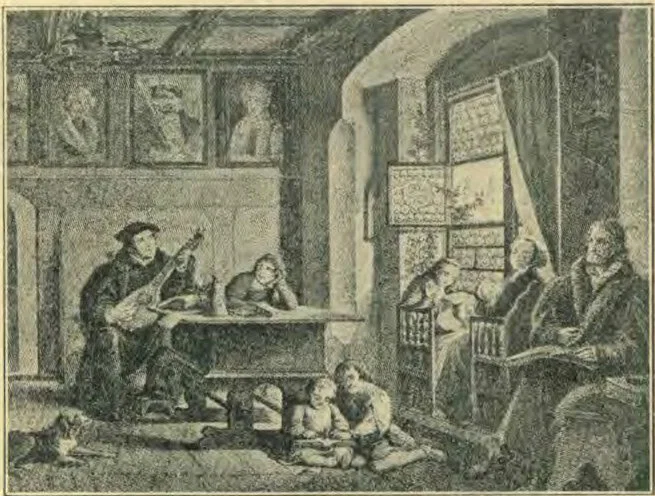
MARTIN LUTHER was never so happy as when associating with children. He was of a kind, genial disposition, an affectionate husband and father. In his home he was a true house-priest, reading and explaining the Scriptures, and singing and praying with the members of his family. “When I rise in the morning,” he says, “I repeat with the children the ten commandments, the creed, and the Lord’s Prayer, and some psalm.”
He was the father of three sons and three daughters, and he brought up no fewer than eleven of his orphaned nephews and nieces. Hans, the oldest son, became an able lawyer and counselor. The second son, Martin, studied theology, but never entered the active ministry, being sickly. He died at the age of thirty-three. The third son, Paul, became a successful physician.
Elizabeth, a beloved daughter, died when eight months old. Informing a friend of her death, the father wrote: “My little daughter Elizabeth is dead. She has left me wonderfully sick at heart and almost womanish. I could never have believed how a father’s heart could soften for his child.” Another daughter, Magdalene, died in the fourteenth year of her age.p. 8 She was a child of peculiarly sweet temper, and her father could say of her that she had never provoked him to anger. Her death was a severe blow to Luther. As she lay very ill, he exclaimed, raising his eyes to heaven: “I love her very much, but, dear God, if it be thy will to take her, I submit to thee.” One day when she suffered violent pain, he approached her bed, and taking hold of her small, thin hands, pressed them again and again to his lips, saying, “My dearest child, my own sweet and good Magdalene, would you like to stay here with your father, or would you willingly go to your Father yonder?”
The dying child answered, “Darling father, as God wills.”
Then he said, “Dearest child, the spirit is willing, but the flesh is weak.”
Turning away, and walking to and fro in great agitation, he said, “I love her very much; if my flesh is so strong, what can the spirit do?”
She fell asleep in her father’s arms while he was kneeling before her bed weeping and praying. When they had laid her in the coffin he said, “Darling Lena, you will rise again and shine like a star—yea, like the sun. I am joyful in spirit, but oh, how sad in the flesh!”
Luther’s youngest child was a girl named Margaret. She was but eleven years old at her father’s death. In due time she married a rich and noble man by the name of George von Kunheim. She left three children, of whom one, her daughter Margaret, has posterity at the present day.
Although deeply affectionate and tender with his children, Luther could also be quite stern. He demanded and insisted on strict obedience. When his son Hans once had done something wrong, the father refused for three days to see him and grant him forgiveness, declaring that he would rather have a dead son than a disobedient son. And yet this was the same Hans whom he loved so dearly, and to whom, when Hans was four years old, he wrote the charming letter which has been a children’s classic from that day to this.
Luther was a lover of music, and enjoyed playing the flute. Many hymns of his composition are in use today, among which might be mentioned “A mighty fortress is our God” (see “Christ in Song,” page 681), which is termed “the battle hymn of the Reformation.” Carlyle says that its notes ring in our ears like bugle blasts from heaven, and the great master Handel confessed that he derived much benefit from a study of its music. “Luther’s Cradle Hymn” is also well known, and many carols by Luther have been sung by old and young through the years. One of these was written in the year 1531 for the same son Hans of whom we read so much. Here are the words, translated into English:
“Good news from heaven the angels bring, Glad tidings to the earth they sing: To us this day a Child is given, To crown us with the joy of heaven.
“This is the Christ, our God and Lord, Who in all need shall aid afford: He will himself our Saviour be, From sin and sorrow set us free.
“To us that blessedness he brings, From which the Father’s bounty springs: That in the heavenly realm we may With him enjoy eternal day.
“Were earth a thousand times as fair, Beset with gold and jewels rare, She yet were far too poor to be A narrow cradle, Lord, for thee.
“Ah, dearest Jesus, holy Child, Make thee a bed, soft, undefiled, Within my heart, that it may be A quiet chamber kept for thee.”
It is related that on Christmas Eve, 1533, when Luther’s wife was very busy preparing for the customary Christmas celebration in their home, little Paul was very restless in his cradle, and the mother asked her husband to rock him for a while. Luther, though engaged in preparing his sermon for the next day, quietly complied with his wife’s wish. While thus sitting at the cradle watching his little son, his heart being filled with thoughts of the Christ-child, Luther indited that most beautiful Christmas hymn which young and old still delight to sing, “From Heaven Above to Earth I Come.”
So great is the love which Christian people feel for Martin Luther and the great good he has done that monuments in various places have been erected to his memory. The cut on the front page shows the monument which stands near the entrance to the Lutheran church in the city of Washington, D. C. While it is well to revere the memory of great and good men in this way, we may also show our love and appreciation by standing true to the principles which they advocate.
Our Luther Monument
Great Luther found the fettered Word, The lamp of light divine, Uncased the candle of the Lord, And trimmed and bade it shine.
As Mary’s fragrant spikenard poured Is her memorial true, So the unsealed and preached Word Is his memorial too.
Where Faith and Love their spires uprear To greet the rising sun, There Luther’s monuments appear, For there his work is done.
Build ye who will the bronze, the stone— A work which cannot grow; Perhaps ’twill make his features known Whose life we strive to know.
But we shall build the mighty work Which his brave hands begun; Though grand its vast proportions be, The work is not yet done.
Let’s build in faith, let’s build in love, Build first ourselves in one; O what a monument were reared, If this grand work were done!
Then with the open Bible haste To meet its friends or foes; Beneath your feet the desert wastes Shall blossom as the rose.
Build schools and churches, conscience, laws, On every continent; Thus as ye build great Luther’s cause, Ye build his monument.
—Adapted from Joel Swartz.
M. V. D.