A carriage, in which sat four men, was rapidly approaching the imperial city of Worms. After it rode a number of horsemen, and before it advanced a herald bearing the yellow and black banner of the empire.
“See how the people are pouring from the gate to receive him!” said one of the riders, Dr. Justus Jonas, of Wittenberg, to a companion. “Hark! The watchman on the gate sounds a trumpet, to announce his coming to the whole city. Now all the people are leaving their midday meal, and pouring into the streets to see Dr. Martin Luther.”
“He is coming! he is coming!” rose the cry within the city.
“Come, hasten! let us see the great man,” exclaimed one citizen to another.
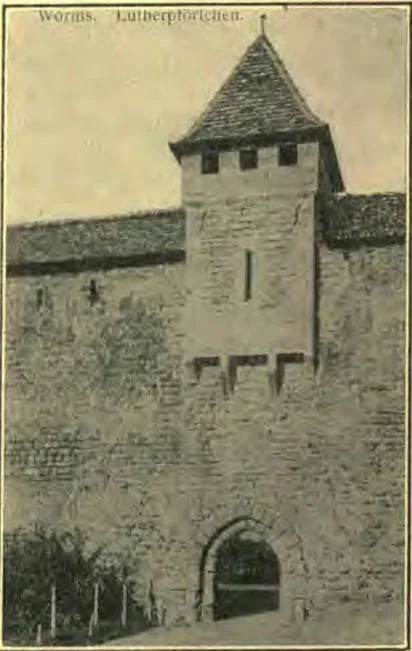
LUTHER'S CELL, WORMS, GERMANY
“This is a great day,” replied his neighbor, as they strained their eyes toward the gate. “The man is coming who has taken up the cause of the people against the evils within the church. No wonder the whole nation has arisen to stand behind him.”
“Not all!” said a surly voice beside them. “Not all, good neighbor! Archbishop Albert is furious with him; Duke George declares that he shall lose his head. It will be well for the noisy heretic if he returns alive from Worms.”
“He has the emperor’s promise of safe-conduct,” said the first.
“So had John Huss at Constance,” returned the other, “yet they burned him alive. This Luther should be careful how he answers the great and mighty council.”
“He comes! he comes!” broke out the shouts again, as the banner of the empire came in sight.
Around the corner came the carriage and halted at the hotel of the Knights of St. John. Out of it stepped a short, dark-haired man in a black gown.
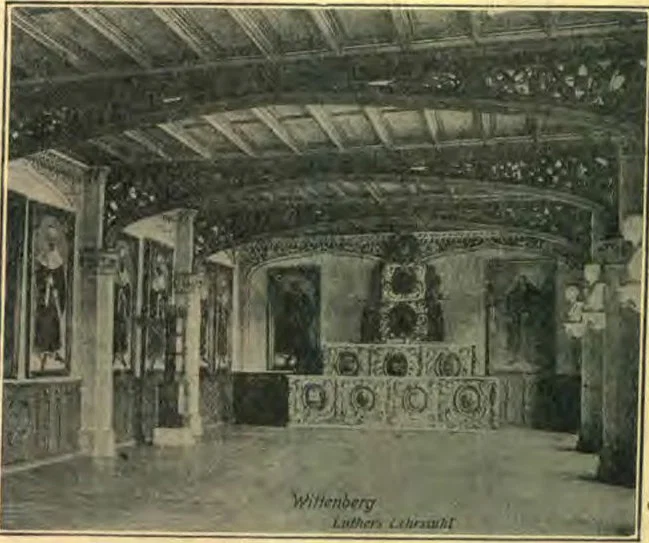
LUTHER'S LECTURE-ROOM IN THE UNIVERSITY OF WITTENBERG, GERMANY
He cast a glance around, with his piercing dark eyes. The throng pressed to touch his garments. Up at the housetops he looked; down the street and up again. Every door, every window, was crowded with gazing faces.
“God be with me!” exclaimed Martin Luther, feeling suddenly that the eyes of all Germany, yes, of all Europe, were upon him. Then, turning quickly, he passed into his hotel.
That evening came Luther’s friend, George Spalatin, secretary to the great Elector Frederick.
“Thank God that you have arrived in safety!” he exclaimed, greeting Luther with warm affection.
“Our journey has been safe and prosperous, dear George,” returned Luther, brightly.
“He speaks very mildly of his triumphal procession,” said Dr. Jonas, laughing. “At every city and hamlet he was met by marching and singing people, cheering him on his way. Everywhere the people begged him not to come to Worms. ‘Your life is not safe, dear Dr. Martin. Do not go on,’ was the cry on every hand. But he answered, ‘Though there were as many devils in Worms as there are tiles on the houseroofs, I would still go on!’”
“Yes,” replied Spalatin. “I myself was afraid, and sent him a message to turn back; but his faith and courage make me ashamed to fear. The elector is here, and will stand by his professor and his university to the utmost of his power.”
“I have a stronger Friend than the great elector, dear George,” put in Martin Luther with a quiet smile.
Next day the summons came for Luther to appear before the diet, or council of the empire, which was being held in the bishop’s palace. The streets were so thronged that the imperial herald was not able to get Luther safely through the crowd; they were obliged to go back into the hotel garden and so make their way to the garden of the palace.
Into the great hall the herald led the solitary, black-robed figure. Within sat waiting for him all the nobles and princes of the empire.
Just as the doors were opened, the gray-bearded old general, George of Frundsberg, stepped to his side and slapped him on the shoulder.
“Little monk, little monk!” he said kindly, “you are about to go into a more terrible battle than I and my knights have ever fought; but if your cause is just, and God is with you, go forward boldly, and have no fear.”
From all around came cries of encouragement. “Play the man!” “Fear not!”
From the crowd outside and the people in the streets, arose shouts that could be heard within the palace: “Luther, our Luther!” “God bless Dr. Martin!”
So Martin Luther went in, with smiling lips, to face the brilliant assembly.
On the throne chair, in his robes of state, sat the young emperor, Charles the Fifth. His long, pale face was calm as marble; but as his eyes fell on the slight figure following the herald, a sneer crossed his cold lips. All about him gathered the princes of his realm—archbishops, cardinals, electors, margraves, dukes, and landgraves; beside these, the ambassadors of all the principal rulers of Europe. Among them all, Luther saw only one face he could count friendly10—the broad, good-natured countenance of the wise Elector Frederick.
Beside the throne stood a table with books upon it. As Luther glanced toward it, he saw the titles of several of his own books.
Then the voice of the chancellor broke the silence. “Martin Luther, His Imperial Majesty has summoned you here, that you may recant and recall the words you have written in these books, published by you and spread abroad.”
“Let the titles of the books be read,” cried a voice. As the names of the books were read, one after another, Luther bowed his head, assenting to each. At the close, he spoke:
“I cannot deny that I have written all the books named; and I have also written some others not mentioned here. As for denying what I said in them, I beg that Your Imperial Majesty will give me time to consider, that I may make my answer without denying my Lord.”
There was a buzz of excited conversation among the councilors. The Italian ambassadors did not wish delay; Martin Luther had spoken in a low voice, and they believed that he was frightened and ready to recant if he were threatened.
At length the chancellor announced that a delay of twenty-four hours should be granted; and the herald led Luther back to his room at the inn.
“Frightened? not at all!” declared Justus Jonas next day to the friends who besieged the hotel all the morning. “You will hear whether he is frightened when he is ready to give his answer.”
“But why did he not answer at once?” asked one impatient nobleman.
“Dear sir,” said Dr. Jonas, “he wanted to consult a Friend.”
“What friend?” exclaimed the noble in surprise. “Surely Dr. Martin needs no one to tell him what to say. Did he consult a lawyer, so that he might be sure of saying nothing his enemies might turn against him?”
“All night,” said Dr. Jonas, in a lower tone, “all night we have heard Dr. Martin’s voice, in his room, talking with his Friend. ‘O thou, my God,’ we heard him say, ‘stand by me against the wisdom of the world. It is thy cause, not mine. I am ready to sacrifice my life, as patiently as a lamb. But the cause is thine; thou must help me to defend it.’”
The nobleman’s voice was husky, as he turned away. “God grant it!” he said.
Once more, late in the afternoon, the herald came to conduct Martin Luther before the diet. The crowd in the streets was greater than ever, as again they made their way through the gardens to the palace.
“How cheerful he looks!” said the watchers in the palace court, as Luther passed into the building.
“Perhaps he has made up his mind to recant,” said one. “He knows he is safe.”
The hall was so crowded that the princes had difficulty in getting to their seats. Again the chancellor called on Martin Luther to recant. His words were bitter and threatening; but they made no change in the serene look on the face of the accused man.
Then Martin Luther began to speak. All hesitation was gone from his manner. His head was raised, and his ringing voice reached every corner of the crowded hall.11
“Most serene lord and emperor,” he began, “most illustrious princes, most clement lords—”
The throng grew still as death to listen. The April twilight was darkening, and torches had been lighted to illuminate the hall. The heat grew intense; yet no one stirred, while Martin Luther spoke on and on.
“Some of my works,” he said, “are on sacred subjects to which no objection can be made by any one. Some are attacks on the many evils in the church; these I cannot retract, without denying Christ. But if any one can show me anything in any of my writings which is false and contrary to the Word of God, I am ready to throw my books into the fire with my own hands.”
“Speak to the point, Luther! Will you, or will you not retract?” cried the chancellor.
Then Luther, his deep eyes glowing like stars, flung back the immortal answer:
“Unless I am convinced by the Holy Scriptures—not by the word of popes and councils, for they may be in error, but by the Word of God himself, by which alone my conscience is bound—I neither can nor will retract anything.”
A tumult of voices arose. The chancellor began to argue, the princes to interrupt. Out of the midst of the din once more arose the voice of Martin Luther, clear and firm as an angel’s trumpet: “Here I stand. I cannot do otherwise. God help me! Amen!”
Then the young emperor arose, dismissing the diet. The assembly poured out of the hall, pushing and thronging so that several of the imperial guards had to be sent to Luther’s side, to lead him safely through the crowd.
As he passed out of the doors, with a guard on either side, the nobles in the court cried out, “He is arrested! they are taking him to prison!”
“They are taking me to my hotel,” called out Luther, and the crowd was pacified.
Across the palace yard and into that of the hotel he was led, to the inn where his waiting friends had spent the anxious hours.
“I am through! I am through!” cried Martin Luther exultingly, with uplifted hands, as they rushed to meet him.
“You have retracted nothing, dear Dr. Martin?” cried his faithful friend, Nicholas Amsdorf.
“Retracted?” exclaimed Luther, with the ring of victory in his voice. “Even though I had a hundred heads, I would have had them all cut off before I would have retracted anything!”—Adapted from “Martin of Mansfeld.”