J. WIBBENS
The house in Leiden, Holland, where lived John Robinson, leader of the English company from whom went out the Pilgrim Fathers to New England, is still one of the sights dear to American visitors. Accompanying this article is a picture of the house where Mr. Robinson lived and died. The little horizontal window marks the chamber-room which was his study and workroom, and the place of his death.
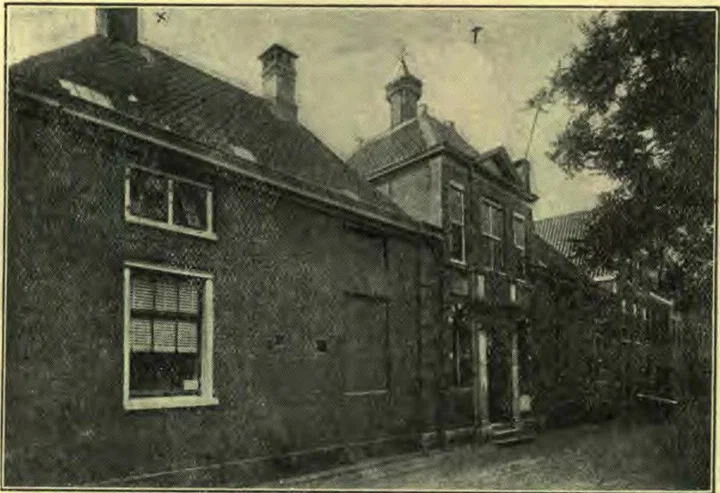
The property secured by the English exiles in Leiden was bought with a view to supplying living quarters for others than the pastor, and a meeting hall for the congregation. The house was a large one, and doubtless a churchroom once stood in the rear of the main entrance. Here it was that they held a solemn fast in July, 1620, as the younger and stronger members offered themselves for the venturesome journey to the New World. “Let us seek God,” they said, “a right way for us, and for our little ones, and for all our substance.” “When all was ready,” wrote one of them, “the brethren that stayed at Leiden, having again solemnly sought the Lord with us and for us, feasted us that were to go, at our pastor’s house, being large; where we refreshed ourselves, after tears, with singing of psalms, making a joyful melody in our hearts, as well as with the voice, there being many of the congregation very expert in music; and, indeed, it was the sweetest melody that ever mine ears heard. After this they accompanied us to Delfshaven, where we went to embark, and then feasted us again; and, after prayer, performed by our pastor, when a flood of tears was poured out, they accompanied us to the ship, but were not able to speak to one another for the abundance of sorrow to part. But we only, going aboard, gave them a volley of small shot and three pieces of ordnance; and so, lifting up our hands to each other, and our hearts for each other to the Lord our God, we departed.”
The charge which John Robinson gave to these pilgrims seeking refuge from religious oppression voices sentiments that we should not forget. He said: “Brethren, we are now quickly to part from one another, and whether I may live to see you face to face on earth any more, the God of heaven only knows; but whether the Lord hath appointed that or not, I charge you before God and his blessed angels, that you follow me no farther than you have seen me follow the Lord Jesus Christ. If God reveals anything to you by any other instrument, be as ready to receive it as you ever were to receive any truth by my ministry; for I am verily persuaded, I am very confident, that the Lord hath more truth yet to break forth out of his Holy Word. For my part I cannot sufficiently bewail the condition of the Reformed Churches, who are come to a period in religion, and will go at present no farther than the instruments of their reformation. The Lutherans cannot be drawn to go beyond what Luther saw. Whatever part of his will our Lord revealed to Calvin, they will rather die than embrace; and the Calvinists, you see, stick fast where they were left by that great man of God, who yet saw not all things. “This is a misery much to be lamented; for though they were burning and shining lights in their time, yet they penetrated not into the whole counsel of God, but were they now living, would be as willing to embrace further light as that which they first received. I beseech you, remember it as an article of your church covenant that you be ready to receive whatever truth shall be made known to you from the written Word of God. “But I must herewith exhort you to take heed what you receive as truth. Examine it, consider it, compare it with other scriptures of truth before you receive it; for it is not possible that the Christian world should come so lately out of such thick antichristian darkness, and that perfection of knowledge should break forth at once.”
Above the doorway of Robinson’s house are two stones set, one containing four lines of poetry in the Dutch language, the other the English inscription: “On this spot lived, taught, and died John Robinson, 1611-1625.”
Over against this building is a church. Facing the house of Mr. Robinson, a great bronze plate is set into the wall of the church, on which the following can be read:—
THE MAYFLOWER 1620. In memory of Rev. John Robinson, M. A., Pastor of the English Church over against this spot, A. D. 1609-1625, where at his prompting, went forth the Pilgrim Fathers to settle New England 1620. Buried under this house of worship 4 March 1625 Æ XLIX years. In memoria aeterna erit justus. Erected by the National Council of the Congregational Churches of the United States of America A. D. 1891.
We are glad that Holland furnished a place of refuge to those Pilgrim Fathers on their way to plantp. 4 the light of the Protestant faith, and of religious liberty as they understood it, on the New England shores.
The Hague.