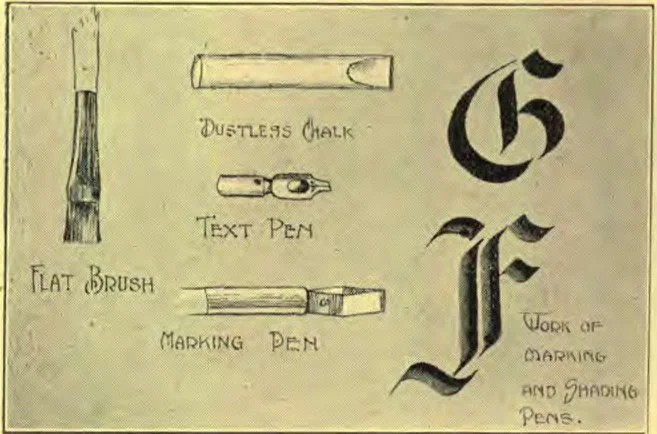
Shading pens are used in exactly the same manner as the lettering pens. Shading pens are toothed for a short space on one side to produce a heavy line opposite the tooth, and a shadow for the remainder of the width. Marking pens are toothed all the way across, to produce a solid color. I have drawn in one of the plates a marking pen, and also a specimen of the work done by both. The most satisfactory results are obtained by the use of Nos. 3 and 4.
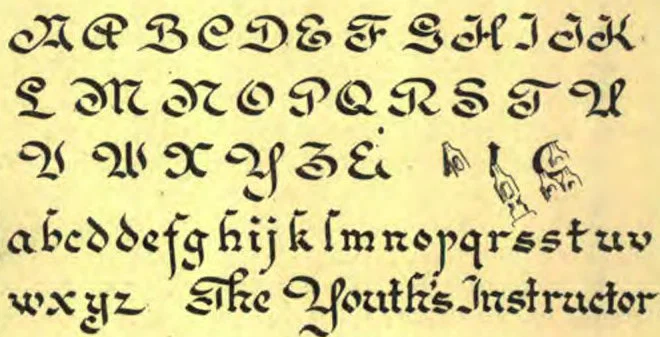
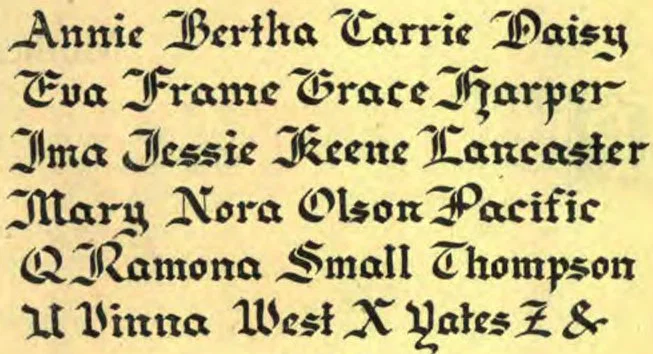
Plates II and III were made with a No. 4 Esterbrook's Text Writer Pen. Guide lines should be made one-half inch apart for capitals and five sixteenths for small letters.
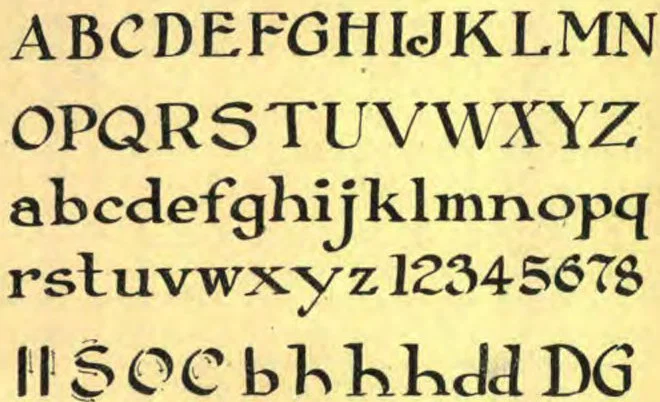
Plate IV was made with the same pen that was used in Plates II and III, but held so that the point was parallel with the line of writing, this position being maintained in making every part of the letter. The little ticks at top and bottom of stems are made by moving the pen in a direction parallel to the line of writing, and filling in as shown in the letters of the last line.
The lines are nine sixteenths of an inch apart in this alphabet for the capitals and five sixteenths for the small letters. Similar letters may be made with a pencil pointed like a chisel. Persistent practice in this line of work will bring the reward.
Lettering with Brush
In lettering with the brush, the same motion may be used as with the text and lettering pens, however a different ink should be used. The best ink for this same purpose is Carter's “Velvet” Show Card Ink. This ink dries with no luster, and the colors are true.
All the styles of letters given in this series of articles may be written with chalk crayons sharpened flat and held at an angle of forty-five degrees to the line of writing for text and Old English letters. The pencil motto accompanying this article was made with a soft lead pencil sharpened flat and held as you have been instructed elsewhere for pen work.
PLATE II
If those practicing these letters desire to take up fully the study of the use of the brush, they are referred to the revised edition of “Modern Show Card Lettering of Designs,” by the Thompson School of Lettering, Pontiac, Michigan. The best book on the subject of lettering and writing is “Palmer's Penmanship Budget,” published by the A. N. Palmer Co., New York, Chicago, Boston, Cedar Rapids. The latter book is not filled with obsolete and out-of-date plates, but it contains no instruction in brush lettering.
PLATE III
[NOTE.—The pencil motto referred to by Mr. Hamilton is shown on page six. Another copy of the motto in which more capitals are used is found on page thirteen. The first article of this valuable series appeared in last week's INSTRUCTOR, bearing date of July 17.—EDITOR.]