The wanton destruction of birds shows how little these creatures and their work are appreciated. Hundreds are destroyed for trimmings for ladies’ hats and bonnets; hundreds more are killed for food; and still other hundreds are destroyed from the simple love of killing them.
In some States large sums of money are appropriated for the purpose of fighting the insects that threaten at times to destroy the ornamental trees and shrubs of our cities. With powders and oils and liquids, aggressive warfare is waged against moths, worms, and insects; and at the same time the birds, which would do this work without one cent of remuneration, are killed and captured. The relation of birds to insects is just coming to be appreciated.
“It is said that two hundred millions of dollars that should go to the farmer, the gardener, and the fruit growers of the United States is lost every year by the ravages of insects; that is to say, one tenth of our agricultural products is actually destroyed by them.”
The ravages of the gypsy moth in only a very small portion of Massachusetts cost the State one hundred thousand dollars a year. When the weather is dry, the only help is rain; and when insects threaten, the only natural help is the birds.
“Consider for a moment what the birds are doing for us any summer day, when insects are so abundant that the hum of their united voices becomes an almost inherent part of the atmosphere.”
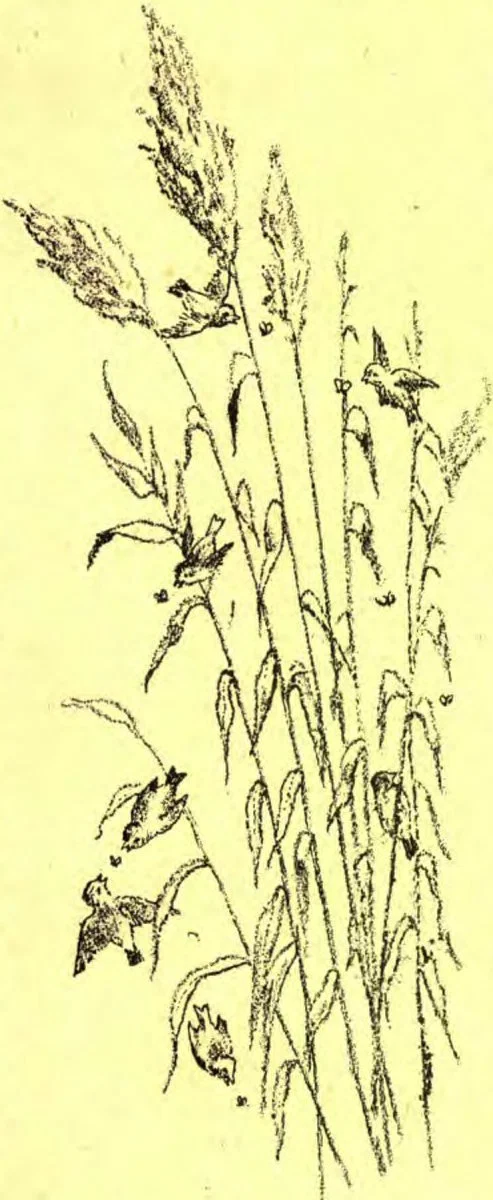
“In the air Swallows and Swifts are coursing rapidly to and fro, ever in pursuit of the insects which constitute their sole food. When they retire, the Nighthawks and Whip-poor-wills will take up the chase, catching moths and other nocturnal insects which would escape the day-flying birds. The fly-catchers lie in wait, darting from an ambush at passing prey, and with a suggestive click of the bill returning to their post. The Warblers, light, active, creatures, flutter about the terminal foliage, and with almost the skill of a Hummingbird, pick insects from leaf or blossom. The Vireos patiently explore the under-sides of leaves and odd nooks and corners, to see that no skulker escapes. Woodpeckers, Nuthatches, and Creepers attend to the tree trunks and limbs, examining carefully each inch of bark for insects’ eggs and larvae, or excavating for the ants and borers they hear at work within. On the ground the hunt is continued by Thrushes, Sparrows, and other birds, which feed upon the innumerable forms of terrestrial insects. Few places in which insects exist are neglected; even some species which pass their earlier stages or entire lives in the water are preyed upon by aquatic birds.”—“Bird Life.”
All this being true, it might still be thought that the birds accomplish little in their war against the enemies of vegetation. It has been stated on good authority that the stomachs of four Chickadees contained one thousand and twenty-eight eggs. In the stomachs of four other Chickadees were found six hundred eggs and one hundred and five female moths. One female moth is said to contain, on an average, one hundred and eighty-five eggs. Supposing, then, that a Chickadee eats thirty moths a day, which is a fair estimate, for the twenty-five days when these moths crawl up trees, in the given period the bird would destroy one hundred thirty-eight thousand seven hundred and fifty eggs of this insect.
Professor Forbes, of the Illinois State Laboratory of Natural History, found in the stomach of a single Robin one hundred and seventy-five larvae of Bibio, a fly which, in its larval state, feeds on the roots of grass. But this does not half express the truth of the case, for birds digest their food very rapidly. The stomach of a yellow-billed Cuckoo, shot at six o’clock in the morning, contained the partially digested remains of forty-three tent-caterpillars. If it had gathered so many at so early an hour of the day, it is a question how many it would have eaten before nightfall.
Hawks and Owls destroy the small rodents that are so destructive to crops. All our Hawks and Owls, except the Sharp-skinned and Cooper’s Hawk, are beneficial. The number of mice and other rodents eaten by some of these large birds seems almost incredible.
Other birds eat and destroy the seeds of many injurious weeds. Prof. F. E. L. Beal has calculated that in Iowa alone the little Tree Sparrow destroys one million seven hundred and twenty thousand pounds of seeds of noxious weeds every year. But the birds which eat the seeds of these weeds, thus destroying them, also eat blueberries, huckleberries, strawberries, and raspberries, but do not destroy their seeds, distributing them unharmed over thousands of acres where otherwise they would not have grown.
In thinly settled portions of the country the Crow probably does more harm than good; but in thickly settled portions the matter is reversed. The English Sparrow is of positively more harm than good, and deserves sentence of death. The Sapsucker and Redhead Woodpecker, with the Crow Blackbird, may be beneficial or injurious according to circumstances.
Evidence goes to show that other common birds are of invaluable aid and benefit to mankind, and should in every way be encouraged and protected.
L. A. REED.