NEW JAPAN

10%

Review and Herald Publishing Company · Battle Creek, Mich. · Apr 4, 1901

FromThe Youth’s Instructor, Vol. 49, No. 14.

Read the full edition

NEW JAPAN

III
Old Japan is supposed to have died many years ago. But it was never decently buried, for it crops out every now and again. New Japan, as you know, has telegraphs, railroads, armies, navies, commerce,—everything except the root of Christianity, which makes people love God, and their neighbors just the same as themselves.
You remember the story Jesus told about the man who had an evil spirit? You know it was cast out, and the man swept and ornamented the room where the bad spirit had been; but he left it empty, and by and by that wicked spirit came back, and brought seven others with him, and the man was worse than he had been before. So Japan is driving out idolatry and superstition quite fast, but she is sweeping the dirty old house with “morality;” that is, the people say, as many say here in our own land, “If we don’t do anything wrong, that is sufficient. We don’t need the Saviour.” And they ornament the swept places with Western learning, and think they are all right. But don’t you know the evil spirits of “modern skepticism,” “materialism,” and “agnosticism” are entering the country as fast as they can? But we believe Japan will be warned, and that she will not act so unwisely that her last condition will be worse than her first.
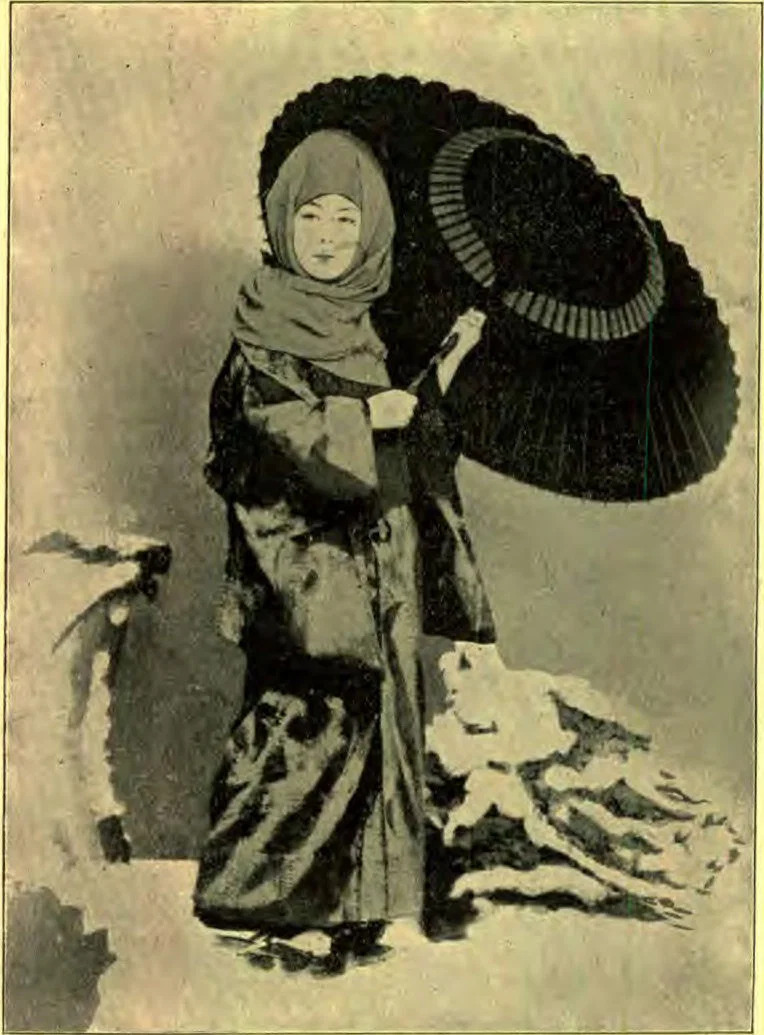
A YOUNG JAPANESE WOMAN
Perhaps you have an idea, as so many have, that Japan is warm everywhere. That is a great mistake. It is bitter cold in the north. There is probably as much variety of climate in the whole empire from north to south as from Canada to Florida. The western coasts are swept by Siberian winds, in the north. The eastern coast is warmed by the “black stream.”
I lived seven years in that cold northwestern region. The snow would drift to the eaves of the low houses. The winds blew cold. We were in a Japanese house. The outside wall was mostly of slides; then a wall three feet wide, and slides again.
You know the Japanese use no stoves,—just a box filled with ashes, and a handful of burning charcoal, sufficient to warm their hands over. Of course their houses, with these paper walls, are very cold. Flannel is not much used yet for clothing. The winter garments are made of much the same material as the summer ones, and wadded with cotton. Poor people wear these bulky garments night and day, with not a change the winter through. After a little while these heavy clothes have an exceedingly disagreeable odor.
A poisonous gas rises from burning charcoal. In some countries, people commit suicide by going to sleep in a tightly closed room where there is a pan of burning charcoal. Fortunately for the Japanese, their paper-walled houses, with a good many torn places, admit a great deal of fresh air; and so the people are to some extent protected from the poison of the charcoal fumes. But in that cold northern land it is very sad to see the old, the feeble, and the very young, come out of their homes in the spring, after being “shut-ins” during the severe weather. They look pallid and death-like. We could not live in such cold houses; so we had to put a stove-pipe through the paper screens, and have stoves in our homes.
LAURA DE LANY GARST.