AMERICANS, as a rule, are not proficient nor enthusiastic kite makers. I do not know why, unless it is that the stores do not often carry kites, and few boys make their own playthings. It may be that it calls for too much perseverance for the average boy; for until he learns the principles governing wind resistance and balancing, he will make many failures.
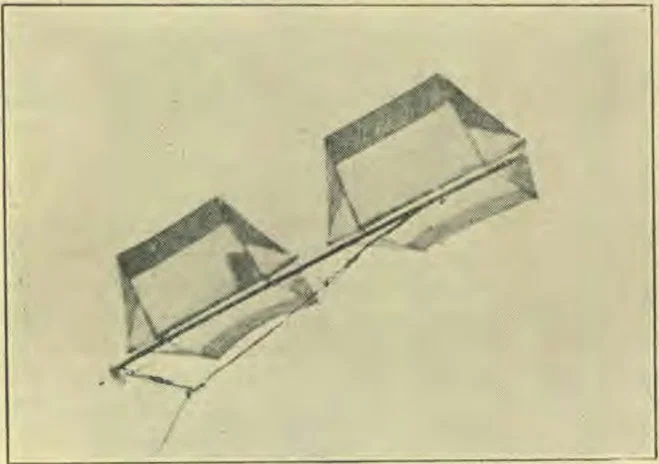
This contribution is not for the uninitiated unless it may happen to touch the right chord of response, but for those who have tasted the joys of success in kiting, and wish to go on. Just a general word or two. There are at least two ways of balancing kites, by tails and by planes. By balancing, I mean holding the lifting surface in the proper position to the wind. The common two-stick and three-stick flat kite must have a tail, while the so-called “box” kite is kept in position by vertical planes, acting on much the same principle as the rudder of a ship. The great objection to the tail kites is the tail. If properly made, the tail is long and inconvenient, frequently getting tangled and broken—an awkward servant for so simple a service. The ordinary box kite is a fragile affair, hard to make, and because of its rigidity and lightness, easily broken.
The kite pictured here has neither of the objectional features, awkwardness nor fragility. It is a wonder for endurance. While it has all the stability of the cross-sticker, it is perfectly flexible, either plane being able to oscillate with the wind independently of the other. In coming to the ground, it settles down gracefully like a bird, or dips like an aeroplane. It will go through a score of scrapes unharmed.
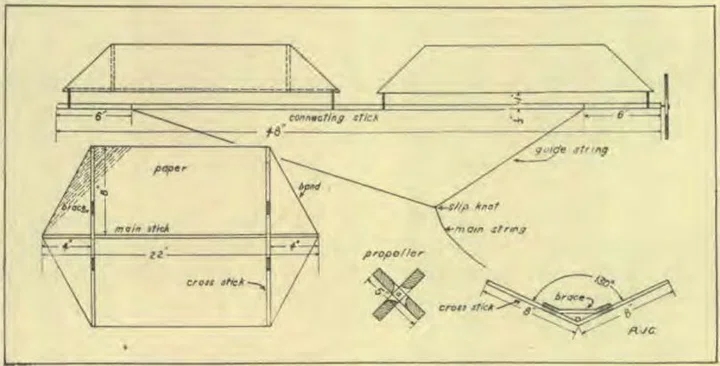
The principle is simple—two V-shaped planes tied to a long stick. For all sticks except the long connecting stick use the lightest material you can secure. For the long stick get a piece of hard wood. Each kite is twenty-two inches long and sixteen inches wide. It is best to make the cross sticks sixteen inches long, and wet and bend them in the middle before tying them to the main stick. The bend is about one hundred and thirty degrees. The braces are similarly wet, bent, and tied. Around the ends goes the bellyband, and then it is ready for the paper, which should be of a light, tough variety such as is used by grocers. It will spoil the best kite ever made to use heavy paper. Tie each kite or plane to the long connecting stick, as shown in the diagram. Put on a guide string, and fasten the main string to it so that the main string may be adjusted according to the strength of the wind.
If you have a light breeze, have the main string eight or ten inches from the top or front end; and if the wind is strong, slip it down toward the center. If the kite shows any tendency to dive or cut circles, it is quite likely that the main string is too far forward. Slip it back on the guide string. On the front end of the connecting stick you may put a little windmill for “effect.” It is possible that it may have a slight gyroscopic effect. For the main string ordinary carpet warp, which sells for about thirty cents a pound, will answer well. There are about three thousand feet in a half pound of it. If your machine pulls too hard for this twine, you have not made it properly. Try again.
O. C. DURHAM.