Glimpses of Burma — No. 2
The Elephants
R. B. THURBER
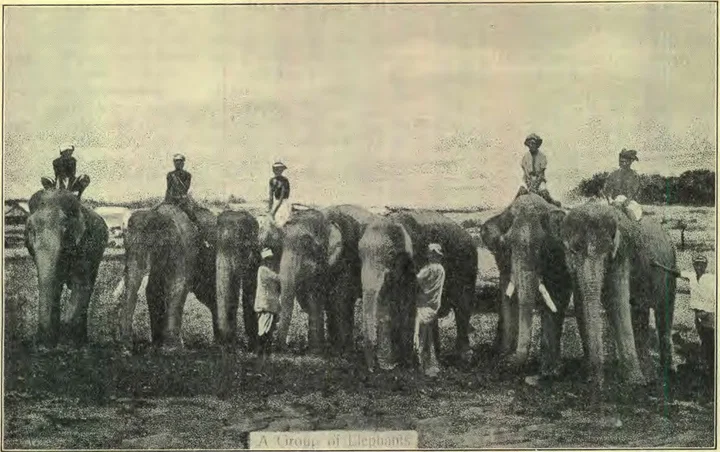
THE impression prevails in many countries that the chief use of the elephant is to look big, to carry around the reputation of being the bulkiest of land animals. It would indeed be a pity if such mountains of bone and muscle could not be harnessed to at least lean against the world’s work and help to make it move. To hundreds of the tame elephants in Burma, life is more than a circus or a zoo. Their deliberate movements and loosely hung skin often deceive one into thinking that they are awkward and clumsy; but rather they are capable of moving quickly, and of performing work which requires skill, intelligence, and delicacy. In this country there are still thousands of these beasts, the wild ones roaming in herds in the jungles, browsing upon the foliage, and at times sporting at the favorite baths in the rivers. Those in captivity are used principally by the large lumber companies, gathering and piling teakwood logs in the forests. The Karen people own many of them, and are expert in their handling. Their value here ranges from two thousand to four thousand dollars each.
A touching story is told of one of these huge log rollers which recently died here in Rangoon. His keeper had been with him for many years; and in his old age, though blind, the affectionate beast was very devoted to the man. As his last moments approached, the great fellow lay upon the ground and swung his trunk around as if reaching for something. The keeper knew what he wanted and came nearer. The trunk gently wrapped him round and drew him closer in loving embrace, while tears gushed from the eyes of both man and beast. In this attitude the huge body breathed its last. Those who saw it say this was a most affecting scene.
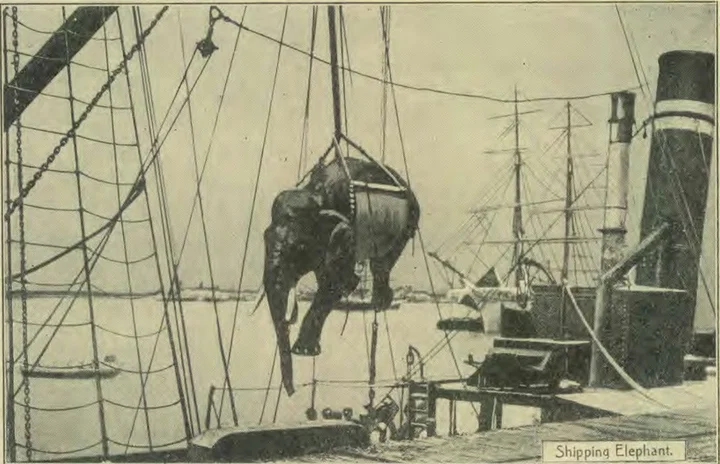
It is often necessary in lumbering operations to move these docile animals long distances to other parts of the country. They walk when possible, of course, but bodies of water present obstacles not easily overcome. Sometimes they are transferred from the wharf to the deck of the ship by means of a derrick. Elephants can swim the rivers even though they do not look as if they could, but they are likely to be very independent and obstinate. Recently we saw a novel way of getting a herd across the Salween River.
We had been doing some prospecting in the Karen country, and had returned the previous evening to the head of steam navigation at Shwegun. The Salween is one of the longest rivers in the world, but it cannot be navigated far because of numerous falls in its lower course. At Shwegun the stream was about half a mile wide at low water, the time we were there. The sixty miles to the sea is traveled in a day by little two-deck steam launches about seventy-five feet in length. We were on board all night, due to start downstream at 9 A. M. the next day. But at daylight steam was got up, and the boat started upstream. We were surprised, but soon saw the reason. In a few minutes we arrived at a place on the river where a high clay bank was topped by forest trees; and among them stood a herd of twenty-one elephants, many of them towering giants with long tusks. A crowd of Burmese and Karens stood on the bank — early comers to see the show.
At the water’s edge stood the first victim — a huge fellow whose small eyes blinked dubiously at the obvious prospect of a forced bath. He was fastened by the forefeet to two firmly set posts. A heavy rope was passed from the chain holding his feet together to the stern of the steamboat. A tin float, shaped like an ordinary harbor buoy, but only about three feet in diameter, was fastened on his back to help keep him on the surface. His keeper took the usual seat back of his ears. The signal was given, and the boat started across the river, soon pulling the rope taut. At this critical moment the fastenings were loosed from the posts, the driver gave a last prod before making a wild leap for the bank, and Mr. Elephant was drawn down the slippery incline into the water. He trumpetedp. 12 loudly with fear, and fought desperately to hold back and regain the bank; but steam power triumphed, and he was towed with ever-increasing swiftness into deep water. When beyond his depth, he disappeared entirely, only the float telling his whereabouts; and even it was dragged under at times. Then suddenly his trunk appeared with a snort, and, waving about wildly, quickly took on a snakelike curve and seemed to point an accusing finger at us as we stood at the back end of the steamer. Then the huge body rose and thrashed the water into foam as it rolled from side to side and over, struggling to get free. Again it disappeared as if to seek the river bed for a foothold, only to reappear and rest content to be dragged rapidly along near the surface, with the water pouring over the gigantic head as it pours over a smooth rock in a rapid river. Soon the opposite bank was reached, which was sandy and shallow far out. As the launch could not approach very near, the elephant was left for a minute floundering in about fifteen feet of water. Meanwhile a Burmese racing boat full of men had paddled at top speed with the driver from the other bank. Now they approached the big fellow cautiously, and at a favorable moment the driver adroitly jumped from the prow of the canoe onto the elephant’s head. Hastily setting free the float, he urged the beast toward the bank with peculiar twitchings of his knees back of the elephant’s ears. While this was being done, the rope was carried to the bank, and a number of men exerted their puny strength to tow him in. And he seemed to have no power nor inclination to resist.

The whole herd of twenty-one was taken over in the same manner. This way of doing it may seem cruel, and some men engaged in the business think it is. The animals looked none the worse for it, and some seemed actually to enjoy it. We could understand how they might if their forefeet had been free.
One of them, which was so unfortunate as not to have a float at his back, went entirely under as soon as he reached deep water, and stayed there till the other side was nearly gained. We could tell by the length and angle of the rope that he must have been about twenty-five feet down. As time passed and he did not come up for air, and seemed to hang as a dead weight, the owners became alarmed, and there was much shouting and ado; but beyond an extra powerful spout when his trunk appeared, he acted the same as did the others.
Another gigantic tusker was determined after the first outrage not to submit tamely to such indignities. When his driver gained his back and tried to prod and urge him to land, he wouldn’t go. Instead, he headed for the middle of the river. All the shouting and pulling by the men on shore hadn’t the least effect. He reached the current and swam rapidly downstream. The driver was game and held his seat, but he might as well have been a fly. The launch gave chase, when there was no other way, and after an exciting few minutes the runaway was rounded up half a mile down. He was so tired when he finally landed that he could scarcely walk.
Our boat was so late in getting down the river that we missed the train for Rangoon, but the sight was worth the sacrifice.