No. 3. Mr. Miller’s Work and Mistake a Subject of Prophecy.
ADDITIONAL light is thrown upon the advent movement previous to 1844, and even upon the mistake in connection with it, by the prophecy of Revelation 10. Here an angel is seen to come down from heaven and take his position with one “foot upon the sea” and the other “upon the earth,” holding in his hand “a little book open.” He cries with a loud voice, and even lifts his hand to heaven, and swears “that there should be time no longer.”163It is evident from the statements in this chapter that this prophecy represents that part of the great work symbolized by the first angel of the fourteenth chapter, which was accomplished previous to 1844; that is the proclamation of the hour of judgment come, based upon definite prophetic time. Deep love, perfect unity, and unusual power attended the preaching of the advent message during those years. Indications of these characteristics are seen in the rainbow (symbol of covenanted love and mercy) upon the angel's head, his face being “like the sun,” and his “feet as pillars of fire.” It is the testimony of those who experienced it that there was a presence and power of the Holy Spirit, fitly represented by the angel coming down from heaven upon the earth to deliver his message in contrast with giving it while flying through heaven, as do the three angels of chapter 14; yet a lack of completeness, a certain obscurity in the message he bore, may be indicated by the cloud with which he was clothed. The extent of the work is suggested by his standing with one foot upon the sea and the other upon the land; it went by land and sea.
The little book in his hand “open” very naturally directs the mind to a little book which was once sealed or closed “till the time of the end,” implying that then it should be opened. The Lord told Daniel concerning his prophecy, “Go thy way, Daniel; for the words are closed up and sealed till the time of the end.” Dan. 12:9. But, he says, at that time “none of the wicked shall understand; but the wise shall understand.” Verse 10. It seems plain, therefore, that the little book in the angel's hand was the book of Daniel.
As to the oath of the angel that time should be no longer—the close of time was preached with much positiveness, yet without understanding the true significance of the oath; for, from the statement of the angel at the close of the prophecy, it is plain that both literal and probationary time were to continue. He says to the church, in the person of John, “Thou must prophesy again before many peoples, and nations, and tongues, and kings.” The oath, then, must refer to the only other kind of time with which the Bible deals—prophetic time. With this understanding all is plain, for there is not to be found a prophetic period reaching beyond the 2300 days in 1844. Prophetic time is indeed no longer; and, therefore, any supposed prophetic dates reaching this side of that time are misleading and absolutely unreliable.
The angel evidently made his declarations upon the strength of the prophecies of the little book in his hand—the book of Daniel—but now John, doubtless as the representative of the church at the time, says to him, “Give me the little book.” The angel replies: “Take it, and eat it up; and it shall make thy belly bitter, but it shall be in thy mouth sweet as honey.” John, or, rather, those whom he represents, the church, did as directed. They feasted upon the prophecies of Daniel, and, as they fully believed that the time of their redemption drew nigh, they were filled with intense joy—it was indeed sweet in the mouth. But (to carry out the simile) those prophecies which brought to them so much joy and comfort in the expectation of Christ's immediate coming, had not been properly masticated and digested, and, as a natural consequence, bitterness was to follow, just as indigestion and bitterness of stomach follow hasty and careless eating of natural food.
A most bitter disappointment was in store for the believers in the precious truths of the little book. While they were fulfilling prophecy, and giving to the world the warning which must be given, a misapprehension of some features of the prophecy was preparing for them a bitter, bitter disappointment. The time passed and their hopes were not realized. Christ did not come, as they confidently expected. They now became a byword, and the objects of ridicule and contempt. Truly that which had been so sweet had suddenly become most bitter.
The work, however, was not to close thus. There was to be to the church another experience of like character, without the disappointment and bitterness, for “he said unto me, Thou must prophesy again before many peoples, and nations, and tongues, and kings.” A work characterized by the same love, unity, self-sacrifice, devotion, and consecration, together with the manifestation of the mighty power of the Spirit of God, symbolized also by a mighty angel coming down from heaven, will again attend the preaching of the “everlasting gospel,” and the worship of “Him that made heaven and earth.”
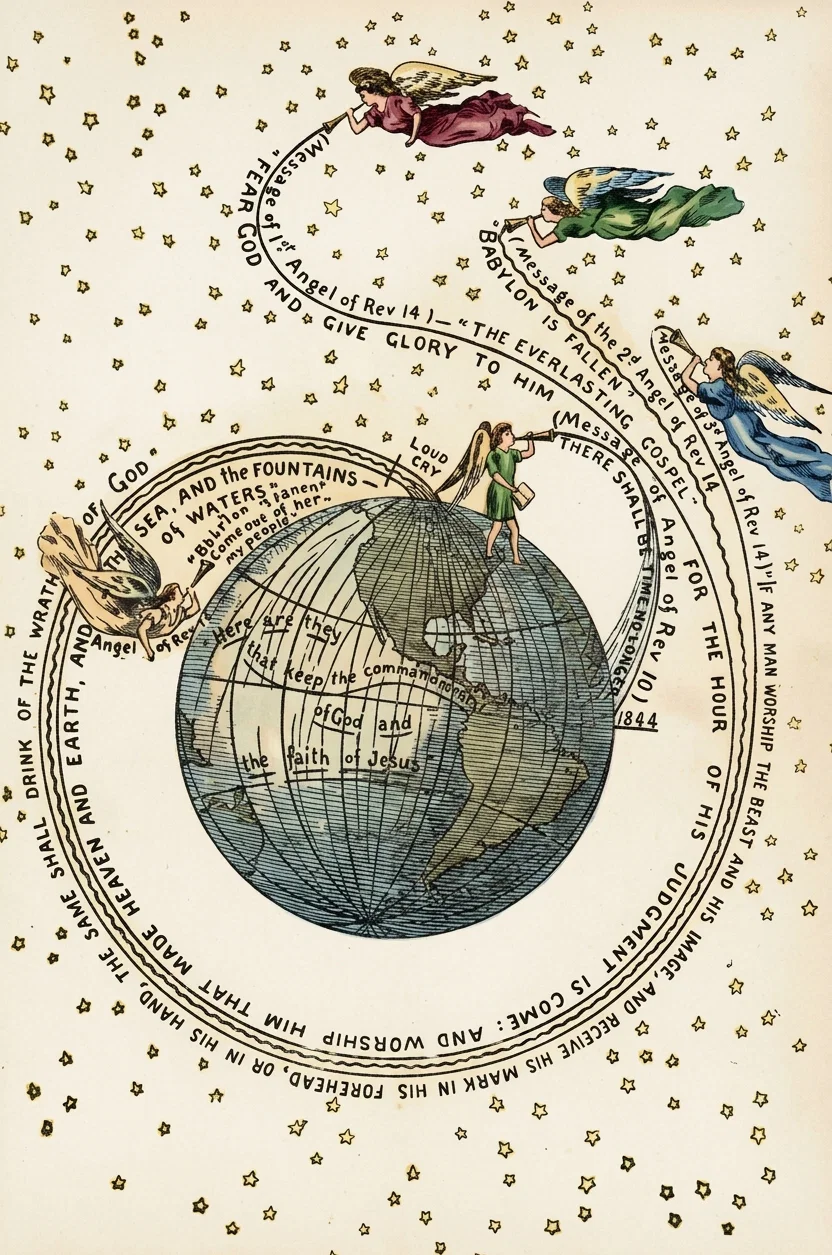
THREE MESSAGES
“I saw another angel fly in the midst of heaven.” “And there followed another angel. . . . And the third angel followed them.” Rev. 14:6, 8, 9.
NOTES UPON THE ILLUSTRATION.
1. THE first message begins previous to 1844, announcing the hour of judgment, but continues to the coming of Christ, proclaiming the gospel and the worship of the true God (the commandments) as the basis of the following messages. 2. Simultaneously with the opening of the first message, and as a special feature of its introduction, it is joined by the message of the angel of chapter 10, which continues to 1844 and ceases. 3. Subsequent to 1844 the truths of the first message became more fully understood and preached, though generally rejected, and as a consequence it is joined by the second message, proclaiming the fall of Babylon, which also continues to the end. 4. Later the two are joined by the third, warning against the worship of “the beast” and his image and the reception of his mark, and also continues to the end. 5. Just before the end of gospel work the three are joined by the message of chapter 18, announcing the complete fall of Babylon, and calling upon God's people to come out of her because of her sins. This in effect produces a loud, earnest, and extended giving of all three messages combined, resulting in the lighting of the earth with all truth, and the development of a company keeping all the commandments of God and the faith of Jesus, and fully prepared to meet Christ when he appears in the clouds of heaven.
While the message of the first angel of chapter 14 is thus introduced with power and glory, as indicated by the prophecy just considered, announcing the hour of the judgment, and the close of prophetic time, its sounding through the earth continues, developing fully every feature of the “gospel” and the “commandments of God,” as it is joined by the second and third, until, as probation is about to close, a “mighty angel” (possibly the same as the angel of chapter 10) “comes down from heaven,” not “clothed with a cloud,” but lighting the earth with his glory, and unites his voice and strength with the work symbolized by the three angels, which causes it to close with the same spirit and power with which it opened. Thus the church will prophesy again, as in the opening of the message, only with increased power. It is then that the first and third messages will together and at the same time go with a loud voice, presenting the “everlasting gospel” and “the commandments of God” in their fullness, and the fearful warning against the worship of the beast and his image in its completeness, developing the company spoken of in chapter 14, verse 12, who “keep the commandments of God and the faith of Jesus.”
This closing work is presented in chapter 18:1: “And after these things I saw another angel come down from heaven, having great power; and the earth was lightened with his glory.”