The voice was childish and sweet-toned, but a little unsteady. The man glanced down from under the brim of an old felt hat that had once been white, and a pair of soft, large eyes looked up into his.
“Shine your boots, sir?”
The man shook his head as he uttered a brief No, and passed on.
But the tender face and soft, asking eyes haunted him. After walking on for a little way, trying to forget the face and eyes of the little boy, he stopped, turned, and went back, he hardly knew why.
“Shine your boots, sir?”
It was the same innocent voice, but a little firmer in tone. The man looked down at the bare feet and worn clothes, and a feeling of pity touched his heart.
“Not this morning, my lad,” answered the man, “but here is the price of a shine,” and reached him a penny.
“Have not come to that yet!” And the lad drew himself up a little proudly. “I am not a beggar, but a shoeblack. Just let me shine them, sir. Won’t keep you a minute.”
There was no resisting this appeal. So the man placed his boot on the boy’s foot rest, and in a little while its surface was like polished ebony.
“Thank you!” said the little fellow, as, on finishing the second boot, he received his fee.
The man walked away, holding in his mind very distinctly an image of the boy.
The next morning, while on his way to business, he was greeted by the same lad with: “Shine your boots, sir?” and in a voice steadier than that of the day before. The little bootblack was gaining confidence in his new calling.
The man stopped, placed his boots on the boot rest, and the boy set his brushes to work in the liveliest way.
“Where do you live, my little man?”
The boy brushed on, seeming not to have heard. As he finished one boot, and was about commencing the other, the man said, changing the form of his question:
“Where is your home?”
“Haven’t got any.”
“No home?”
“No, sir.”
“Where do you sleep?”
“Most anywhere that I can creep in,” replied the boy, as he brushed away with all his might. Then, as he rose up, he said, with a business air,—
“That is a good shine, sir!”
“First-rate,” answered the man, whose interest in the boy was increasing. “It cannot be beaten. And now what is the charge?”
“A penny, sir.”
The penny was paid.
“Sleep almost anywhere that you can creep in?” said the man. “What do you mean?”
“Well, sir, it is so. Sometimes I get a bed in a cellar, and sometimes in a garret, just as it happens.”
“Do you pay for it?”
“Oh, yes, indeed. One cannot sleep for nothing.”
“How much do you pay for a bed?”
“Threepence or fourpence, according to where it is.”
“Why don’t you stay in one place? Why do you go from cellar to garret?”
“Because, sir, they get drunk, and fight and swear so almost everywhere I get in that I do not care to go again, and so I keep moving along. Shine your boots, sir?”
And, seeing a customer, off the boy ran, for he had his living to earn, and could not stop to talk when there was business to do.
The man walked away more interested than ever in this brave little fellow, at so tender an age fighting the battle of life.
A few hours later in the day,—it was midsummer, and the air was hot and sultry,—as this man was passing the corner of a street where an apple woman had her stand, he witnessed an interesting scene.
The apple woman had fallen asleep. Two boys—a newsboy and the little bootblack just mentioned—were at the stand. The newsboy, who was larger and stouter than the bootblack, seeing a chance to get apples without paying for them, was seizing two or three of the largest, when the little bootblack pushed bravely in, and the man heard him say:—
“That is stealing, and can’t be done.”
The newsboy grew red with anger as he turned fiercely upon the little fellow, raising his fist to strike him; but his well-aimed blow did not reach the soft, yet bravely indignant face, for an arm stronger than his caught the descending fist, and held it for an instant with a firm grip. In the next moment the scared newsboy had broken away, and was scampering down the street as fast as his legs could carry him.
“That was well done, my little fellow!” exclaimed the man, turning to the young bootblack. “And now,” he added, “you must come to my warehouse.”
“Where is it, sir?” asked the boy.
“Not far away. Come,” said the man as he moved on; and the boy followed. They walked a distance of two or three blocks, and then entered a counting-house, the man moving along through the bales and boxes until he reached a counting-room at the back. Taking a chair, he turned to the lad, who now stood before him with a curious, wondering face, his foot rest, containing brushes and blacking, slung across his shoulders.
“Take that thing off, and set it out in the warehouse, or throw it into the street, I do not care which,” said the man, pointing to the dirty box.
The lad took it off and set it outside the office door, then came back and stood gazing at the man earnestly.
“What is your name?”
“Jimmy Lyon, sir,” said the boy.
“Is your father living?”12
“No, sir.”
“Your mother?”
“She is dead.”
“How long has she been dead?”
“Not long, sir.”
“And there is no one to take care of you?”
“No, sir.”
“How old are you?”
“Eleven last June, sir.”
The man thought of his own little boy at home, just eleven last June, and a shiver of pain crept through his heart.
“What are you going to do?”
“Take care of myself, sir. I have got to do it now.” And Jimmy drew himself up, and put on a brave look, which touched the man’s heart.
“Was it in this city your mother died?” inquired the man.
“Yes, sir.”
“How long ago?”
“It is only three weeks, sir.” The brave look went out of his eyes.
“Where did she die?”
“Down in Water Street. She was sick a good while, sir, and could not work. Father died last winter. But he did not do anything for us.” A shadow of pain was in the child’s face, and the man saw him shudder.
Ah! he understood too well the sad story that the little boy could tell—the story of a drunken father, and a sick, heartbroken mother, dying in want and neglect.
“Your mother was good, and you loved her?” said the man.
Instantly the large, soft eyes were filled with tears.
“What did she say to you before she died?” asked the man, speaking in a low, tender voice.
“She said,” answered the boy, sorrowfully, yet with something brave and manly in his voice, “‘Never steal, never tell a lie, never swear, Jimmy, and God will be your friend;’ and I have not done any of them, sir, and I never will.”
“Your mother taught you to pray, Jimmy?”
“Yes, sir; and I say my prayers every night. Sometimes boys make fun of me, but I do not mind it. I just think it is God I am saying them to, and then I feel all right.”
The man felt a choking in his throat, he was so moved by this, and would not trust himself to speak for some moments.
“God is our best friend, Jimmy,” he said, after a little while; “and no one trusts him in vain. He has taken care of you since your mother died, and if you will be a good boy, he will always take care of you. Do you know that it was God who led me to the apple woman’s stand just in time to see your brave and honest act?”
The boy opened his large eyes wonderingly.
“We cannot see God, but God can see us; and what is more, can look into our hearts, and knows all we think or feel,” continued the man.
“Oh, yes, sir! My mother told me that. But I do not know how he led you.”
“He leads us by ways that we know not, my child. I think I can make you understand. God sees and knows everything. He knew that you would see the wicked boy try to steal the apples, and that you would do all you could to stop him. Then he put it into my mind to go and see a man whose place I could not reach unless I went by the apple stand, and this brought me to the spot just at the right moment. I call that God leading me. Now do you understand?”
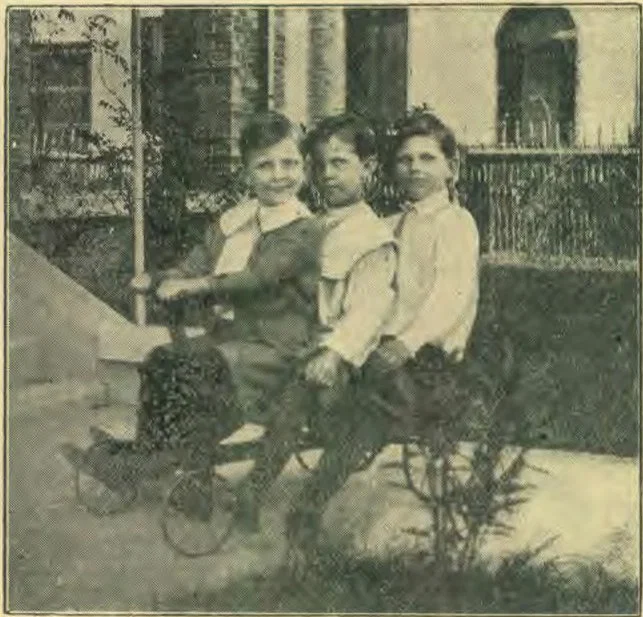
THE SONS OF ELDER JAMES SHULTZ, NOW A MISSIONARY TO CHINA
“Oh, yes, sir, I see it as clear as day!” answered Jimmy, a new light breaking over his face.
“And God, who loves you, and wants you to be good and happy, knew that if I saw how honest and brave you were, I would be your friend.”
“Oh, sir, will you?” cried out little Jimmy, his fine face lighted up suddenly with hope and joy.
“Yes, my boy,” answered the man, whose heart was feeling very tender toward the child; “I will be your friend always, if you will be honest, obedient, and truthful.”
“I shall try to be as good as I can, sir,” said Jimmy, almost losing command of his feelings.
Then the man went with him to a shop where boys’ clothing was sold, and selected everything he needed to wear. But before he let him dress up in his new garments he took him to a bathhouse, that he might wash himself clean all over, and comb the tangle out of his curly hair.
No one would have dreamed that the handsome, well-dressed boy, who, a little while afterwards, walked beside his new friend, was the same whose voice scarce an hour before had been crying in the street, “Shine your boots, sir?” God had sent the brave child, who tried to be good, a friend in need, and he is now a happy boy, studying with all his might, intending to become a good and useful man.—The Good Templars’ Watchword.