Galileo
GALILEO, one of the earliest and greatest experimental philosophers, was born at Pisa, Italy, in 1564. His father was descended from a notable family which once ruled the state, but lost fame, and its descendants became impoverished when the empire declined. The father was a mathematician and was versed also in music. Inheriting some of his father's ability, the lad early displayed an intellectual aptitude for constructing mechanical toys.
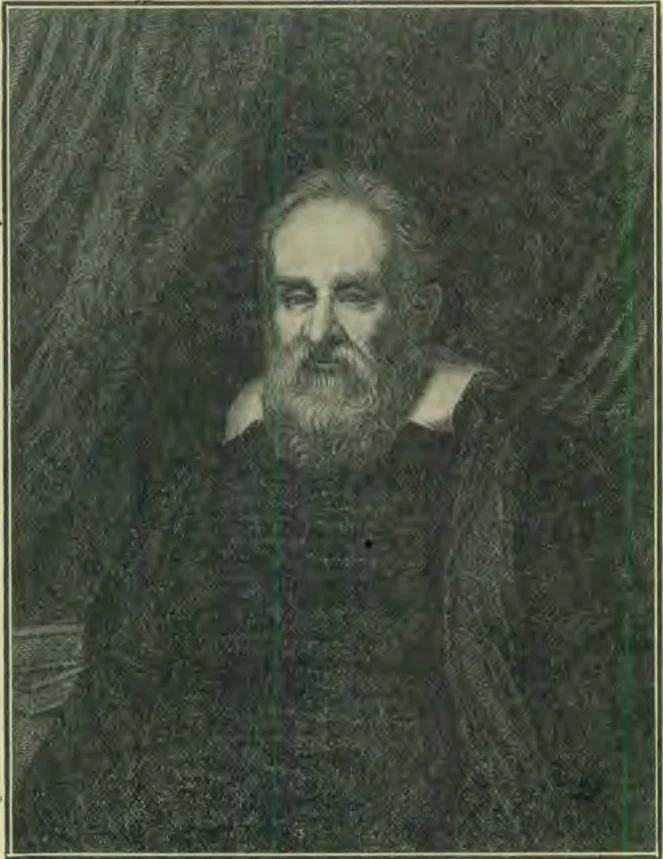
Galileo was sent to the monastery of Vallombrosa, where he mastered the Latin and Greek languages. One of the monks tried to teach him logic, but this proved uninteresting, and was summarily abandoned. Under the influence of the monks he decided to take holy orders, but his father, not favoring the idea, and desiring him to study medicine, withdrew him from the monks' influence, and sent him to the University of Pisa when he was eighteen. Not caring for medicine, Galileo took up any line of study that seemed to please him. In music he became proficient, ranking with the best professors in Italy; he liked painting, and he had wit and eloquence that promised to the country literary glories.
When twenty years of age, he noticed a brazen lamp suspended from the chapel ceiling, swinging; he observed that the oscillations, whatever the length, were invariably executed in equal times. This important discovery led him to construct a clock fifty years later. His father, desiring that nothing should interfere with his medical work, had kept him ignorant of the study of the higher mathematics, but by chance Galileo heard a lecture on geometry, whereupon he decided that from henceforth he would devote his attention to mathematics. He was soon withdrawn from the university, and the next that we hear of him, he was lecturing before an academy in Florence. He was later elected to the chair of mathematics at Pisa, where he demonstrated to his contemporaries, by the use of the leaning tower, that bodies of unequal mass fall at the same rate. The enmity he aroused by this demonstration led to his removal from the university. His father having died, and the charge of keeping the family falling upon him as the eldest son, he was very glad when offered the same position in Padua as he had held in Pisa.
Here he remained for eighteen years, having much prosperity. Great educators from all over Europe came to hear his lectures, a hall to seat two thousand persons having been built for his express use. He here invented the proportional compass, and also the thermometer. This thermometer had an open tube; it was hermetically sealed later by another man; and later still, mercury was used instead of water, which completed the invention of the modern thermometer.
In a letter to Kepler, Galileo states his belief in the Copernican theory, which claims that the earth with the planets revolves around the sun; but to avoid ridicule, he continued teaching the Ptolemaic theory. He confirmed his opinion of the Copernican theory by the use of the telescope. Galileo was not the discoverer of the telescope, but he increased its range from threefold to thirty-two. He manufactured telescopes and sold them readily. Through his telescopic observations certain theories concerning the Milky Way were abolished, Jupiter's satellites were discovered, and the Copernican theory was given a base upon which to rest. He left Padua to go to Florence, and soon was elected head mathematician and philosopher to the nation, with the salary of one thousand dollars a year,—a fortune in those days,—and he had nothing to do but to continue his experiments. In 1610 he discovered the rings of Saturn, the phases of Venus, and the sun spots. These discoveries were the result of much laborious effort. He went to Rome, and before the pontifical majesties in the Pope's garden, gave a lecture on the Copernican theory, using his telescope to demonstrate this theory. He received encouragement from them. and was flattered by their offers; so when the question of harmonizing the Bible with this theory came up for consideration, he of course took his side, but to the astonishment of all, found the influential pontiffs against him. His writings and ideas were condemned, and he was told not to teach such absurd doctrines longer. Galileo returned to Florence, and was little heard of for eleven years. During this time, however, he wrote a treatise on comets, which, being received with favor, led to his reinstatement.
Sixteen years after the edict against his theory, he thought that the age was ripe for the edict's overthrow, so he published a renowned work concerning this theory. This work received instant recognition by the people; but the sale of the book was prohibited by church authorities, and he was ordered by the Pope to come to Rome. He pleaded his age, as he was over seventy, but the Pope persisted. He was tried before the cardinals and found guilty. The cardinals knew that he was right, but it would cause them top. 9 lose power if they should concede, so they made him do penance by reciting once a week for three years seven penitential psalms. This sentence was signed by seven cardinals, but never received the customary ratification. He was sent away from Italy, but was allowed to return to Florence, where he lived in seclusion the remaining years of his life. His last telescopic discovery was that of the moon's diurnal and monthly librations. He was two months later stricken with absolute blindness, but his good reason and logic remained with him to his death, on the eighth of January, 1642; and the coincidence of the day of his birth with that of Michelangelo's death was paralleled by the coincidence of the year of his death with that of the birth of Sir Isaac Newton.