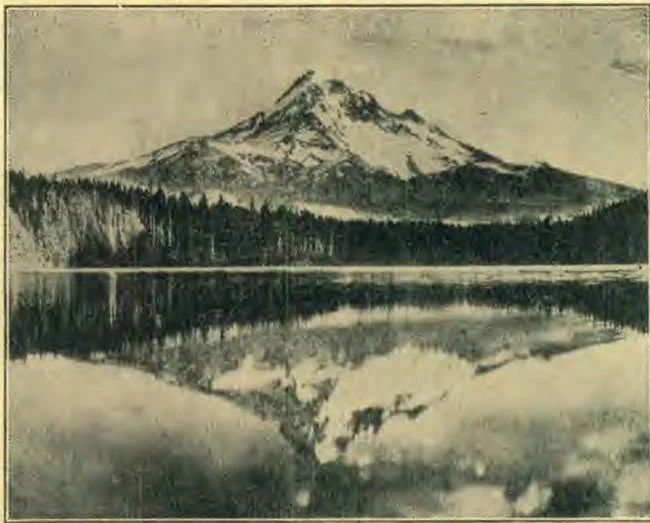
MT. HOOD is one of the most visited snow peaks of America. Its glistening summit is a constant challenge to the sight-seeing stranger, and an invitation to the native Westerner, for mountain climbing is a fascinating pastime. In a recent issue of Sunset, Hamilton M. Laing describes the start from Government Camp, after a night spent in the open, and his experiences on the ascent and descent of this skyscraper of Oregon. We give an excerpt of his story for the edification of the uninitiated:
“We were off at 2:45 A. M., and toiled up the wood path through the scattered timber. There were six of us, including Hans, the guide. Two parties from Portland had beaten us on the start; a yell or halloo ahead anon broke the mountain quiet; a flash glinted here and there, though the moonlight was so strong that our guide did not light the lantern he carried.
“The first flowers were bidding good morning as we emerged from the timber; then the sky grew yellow; Sol peeped over a ridge; it was morning. Flowers appeared all about us. We had left the tall lupine and the Mariposa lilies and squaw grass down in the timber; but here were beds of phlox, white and pink, fuzzy spraguea, short-stemmed purple asters, and masses of frost-tinted polygonum lying like orange and crimson rugs upon the ash-gray hills.
“The other parties toiled up the snow ahead of us; a far yell or yodel came drifting back with a strange hollowness in the morning air. Then just before we took to the snow fields, Hans mounted a small rock and said, ‘Now I will give them a call,’—with a trifle of emphasis on the ‘I,’—took in a barrelful or less of mountain air, threw up his head, and let go. I can no more describe that yodeling melody or its effect on me than I can paint a sunset. I know it sent the prickles running strangely up and down my spine, as music has done but rarely. I had heard this musical juggling before, but I had never heard Swiss Hans yodel in the mountains. It was the proper setting. He gave half a dozen calls, each seemingly better than the last.
“I was charmed; I would learn to yodel or I should know why! During the next hour I myself awakened a whole legion of slumbering echoes. Unheeding the agony in the faces of my comrades—we wore grease paint and amber goggles anyway—and the smiles of the Swiss, I yo-o-o-odel-odeled till I was hoarse. . . . But when I had ended with a throatful of frogs, Hans eased me down with the solemn assurance that it had to be ‘borned in you.’ I understood then that I had been ‘borned’ without it.
“Then we tackled the snow fields, . . . and as we toiled toward Crater Rock the going became stiffer. The haul up the wire cable hand over hand brought extra fatigue, and the ascent was covered in short drives. The climb begins to be more real here; the breath comes fast; the heart hammers and pounds; the senses grow dizzy in this light ether, and it needs no guide’s warning at such times to hold the climber back. Our trouble now was in getting ahead. . . .p. 7
“It is fine to be a greenhorn and get impressions new and first hand. . . . Even in this barrenness there were living things. Grasshoppers, beetles, and moths, mostly dead and long in cold storage, but a few alive, were observed on the snow. Some large buzzing fly that none of us could capture followed us noisily at times. Several butterflies were seen flitting around the sun-warmed rocks; and later as we rested at Crater Rock an able-bodied daddy longlegs was found walking at his grandfather gait over the rocks! It is easy enough to account for the presence of the migrant birds, but the live grasshopper on the snow and the vegetarian spider miles beyond the last sprig of vegetation, were puzzlers.
“The southern ascent of Hood—and mountaineers say that it is a very easy peak to climb; a good one for beginners—passes up through the throat of a great volcano that long ago poured out its material to build the mountain. The southern side of the mountain is missing, . . . but part of the rim remains. This is the sharp tip that pleases the eye of the thousands who see it from the valleys. Crater Rock is the mound in the heart of the old crater left by the last throes of the dying volcano. It is a wild spot. Steam and sulphurous vapor issue from holes here and there. The air is laden with a smell that suggests an interrelation of laboratory, naughty student, and hydrogen sulphide.
“After we had rested at Crater Rock and eaten chocolate and stiffened our knees with a sandwich each from the hamper Hans carried on his broad shoulders, we journeyed upward and along the hog-back or snow ridge toward the crevasse. Small bits of rock chased each other down the white slope in such close succession that they seemed alive.
“Then the thing happened that Hans had warned us might befall ‘if we were not careful.’ Friend J—— said that he felt horrible; to look at him was to believe him. Our guide and comforter explained that many climbers got sick, that mountain sickness was a twin brother of seasickness, a harmless ailment but dreadfully unpopular. Friend J—— just wanted to lie there in the snow and die. He besought us to leave him; and indicated brokenly that when he could get his stomach back to its old moorings he would start downward. It is plainly useless to argue with a man when he has mountain sickness, so we waited till he felt better and said he would try to make the summit. And he did.
“The last hour brought the toughest work of all. At the edge of the ascent we came to the crevasse. A ladder and rope were across the gap, but Hans went ahead and fixed everything securely. A new snow had recently fallen, and the light was dazzling. To remove the amber glasses for a few moments meant eyestrain; to expose the skin unprotected for any considerable time meant sunburn almost as severe as a scald. Hence the grease paint.
“The last thousand feet was the hardest pull of all, much of it being hand over hand on the ropes. A few feet at each drive was quite enough. Up, up, another heave or two, with rests between, and it was over. To climb such a mountain is not an achievement, but it is gloriously good fun. It was now exactly noon. We were on the summit on the edge of this old crater rim, 11,225 feet on high, the loftiest spot in Oregon.
“As for the view itself from this mountain top, words are cheap and impotent. It is easy to tell that the sun shone from a sky that held not a vestige of cloud; that the glaciers rolled away far below to divide into their respective canyons and feed a dozen rivers in the green timber; that we could look into the famous Hood River Valley and out upon the mighty Columbia; or even turn about and sweep the swelling blue Cascades 7,000 feet below us, ridge on ridge lying in a maze of blue overcuttings and fading off into the mellow haze that intermingled earth and air; that the very world seemed spread out below us, and we saw it now as the eagle sees it; that the white mountain gods of the West lay off in the distance: St. Helena, Adams, mighty Rainier, with their glistening heads high over the haze that mantled the valleys; easy, but all this does not tell what I felt.
“We rested a little time while Hans flashed a mirror signal to the watchers at Government Camp, and then we set off downward. Hans knew the short cuts, and led off down the slopes like a wild torpedo. The climber is supposed to play himself on the return, and our guide showed us how. With alpenstock for rudder and drag or brake trailing behind, you sit down or lie down and toboggan. You may slide, roll sidewise, or end over end, but you always get down. It makes no difference whether you are under twenty or over fifty and the father of a family; in four seconds you go down a slope that on the upward journey took an hour of siege. No one would have guessed now by looking at Friend J—— as he delightedly bored the snow out of his ears, that scant three hours ago he had voiced a wish to die.
“By 4 P. M. we were back at Government Camp. I bivouacked at a little mountain stream several rods up the trail from the hotel, and had the night with the moon and the glistening ghost mountain, with thrushes for comrades and the chattering water for a lullaby when I dozed; and in the bright morning, after breakfast and a visit from the mountain jays and chickadees, I set off on the back trail and spent a whole golden day on it, as though time in these mountains was simply made to waste.”