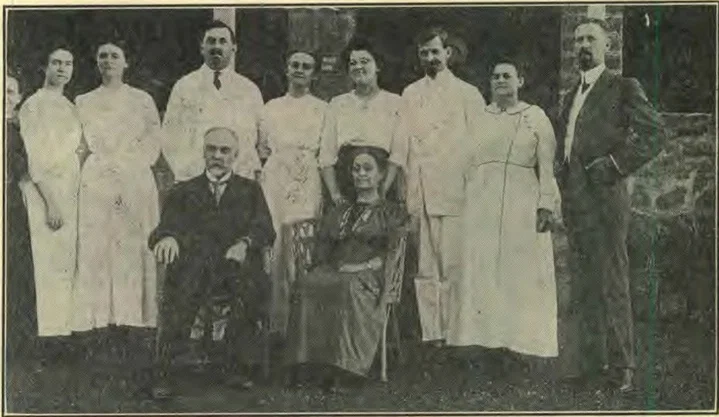
A. G. DANIELLS
In West India we visited the Kalyan dispensary for the Marathi people. The work here is carried on by Elder and Mrs. M. D. Wood. Kalyan is a city about thirty miles from Bombay. It is a desolate place, and the people are the poorest of the poor and the lowest of the low. After Elder Wood had taken me around, I said to him, “Are there any people in India lower than these?” He replied, “None that we know of.” Here is the lowest stratum known in India. And I am glad that our people were the ones to open up this field. Other missionaries have accused us of proselyting, but they can never say that we have done that among this people, because no missionary has ever before ventured among them. It was not considered safe; but our workers went in and are doing a good work.

We arrived at Kalyan early in the morning, and when we reached the dispensary there were perhaps fifty persons waiting for it to open. The first thing the mission people did was to throw open the doors and gather as many as possible into the large waiting room. There a native brother gave a Scripture reading, talked for perhaps twenty minutes, and offered prayer. Then the people were sent out, to come in again for treatment. Miss Reid, a nurse, had a desk at one side of the room, and received the patients as they came in one by one. In a large book she entered the name and address, with other information which might be useful in following up the case. The patient then received a card bearing his name, and was passed on to Sister Wood, who had her desk in the center of the room. She gave him an examination, and if only a little attention was needed, a nurse having her desk at Sister Wood’s right attended to it. The more complicated cases were sent to the rear of the building, where separate rooms were arranged for treating men and women. There are also accommodations for a very limited number of people who are so sick when they arrive that they must stay awhile, or until they die.
While I stood there, a young man was carried in who was in great agony. He was groaning terribly. Sister Wood had him taken at once to the treatment room, and she followed as soon as possible to see what could be done for him. He had stepped on a thorn or something sharp, and his foot was terribly swollen. Sister Wood said, “This must be lanced at once,” and she directed the woman who was with him to hold his head still, and the two men to hold his arms and body. Then she took a long, sharp instrument and ripped the abscess open. Of course it hurt dreadfully, and the man made a serious fuss, but it had to be done. I said to Sister Wood, “But don’t you give an anesthetic, or something to deaden the pain?” “O no,” she said, “I have no one to give it if I had it, and no money with which to buy it if I had some one to give it. I am compelled to do this way.”
And so Sister Wood went on through an endless routine, the sick people coming before her one by one. Seventy-five persons were attended the day we were there. She comes in contact with every form of disease. I saw her open a man’s shirt, look him over, and shake her head as she passed him on. I asked, “What is the matter with him?” and she said, “O, he has leprosy badly!” He was given a little medicine to satisfy him, and passed on. As Brother Wood took me around through the village, we saw people laid out in front of their homes to die—placed right in the streets. I inquired, “Why is something not done for them?” He said, “There is no doctor. We cannot reach them all. They do not know what to do, and when they get in that condition they are left to die.”
As I looked over the records I found that sixteen thousand persons had been attended by Sister Wood and her helpers during the last year. I found that in order to do this she had gone out to over eighty villages and into 975 homes, to visit and work for the people.
In the evening we went to a hilltop just out of Kalyan and saw villages lying in all directions. In these live thousands upon thousands of persons waiting to be led out of the darkness of heathenism. They have no schools, no doctors, no one to help them, and to me the situation is terrible. Missionaries have been working for a hundred years in Bombay, but they have never done anything for the people of Kalyan and vicinity.
Besides the work at the main dispensary in Kalyan, Sister Wood spends one day of the week in similar work in a large town about sixty miles away. She is granted a pass on the railway to and from this place. After working all day in Kalyan, she boards the train, spreads her blanket on the seat of a compartment, and, throwing herself down upon it, tries to sleep until her destination is reached in the early morning. Then she gets up, freshens up a bit, and goes to work, keeping at it all day. In the evening she rests on the train again, and is back at Kalyan the next day for her full quota of work.
Our church in Kalyan has fifteen members, and the workers there have earnestly set their hearts on building up a strong center at that place.