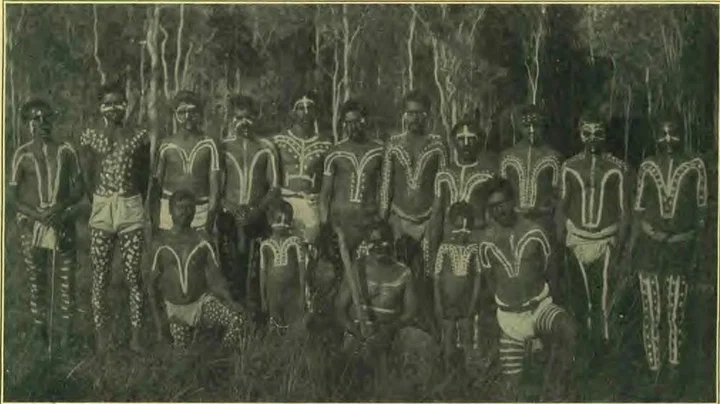
The first European ships which touched at the shores of Australia, came in the sixteenth century. It is not known with any certainty who was the Columbus that discovered this wonderful continent of the southern seas. What is known is that Portuguese, Spanish, and Dutch ships were spreading their sails to catch the winds which would carry them to any land where they could establish their trade. Time after time these ships sighted the coast of Australia, some of them sending their boats to shore to reconnoiter for water or fresh food, but going away again quite ignorant of the fact that it was anything but an island which they had reached.
The records give us no glimpse of the natives until the daring Dutch sailor, Tasman, rounded the island far to the south, which now bears his name, but which he called Van Diemen’s Land. He and a small crew went ashore, and there discovered traces of living beings.
Over the hills curled a wreath of blue smoke; a conch shell sounded afar; in the trunks of the trees growing on the shore were notches cut five feet apart. From this last they concluded that the natives were giants, and they discreetly put back to their bluff-bowed boat without having seen any of the dark people whose later history was to be written in blood and cruelty.
More than fifty years after this, the English king sent out the “Roebuck,” with the explorer Dampier in charge, to learn what he could about the strange land of which there were so many vague rumors. For four months Dampier cruised along the barren western coast, making rambling visits ashore. His reports of the land were no more favorable than had been those of the Dutch navigators before him. The land was sandy and waterless, dreary and desolate, to the eye of an Englishman.
To the keen dark eyes of this buccaneer and scholar of two centuries ago, the aborigines presented anything but a pleasing picture. In the report which he wrote when he returned to England his description was:—“The inhabitants of this country are the most miserable people in the world. The Hodmadods of Monomatapa, though a nasty people, yet for wealth are gentlemen to these; and, setting aside their human shape, they differ but little from brutes. They are tall, straight-bodied, and thin, with small, long limbs. They have great heads, round foreheads, and great brows. Their eyelids are always half closed, to keep the flies out of their eyes, they being so troublesome here that no fanning will keep them from coming on one’s face; and without the assistance of both hands to keep them off, they will creep into one’s nostrils, and mouth, too, if the lips are not shut very close. So that, from their infancy, being thus annoyed with these insects, they do never open their eyes as other people do; and, therefore, they cannot see far, unless they hold up their heads as if they were looking at something over them. They have great bottle noses, pretty full lips, and wide mouths. The two fore-teeth of their upper jaws are wanting in all of them, men and women, old and young; whether they draw them out I know not. Neither have they any beards. They are long-visaged, and of a very unpleasing aspect, having no one graceful feature in their faces.”
The first unfavorable impression of the blacks of Australia has never been wholly effaced from the minds of Europeans. Nor have the flies improved on closer intimacy; at certain seasons of the year they are a plague in the land.
There are estimated to be about two hundred thousand natives on the continent, the most of them living outside the settled parts of the commonwealth. Tribes of them occupy the semidesert lands of central Australia, and these come only into occasional contact with the whites. In Queensland there are many camps of them, skirting the edges of the settlements, and living far back in the bush-clad hills.
In the east and southeast of the continent, they are fast dying out; but in other parts, where the whites are few, as in the far north of Queensland, in the Northern Territory, and, in the northwest, they still flourish in a more or less wild state. Year by year the white population pushes back from the coast and brings more land under cultivation for flocks and crops. This destroys the game and wild food upon which the blacks depend. And, as they mix with the settlers, they contract diseases which their uneugenically-born bodies cannot resist, and they fall into habits which, though perhaps harmless to white races, prove deadly to black ones.p. 9 They are, too, bringing about their own extinction by carelessness and ignorance in the rearing of their infants. It is not unusual for their little ones to be done away with, as they are a nuisance to the mothers already heavily burdened with the hard work, which all falls to them.
Whence came this people, so few in number compared to the vast continent they have overspread, and so low in civilization, is a question yet unanswered. Their traditions or legends throw little if any light on their ancestry, but it is pretty certain that they were not the original owners of the soil. Their predecessors were probably driven south across the wind-whipped Bass Strait, to the island of Tasmania, where they have become extinct within the memory of our own generation.
The present blacks may be descendants of more than one race, there being several theories on the subject, each of which is vigorously maintained.
In all probability the facts can never be fully determined , but there seems little objection to the theory that they came in canoes from the tropical islands to the north, having drifted or been storm-swept across Torres Strait. Having passed down Cape York Peninsula, they spread out at its bottom fanwise, along three main routes of travel. There is a natural highway across Australia, from northeast to southwest. Some took this route, first ascending the rivers on the northeast and then descending those on the southern watershed, while others crept down the eastern and western coasts, until all converged about Lake Eyre. The traveler who fares across the great table-land, say from St. Vincent Gulf to the Gulf of Carpentaria, finds himself continuously among tribes whose customs are similar. There is, too, a uniformity of dialect among tribes diverging north and south; whereas one traveling from Adelaide to Sydney, from west to east, will find very decided differences in dialects and tribal habits in the various tribes he meets.
Not unlike the Negro in appearance, the Australian black has a higher forehead, a less projecting under jaw, and a nose less flattened and extended than the African. The lips are thick, and the eyes large, black, and sunken.
The scientifically correct give the color of the skin as chocolate brown, but it may vary from a dusky copper to a brownish black, the newborn being singularly fair. The smearing of the body with fat and ocher or pipe clay gives the skin a darker shade, but the smear helps to resist heat and the irritation caused by the mosquitoes, fleas, sand flies, and other insect pests in which Australia is rich.
One summing up of type does not fit all natives, any more than one description would fit all Americans or all Germans. Big differences will be seen in one locality; more in different localities. The black fellow is often pictured as a wretched, emaciated creature whose bones may all be told. That picture may be true of those who live where food is always scarce, or of those who are suffering from shortage in a bad season.
In the fertile coastal districts are to be found the most favorable conditions for the physical development of the tribes, the advantages increasing on coming eastward from Spencer Gulf. The lakes at the mouth of the Murray River, and the extensive lands bordering on them, furnish an abundance of fish and game. And so on around the coast. In well-watered regions wallabies, kangaroos, and small game flourish, and from ponds and lagoons may be obtained edible plants. But in the central deserts, where the fierce heat and the frequent long droughts parch the scanty vegetation and dry up the water holes, life was a miserable existence to the savage.
A very general rule may be given, that the height of the blacks does not exceed five feet, six inches; and yet it is by no means unusual to find a six-footer, especially among the tribes who live in the rich tropical districts of north Queensland. The height and general physique are dependent upon climate, food supply, and it may be, upon descent.
Among native races generally, the young women have an erect and graceful figure, but the drudgery of food collecting and childbearing tells upon them at an early age, and they grow old and wrinkled very fast. A woman of fifty will have reached a stage of ugliness that baffles description.p. 10
The custom of ornamenting the body of the men with scars adds ugliness where there is no original need. On the body, horizontal cuts are made. (A piece of flint was used for this purpose in pre-European days.) On the arms the incisions are longitudinal. These are filled with ashes, earth, or the down of the eagle hawk, to keep the wound apart and make the cicatrices stand out thick. Sometimes they are simply for ornament,—beauty marks,—and again they seem to be a tribal or totem mark.
Other horrible forms of mutilation have existed in the past; some are still practiced. Among some tribes of the Queensland coast, the young women amputate the first two joints of the right forefinger by tightly winding about it a thin skein of strong cobweb. The barbarous habit of knocking out one or more of the front teeth is practiced in many parts. The methods of accomplishing this and other terrible rites are beyond belief in the savage cruelty which accompanies them, and the absolute disregard of human feeling in the young boys and men, women and girls, who have to undergo them. These rites must be undergone during the initiation period into manhood. The details of their performance and of the treatment of the dead are revolting beyond any conception of civilized minds.
BERTHA SHANKS CHANEY.
(To be concluded)