AMONG the lands whose names are most often spoken and whose associations are most universally loved, perhaps there is none greater than Palestine. It is a little country, not much larger than the State of Massachusetts, and yet it has influenced the world more than great empires that covered quarters of the globe.
Palestine is not more than fifty miles wide at its farthest extent, and about one hundred and eighty miles long. From the central hills one can see distinctly the blue Mediterranean on the west; and away to the east, the blue hills of Gilead and east Jordan, and even out into the Arabian desert.
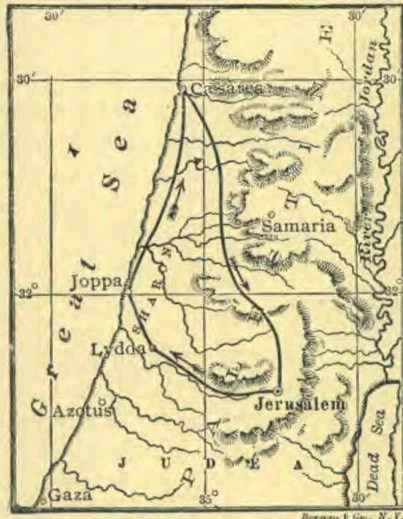
Mountain ranges traverse the whole country from north to south, and the only large river, the Jordan, flows in the same line. These are parallel to the coast line. Three different kinds of territory are the result, three meridional belts, traceable all the way from the eastern boundary to the seashore.
On the east is the parched and arid land of the great desert, remarkable for nothing save the steppe lands, rocks, sand, and débris which compose it. A few oases relieve the monotony, and furnish water and rest to the travelers. The great caravan routes lay along this edge of Palestine, and the people who dwell in this part are disposed to commercialism, rather than to the shepherd life.
On the west side of the land is the maritime belt, a narrow strip of land at the best, being never over a few miles wide, and often only a fringe, where projecting hills push it out into the sea. There is a strange lack of good harbors. Farther north, in Phenicia, there are plenty of them. Perhaps this was God's plan, that the two nations might live close together without mixing, and the children of Israel thus be uncorrupted with commercial interests.
The third belt lies intermediate between these other two. It possesses various modifications that must have exerted a powerful influence over the character of the people inhabiting the country. The rounded, grassy hill pastures rise step by step from the sea to the heights of these central mountains. On the east, the mountains drop abruptly to the desert plains. Between these two mountain tops is the wall-like valley of the Jordan, which shows scarcely a trace of likeness to either of the sides.
The Jordan may be called the main artery of the land. It is fed by many springs, and quickens life wherever it runs. It gives occupation to the people of the land, and directs them to the most fertile and fruitful fields. It receives its supply of water from the snowy summits of Lebanon and Hermon; these, together with the rains and numerous wayside springs, insure a constant flow of water in the Jordan; and when other streams are dry, the sacred river flows on. It supplies many blessings to the dwellers in Palestine.p. 9 and well may they praise it and its lofty mountain sources in song and story.
There is a close connection between the local geography of Palestine and the mental characteristics of the people. The peculiar simplicity and closeness to nature in which the patriarchs lived, their intimate knowledge of the fields, hills, trees, and water, are traceable in all their literature. Often we see the blue skies of Mesopotamia and Assyria, beneath which shepherds wound their way; Ararat and Hermon lift their lofty peaks into the clouds, and the Jordan and the Euphrates flow peacefully along their courses, or rush in madness before us. It would be hard to imagine the history of the children of Israel taking place in any other land than Palestine. The very hills and valleys were a part of them, and influenced everything they did. One writer has thus expressed the influence of the geography of the land on the literature:
“Two voices are there—one is of the sea, One of the mountains.”
In every picture we see the deep purple shade of the one or the glittering light of the other.
The rugged beauty of the mountains, the lonely caves and sunny hillsides, all contributed to the character of the people whom God chose for himself, and set in this little paradise. The whole simplicity of the land was reflected in the wonderful characters of the great leaders whom God chose to lead his people righteously.
RACHEL SALISBURY.