RACHEL SALISBURY
A SHY little girl of eight years swung her feet in a listless fashion from out the big armchair that had been placed for her at the end of the class. The other children had little chairs, the dearest little chairs that she had ever seen, except in the shop windows; and she wanted to sit in one so badly. She was a visitor at the Sabbath school, and felt alone and strange, perched way up there above the others; but she had an opportunity to look around and see what all the other children were doing.
In the class next to Genevieve, there was a girl about her own age who was sitting very straight in her tiny chair. She had a big, shiny, yellow bow on her hair, that just matched the stripe in her silk dress, and her black slippers were laced with yellow ribbons. Genevieve stared at her, and sighed, thinking, “Wouldn’t it be nice to have fine dresses and things like that girl has!” She fancied herself in beautiful clothes, and imagined how she would swell with pride, and sit up real straight in her chair. But what good would it all be to her? She would only spoil the fine things in the dirty kitchen where she made her home.
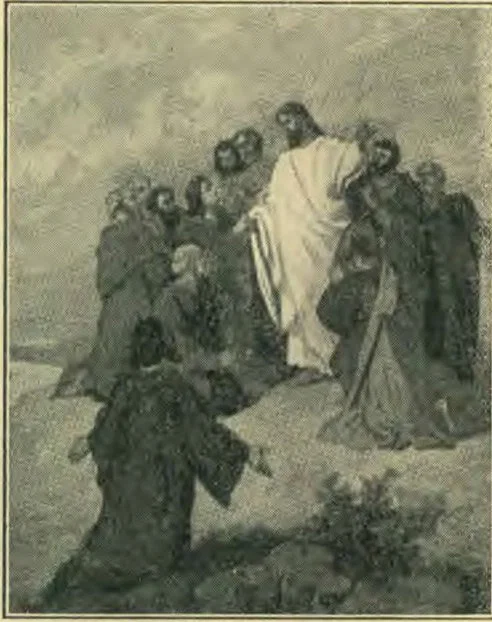
Just then Genevieve’s teacher showed a beautiful picture to the class, and she turned to listen to what the lady was saying. It was a picture of a man dressed in white. He was standing on the top of a hill, and there were many queer-looking people sitting around on the ground in front of him. His arm pointed toward the sky, and he seemed to be talking.
The teacher was telling about some things that Genevieve did not understand. She said that the people were Jews, and that the man was Christ, and that he was going to leave them and go up into heaven. Genevieve wondered who this man Christ was, and where he lived, and how he could talk about going up through the sky, for only the birds, which have wings, can go up into the sky.
The lady continued to talk, saying that the Man loved the people very much, and did not want them to grieve because he was going to leave them. He said: “Let not your hearts be troubled: ye believe in God, believe also in me. In my Father’s house are many mansions: if it were not so, I would have told you. I go to prepare a place for you. And if I go and prepare a place for you, I will come again, and receive you unto myself; that where I am, there ye may be also.” The teacher explained that the man Jesus was going up into heaven, where God lives. He was going up there to build houses for all his children, and when they were finished, and all the beautiful things in the city of gold were completed, that he would come back and get his children who had been faithful to him, and take them up to live with him. While he was gone, he wanted his little boys and girls to be good children, to do kind deeds, and say kind words, and sacrifice their pleasures for the sake of others. They were to do their best to make everybody around them happy.
A bell rang, and the teacher passed colored cards to all the class. On each was a little picture of the man in white, teaching the people; and below it was written the promise he made them on the mountain top. Genevieve took her picture, and very carefully tucked it away in the pocket of her little gingham dress, holding her hand over it all the time, to be sure that it was there. After some singing, which sounded very beautiful to her, the big girl came and took Genevieve home again.
The strange story she had heard lingered in her mind all the next morning. She thought of that wonderful home that the teacher had described to her. And then she thought of the way that every little girl can obtain a place in that beautiful land. The teacher said every girl or boy who is kind and loving, and tries to make every one happy, can go there to live. It must be that if she, Genevieve Briggs, does those things, she can have a place there too. All these thoughts were interwoven with her duties of the morning.
Mr. Briggs was a baker, in rather meager circumstances, and the only errand boy whom he could afford was his own little girl. In the late forenoon he sent her with a basket of rolls to a big house about a mile distant. She did not mind the long walk on this special morning, for her mind was still busy with the impressions of the day before. She often stopped to set down her basket, and pull from her pocket the cherished picture, which her eyes almost devoured.
At length she reached the servants’ door. Entering, she gave the rolls to the portly cook, who was a big-hearted, motherly woman, and on most friendly terms with the little girl.
“Good morning, Genevieve,” she said cheerfully; then, noticing the thoughtful little face, she questioned, “Where has your little ‘imp’ gone this morning? I usually see his red cap and silver slippers dancing around the corners of your eyes by this time of day. Guess you must have forgotten him, eh?”
“You see,” replied Genevieve, brightening her face and responding to the cook’s jovial air, “he got out yesterday afternoon, and I haven’t been able to find him since. Guess he went to the picnic with Master Carl, and maybe he was eaten in a sandwich for a red pepper.”
The cook’s expression changed immediately at the mention of Master Carl. She said, “O that Master Carl had never heard of that picnic! He was taken ill in the night, and the doctor says he is very sick. They even doubt if he will live. But he is better since he had his nap this morning, and his mother has lots of courage. Wouldn’t you like to see him? I think your bright face would cheer him. He always looks forward so much to your weekly visits because he gets so lonely playing by himself. I’m sure he will be glad to see you!”
Genevieve readily assented, and they went up to thep. 13 sickroom together. The boy looked up with a pleased smile as she entered. They visited together for a few minutes, and then Genevieve started to go, not wishing to tire him. But she thought, “If I only knew what I could do to make him happy, while he has to lie here in bed! If I were sick, I should want some things to play with, some books to look at, some pictures—” Pictures! Her hand went down involuntarily to her pocket. Yes, there was her picture; could she give it up? It meant so much to her, that picture of the great, good Man in white, that was king up in the sky. Could she part with that dearest treasure of her heart? But the Man had said that any one who did the best he could to make others happy should have a home with him, where there would be no more sin and sorrow. It was the only thing she had to give to Carl, the very best she could do to make him happy.
Reluctantly she drew the little card from her pocket, and slipped it over the white spread to the little boy. Her eyes looked long at the face of the Man, as the lad held the card in his hand, and asked her what it was about. She told him, as well as she could remember, the story that the Sabbath school teacher had told her little class the day before. And then she read in a stammering tongue the words of the promise printed underneath. The boy was greatly interested. He could not understand all about it either, but he said he would ask his mother. With two different feelings tugging at her heart, Genevieve went away, grieving to have lost her picture, glad to have made little Carl happy.
A few mornings later, a servant girl from the big mansion came over to the bakery for some extra supplies, and brought to all the sad news that Master Carl was dead. The fever had attacked him with new force, and he was gone. Genevieve listened in silence while the girl related through her tears the story of his death: how in the early evening he had called his mother to him, and asked her many questions about a little picture he had in bed with him, questions which she satisfied with the simple story of the cross,—a story nearly forgotten in her own heart; and how they had both cried as the old grandmother knelt down by the bedside and prayed, as his mother said the wonderful Man in white often did; and how the lad seemed perfectly happy and ready to sleep, when they all went out and left him for the night.
And then came the terrible crisis, which took his young life away. As they smoothed out his dark curls on the pillow, closed his sweet blue eyes, and folded the little hands across his breast, they found crumpled in his fist, the picture of the Man in white, whose hand was pointed toward heaven, and who promised, in loving words, “In my Father’s house are many mansions: . . . I go to prepare a place for you.”
The warm tears dimmed Genevieve’s eyes, and her throat had a choked feeling; but in her heart was joy and peace, for she had done the best she could.