What I Can See from My Window
By R. D. Brisbin
R. D. BRISBIN
It is a very unpretentious window, consisting of a rough frame about two and one-half feet by three and one-half feet, set with four windowpanes, and swinging on hinges against the outside wall; yet it opens unto some of the most wonderful and interesting sights I ever saw. I know you want to hear about it, and that is the reason I am going to write.
The little sheet iron cottage of which it is a part we call “The Lodge of Minnehaha.” It sits astride a spur of one of the vertebræ of the backbone of the world, the Himalayas, or abode of snows. Our altitude is 6,500 feet above the sea, and within a hundred miles are the eternal snows. Just above us towers Landour, lifting its head 500 feet higher, from which can be seen hundreds of miles of snow ranges, and Nanda Devi, 26,500 feet high in the snowy distance.
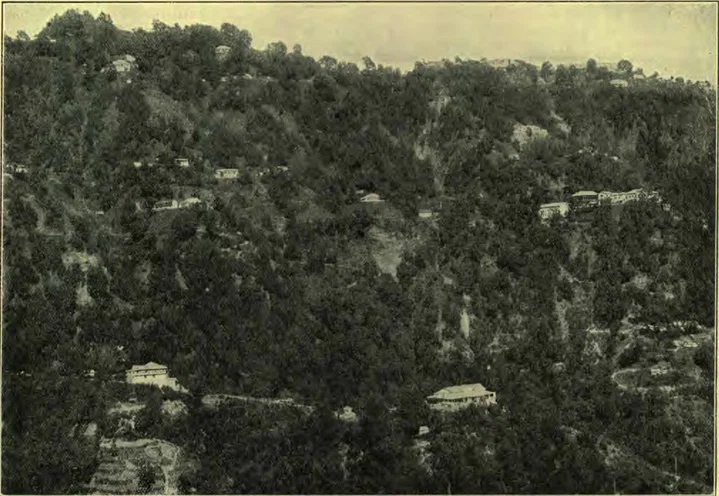
On both sides of the spur the earth seems to drop away—down, down—for nearly 400 feet, so steep you would not care to fall. These slopes, however, are covered with live oak trees, which partially cover the ragged aspect of the whole. These ravines, or khuds, as they are here called, are filled with raging torrents. The two streams on either side meet about half a mile below, and joining forces, they roll huge bowlders and tear loose the soil on their downward path, until they tumble at last into the plains and help to form the headwaters of the sacred Ganges.
I look down after the morning’s rain and see the city of Dehra Dun nearly 3,000 feet below on the plains, sweltering in the heat of an Indian summer, while we have just experienced a hailstorm. Dehra Dun is more than twelve miles away by road, but the air is so clear we can see the houses as they nestle among the trees, and with a glass, can see the people as they move about. Twenty-five miles to the west from there a low range of mountains divides the valley, and beyond twines the silver ribbon of the Ganges. Still farther the eye may rest until verdant plain and the blue sky meet fully 150 miles to the west. Aren’t you beginning to think it is a wonderful window?
Opposite, on another spur, about one-half mile distant, are schools, a hospital, a church, and many other buildings of the town of Mussoorie, all seemingly in reckless attitudes on the face of a cliff, as it were. I tremble to think what would happen if we had a severe earthquake shock; for here in India the houses are built mostly of brick, which is covered with plaster and then whitewashed, and the foundations that many of the masons lay are not to be relied on in strenuous circumstances. Built on side hills as they are, it would not take very much to send them down like a pack of cards, and earthquake shocks are by no means uncommon.
And what are those queer-looking little whitewashed affairs on the little hill below us? O, that is the Mohammedanp. 4 burying ground! The Mohammedans believe they must sit up after being buried, and answer several questions to the angel of death regarding their faith, and their conduct before death; so their tombs are made so they may assume the proper posture when being examined. Look, there comes a procession now. Four men are carrying a rough framework of poles, on which the dead man is laid. How strange! we hear no sound from any of them. No. The Moslem is taught to refrain from weeping for his dead, so all is quiet and still. The last prayer is said by the moolvee, or priest, and another of India’s sons has gone to his long home to await the resurrection. Fifteen people a minute, hour after hour, day after day, year after year, thus pass from India’s life of sin and misery.
But what is that coming now? That cannot be a funeral procession, for they have some men playing drums and a horn. That is a Hindu funeral, and the road down which they are winding from our right leads to the burning ghat. You exclaim, “What a hideous noise they are making!” Perhaps we may think so, but they think it is music; so as they lived here and were ruled by wise and powerful kings long before Englishmen were heard of, perhaps that is music after all, and what we call music is noise. Who can judge?
The complicated ceremonies for the dead were largely completed at the house. Now all that awaits is for his body to be burned, and his soul will commence another cycle of life, perhaps as a fish, an alligator, or a mammal of some kind; for is he not but a poor shopkeeper, and must suffer for the sins he has committed in this life? If he were a Brahman, that would be different. Then he might merge into Nirvana; but—“Bah! He is one of the common herd; so off we’ll hurry him and have it over.” We see the smoke ascending a little later, and know that another of the fifteen has gone. His ashes will be scattered in the stream and join the Ganges on its way to the sea. I wonder if I ever had a chance to tell him of Christ, and improved my opportunity?
The sun is now setting over the hills. How beautiful the colors! If they were painted, one could scarcely believe them to be true. During the rains the sunsets in the Himalayas are unequaled for beauty, and are indescribable. The afterglow in the eastern skies is also one of the beauties of these hills. Many times the reflection is so bright that the sun appears to have lost its way and to be setting in the east. We go outdoors and linger to catch the last rays as they nestle among the clouds, and then night settles over all, and we bow our heads and thank God for the beauty of the “everlasting hills.”
But I forgot to tell you about the birds. From the tiny little sapsucker and humming bird to the great lazy kite which soars in never-ending circles, all are here,—the omnipresent crow and English sparrow, the swallow, tailor bird, brown thrush, Indian robin, spectacle bird, wagtail, blue jay, kingfisher, parrakeet, cuckoo, wild pigeon, owl, and all the night birds, some of which have peculiar bell-like calls of one or two notes, which once heard can never be forgotten. But best of all is the whistling thrush. Of all the care-free, wild songs of the forest or field his is the most beautiful I ever heard or ever expect to hear in this earth. Early in the morning, before the world is astir, he is up and bursting his throat with melody which seems to be heaven-born in its fulness, and the last thing at night he perches on a tree or prominent rock and sings his matin. Dear little fellow, how many lessons we may learn from you!
In one of my jaunts in the jungle I heard the whip-poorwill, although he seemed to be just learning English, and stuttered badly when he tried to sing. But I knew his call, even though not so clear and sharp as that of his American cousin, and gave him credit for the attempt.
But did I tell you that the bobwhite often comes to entice me with his call and to flaunt his bravery right beneath my window? I often hear his voice down the khud and across on the wooded slopes of the other hills, and I answer back to him and try to deceive him into thinking I am one of his bitter rivals.
The best of all happened early one morning about five o’clock, when the mists hung heavy as a gray mantle about the cold, dripping trees and rocks. I was awakened by a strange clucking and beating of wings. It was another call of the wild, and in a moment I was standing in my magic window witnessing a royal battle between two wild cocks. Back and forth they rolled and tumbled and spurred and fought, much as their barnyard cousins. I was only twenty feet away, but they were so interested in their quarrel they paid no attention. Finally they rolled fighting down the path out of sight into the mist. They had evidently met on the narrow path which skirts the cliff below, and being old rivals, as I should judge from their hatred of each other, they had fought at sight. Many times they and their kin have visited my cottage for the crumbs outside. These birds are about the size of the Minorca fowl. The plumage of the female is brown and black, while that of the male is brown and black, with dashes of blue, red, and gold. A prettier family of fowl would be hard to find.
The insect life of the Himalayas includes some of the most beautiful butterflies and moths. The beetles are the fellows that make life interesting, though. If I happen to leave my window open during their season of flying tournaments I am likely to have two or three from two to four inches long, with ferocious-looking mandibles and horns, making circles about my electric light. I suppose that is part of the conditions in their contest for the championship. There is no peace until there is a skirmish and a capture. And what crabbed fellows they are! If two are placed together they will fight with terrible clashes of armor and grinding of incased legs until one gets enough. But it is a hard matter to separate them in their duels, for with horns and wings and twelve legs all mixed up together, it is almost too much to attempt.
I must not forget the flowers. Lilies, forget-me-nots, dahlias, roses, morning-glories, and many other flowers peculiar to the country, grow wild, and I look from my window down into their bright, sunny faces every day, and think how dreary this old world would be without flowers.
All this and more have I seen from my window.