BOX 41, R. F. D. 1, Bloomfield, Colorado (all the address he had), was what Farmer J. B. Plato wrote to Eastern buyers when they advised that they intended visiting his farm to purchase certain registered live stock. He tells of this experience in this way:
“The week passed and no buyers appeared. Then I got a letter—delivered as promptly as you like. It was from the men I had expected. They had made the trip to Bloomfield, and asked everybody about the town where my farm was located, and found that, except to the postmaster, I was a total stranger. This individual volunteered the information that ‘Plato gets his mail through this office, all right. Don’t know where his place is. It’s out on Bill’s route somewhere. Bill’s gone for the day though, and you’ll have to wait till morning to see him.’”
“My buyers, however, weren’t the kind to wait till morning. They took the afternoon train back to Denver and went on their merry way. They put a polite paragraph on the end of their letter, saying that they regretted being unable to make a deal with me, but that ‘it takes time to find your place,’ and they were not able to wait.
“That killed a profitable bargain for me.”
“Naturally, this experience set me thinking about rural addresses—if you can call them that. Always having lived in the city I could not realize how any farmer, back-to-the-lander, or country estate owner could submit to having his place lost under an R. F. D. alias, that only he and the mail carrier could decipher. So far as actual location was concerned my address would just as well fit on to the box of any farm within the radius of about fifteen miles. It irritated me, and set me devising new methods of numbering farms. I didn’t know anything about mapping, but I did know that if the problem was to be solved through mapping, as it is done by the experts, the big map houses would have had the answer long ago. So I realized that it could be mastered only by the introduction of an entirely new element of location, one that would be applicable without the use of a map or chart of any kind and that would, at the same time, be universal. What could furnish universal location?—The compass. Surely, but even that was too technical for the average farmer to work from. Besides, I wanted a key that would be instantly available to every one. ‘Takes time to find your house.’ That kept running through my mind. And, of course, every time that phrase came to mind there appeared a mental picture of a watch or clock—and that was my solution. I realized it one day, when my own watch had stopped. As I stood scowling into its face it smiled back my answer—the solution of my problem. It was a key that every one carried, it was familiar to the smallest child.
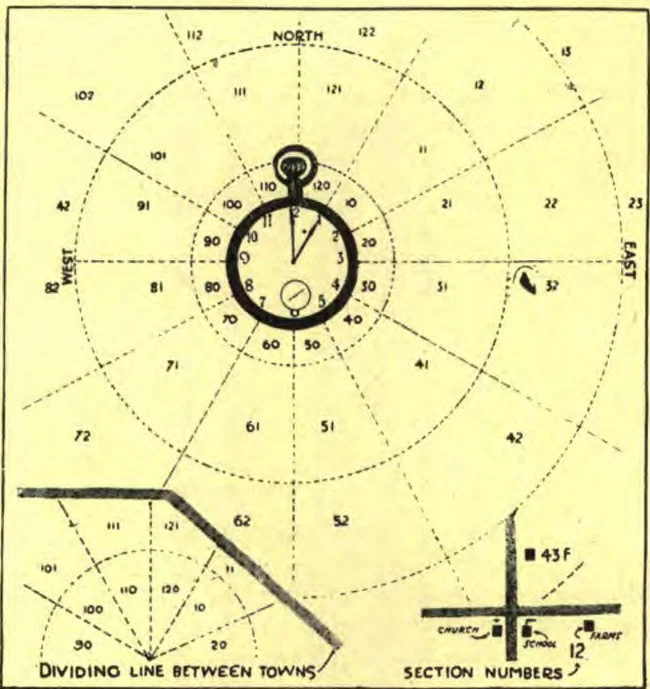
“Turn the figure twelve to the north—there you have the universal key. Twelve then points straight north, three straight east, six straight south, and nine straight west. The other figures give the intermediate points. For instance, one is northeast by north, five is southeast by south, ten is northwest by west, eleven northwest by north, etc. Instantly I had my basic key—the rest was easy.
“I had the directions—next thing was to get the distances. That was simple enough. If a man lived a mile out, I would give him number one for distance. I would combine the figures for direction and distance to get the man’s house number, or location number. The direction would come first, the distance next. Thus if a man lived four miles west of his post office, his number would be 94 (nine for west and four for distance). If he lived two miles south, his number would be 62. When I struck upon this combination, I knew I need look no farther—that I had made it possible for the American farmer to shake his R. F. D. lottery hoodoo. So I set about without hesitation to perfect and patent my discovery.”
Mr. Plato accomplished his work and now holds a basic patent on the “Clock System” of rural address, which, with the addition of the lettering scheme that he later devised, will enable a man to determine, from its rural number, the exact location, within a few hundred feet, of a house situated in another State, or country for that matter. The letter affixed in the numbering scheme divides a mile into various parts. A to L are used for houses in the first half mile and M to Z for houses in the last half-mile. Thus 32A would mean that the house was just two miles east, 32K would mean it was about two and a half miles east, 32T would mean it was about three quarters of a mile beyond the two-mile mark, and 32Z would mean it was at the very limit of the two-mile division, or practically 33—three miles east from the courthouse of the town.
When Mr. Plato brought his invention before the government, a post-office official told him that he had exactly what the Department had been looking for for years, and that they would be glad to incorporate it in their system.
Of course, however, the chief advantage derived from this invention will not be to Uncle Sam, but to the rural residents who are given the numbers. It individualizes their farms, summer homes, mines, or whatever they may have in the country. For instance, when a farmer wants to sell some stock, hep. 12 need only put his rural address number at the bottom of his advertisement. The prospective purchaser knows, from the description contained in that number, within a hundred yards of where the farmer’s house stands, and knows it without pulling down a map, too.—W. F. French, in Illustrated World.