The lover of music finds many interesting incidents in the lives of famous musicians which tell of the hardships endured in childhood in their struggle for a musical knowledge, and the criticism, rebuff, and opposition received during manhood. It was an intense desire to rise higher in a knowledge of their beloved art that enabled these masters to endure poverty and hunger.
Of Bach we learn that when he was but ten years old his passion to study the masters was so great that he obtained, against his brother’s wishes, a book of manuscript from their library, and one moonlight night, long after the others had retired, began the task of copying out the pieces contained in the book. It was not until the moon had shifted her position, so that the little fellow could no longer work, that he returned the book to its proper place.
For six months, whenever the moon shone brightly, Sebastian continued his task. But, alas! he had become so accustomed to his nightly vigils that fear of discovery had ceased to haunt him, and one time he failed to remove the traces of his work. His brother, thinking he heard sounds in Sebastian’s room, came to seek the cause. His glance fell upon the open books, and angrily seizing both manuscript and copy, he hid them where the boy could not possibly find them.
But there was one thing of which Bach could not be robbed, and that was “the memory of the beautiful music he had copied with such infinite pains.” This same spirit of industry is seen throughout his entire life; in fact, he could not be idle, and it seemed the one idea of his whole life was to be of the greatest use to his fellow men.
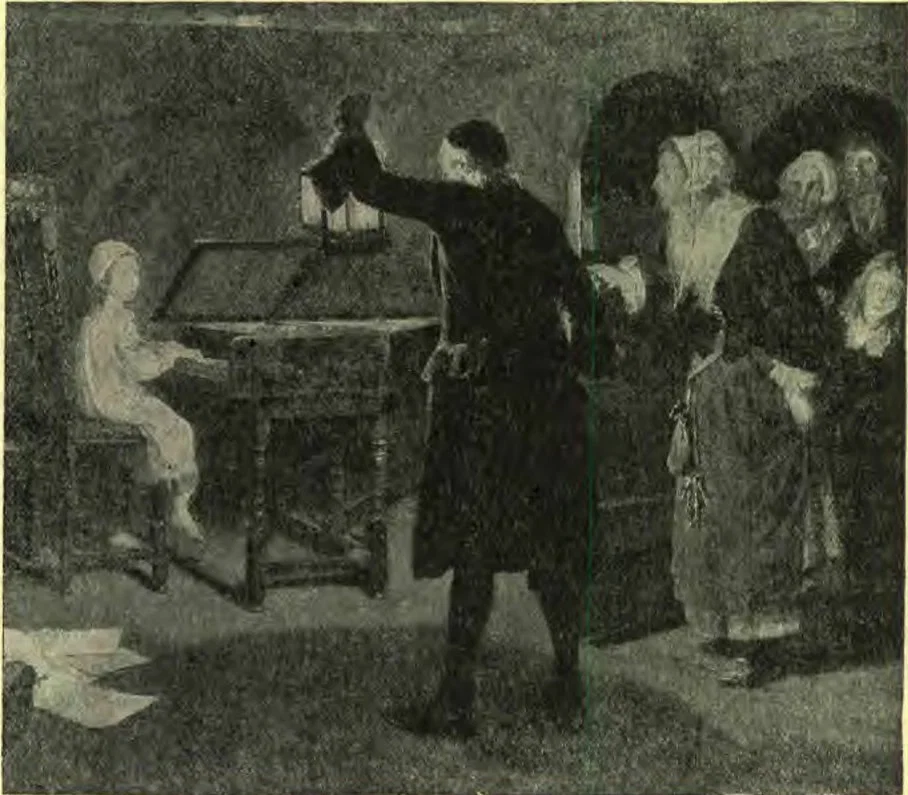
Handel also in his childhood met with serious objection on the part of his father, who regarded the art with contempt. It was Handel’s greatest delight when five years old to steal away to his garret, where had been concealed a dumb spinet, “a small harpsichord having its sound deadened by strips of cloth tied around the strings.” For some time he secretly continued to practice, but one night he was suddenly missed. The servants and parents started in search. “Great was the father’s surprise, on reaching the topmost landing, to hear faint musical sounds proceeding from behind the closed door. Noiselessly retracing his steps, he summoned the rest of the household, and then, ascending the stairs in a body, they paused outside to listen. Sure enough, the old garret was full of melodic sounds! The master softly lifted the latch, and, having peeped into the room, beckoned silently to the rest to follow him. It might have been one of the angel choir itself whom these good people of the underworld had stumbled upon unawares! for there, seated before the spinet, was the white-robed figure of the child.” The discovery did not seem to embitter the father, for Handel continued his practice.
When Handel was seven years old, his father planned a visit to the Duke of Saxe-Weissenfels to see his son, a valet to the duke. George was most anxious to be allowed to accompany his father, as he had heard of the musical delights of the duke’s home, but his father refused his consent. Seeking the seclusion of his garret, George muttered, “I will go, even if I have to run every inch of the way.” He did not know that it was forty miles to the duke’s castle, and that the roads were muddy, so when his father started in a closed carriage, the boy did his best to keep pace with it. At last his strength failed, and he called to the coachman to stop. “At the sound of the boy’s voice his father thrust his head out of the window, and was about to give vent to his anger at George’s disobedience; but a glance at the poor little bedraggled figure in the road, with its pleading face, melted the surgeon’s heart. They were too great a distance from home to turn back, and so Handel was lifted into the carriage and carried to Weissenfels, where he arrived tired and footsore, but supremely happy at having won his point.”
“There, seated before the spinet, was the white-robed figure of the child.”
Handel was rewarded for his perseverance, for the organist of the household was impressed with the boy’s genius, and he decided to “surprise the duke by letting Handel play His Highness out of chapel” the following Sunday. The duke arose when the music began, but he was instantly attracted by the melody pouring forth from the organ, and instead of walking out of the chapel he remained standing. He at once sent for the boy and inquired who he was. When the duke was told that the “boy’s father had refused to let him follow his musical studies,” he cried, “What! is it possible that he can contemplate anything so foolish and unjust as to stifle the genius of his own son?” Then he sent for the surgeon and10pointed out to him very strongly that he was doing his son a great wrong in opposing him in his studies. The father then reluctantly consented to Handel’s pursuing his work. And to the duke much credit is due for the wonderful anthems and oratorios of the great musician, including the “Messiah,” which is said to have been completed in twenty-four days.
An amusing but disastrous incident is told of Haydn, another famous musical master, when he was a youth attending a singing school. In those days it was the fashion for boys to wear pigtails, and one day Haydn’s attention had been distracted by the movements of a pigtail belonging to the boy who sat in front of him. He had secured a pair of scissors, and “the itching to cut something was too strong to be resisted, and the next moment, ere the owner of the scissors could realize the crime he was committing, the once active pigtail lay as dead as any doornail upon the floor.” For this offense Joseph was to receive a caning on the hand, before the whole school, but rather than submit to the disgrace he decided to leave school; however, he was compelled to take the caning, and then received his dismissal. For days and months that followed, Haydn battled with poverty; but later, fortune smiled on him, and music lovers the world over are grateful to him for what he accomplished for the symphony, quartet, and the sonata.
One must be impressed with the merry side of Mozart’s nature. Even during times of adversity he retained the sunshine of his boyish days. One winter evening a friend called at his home and found him and his wife dancing around the room. Upon the friend’s remarking how light-hearted they were, Mozart pointed to the empty stove and said they were dancing to keep warm, “as they had no money to purchase fuel.” Horror-stricken, the caller darted from the house, and returned in a few minutes with his arms laden with logs.” Many were Mozart’s financial embarrassments because he had a leaning toward extravagance in dress, and a weakness for lace and watch chains.
There is much of interest in the life of Ludwig van Beethoven. In 1781, when he was only ten years of age, he made his first attempt at breadwinning for the family. His father was of intemperate habits, and it devolved upon young Ludwig to help in the support of the family. He and his mother undertook a tour through Holland, in the hope that his playing at the houses of the rich might bring in money. They were not disappointed in this respect, but the boy did not carry away pleasant recollections of his visit. He remarked afterward that “the Dutch are very stingy, and I shall take care not to trouble them again.” His life is characterized by a rare personality; he had a temper that was apt to explode at the slightest provocation; he was rude and abrupt; “but his great genius, combined with the absolute simplicity and straightforwardness of his character, won him his way everywhere.”
Strangely enough the emotion that his wonderful expression produced in his hearers, found no response in Beethoven himself. Often when he saw how deeply he moved his audience, he would burst into laughter; while at other times it stirred him to angry resentment, and he would exclaim, “We artists don’t want tears; we want applause!”
His absent-mindedness was the subject of many a joke. “He often forgot to go home to dinner—a fact which, seeing that he was a man, deserves to be recorded; and it is even said that on one occasion, he insisted on tendering money for a meal which he had not ordered, under the belief that he had dined.”
It was Beethoven’s practice to keep his sketchbook by his bedside, and curious was the origin of some of the suggestions in it. One night he was awakened by the knocking of a neighbor who had accidentally been locked out of his house. The neighbor knocked four raps at a time, with a pause at the end of every fourth rap. The rhythmic regularity of the rapping suggested a musical idea to Beethoven’s mind, and arising, the composer entered the idea in his sketchbook. The next morning the jotting was included in one of his most striking compositions, the “Violin Concerto in D,” where the passage, given to the drums, is many times repeated.
With all his peculiarities, this great master was not devoid of noble qualities; his faults were of the head, not of the heart. His compositions are numerous, but his powers of playing is shown to greatest advantage in his adante movements.