Answers to Questions in “Instructor” of April 3
PART I
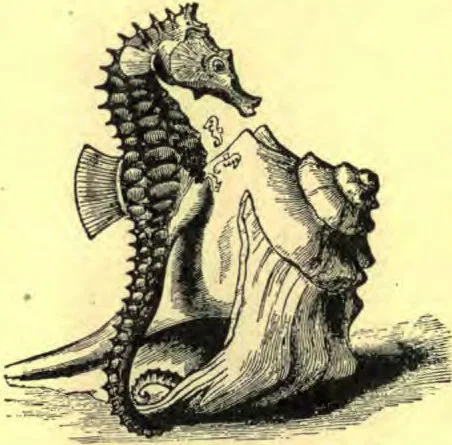
1. Sea horses are small marine fishes, a cousin to the pipefish. The configuration of the fore part of the body, as well as the peculiar manner in which the head is joined to the necklike part of the trunk, bears a striking resemblance to a horse’s head. The body is compressed and more or less elevated, and the head terminates in a long tubiform snout, at the end of which is a small mouth. The tail is long and curved like a monkey’s, and, like the rest of the body, encased in a dermal skeleton. They are poor swimmers and unable to resist currents. There are about forty known species of the sea horse, and on the coral banks of the Indo-Pacific Ocean they vary from two to twelve inches in length. The common species of the American Atlantic coast is usually about three inches long. Around Australia is a species which is decorated with numerous spines, terminated by leaflike appendages.
A peculiarity of the sea horse as well as of the pipefish, is that the male receives the eggs from the female, and carries them in a small pouch on the breast. By simple pressure of its tail, or by rubbing against some fixed object, as a shell, it forces the fry, to the number of about a thousand, out of its brood pouch. The young at this time measure less than one-half inch.
2. Talcum powder is made of talc, a mineral which in its compact forms is known as steatite, or soapstone. Steatite is usually a white, gray, greenish, or brown substance, occurring in veins or nodular masses, or in lenticular bedded deposits. When first raised, the stone is soft, but hardens on exposure. The ease with which steatite may be worked, coupled with its power of resisting heat, has led to its employment for vessels for household use. When ground, it is used as a filler for paper, for leather dressing, for covering steam pipes, as an ingredient in soap, for toilet powder, for certain paints, and as a lubricant. Four million dollars’ worth of talcum powder was used last year.
3. The break with Germany, February 3, occurred because of the question of neutral maritime rights. After the sinking of the “Sussex” the United States government announced that it would break off diplomatic relations with Germany unless she abandoned her methods of submarine warfare. But Germany declared her purpose, January 31, to resume these methods, and the United States had “no choice but to follow the course laid down in its note of April 18, 1916,” when the German note was delivered to the Secretary of State announcing a campaign of ruthless submarine warfare against neutral as well as belligerent ships.
4. The German ambassador, Count Johann von Bernstorff, was given his passports by our government, and the American ambassador, James Watson Gerard, was recalled from Germany, when diplomatic relations were broken between the two countries.
5. Dr. Paul Ritter, Swiss minister, now has charge of Germany’s interests at Washington. The Spanish ambassador at Berlin takes over American interests.
6. The stickleback is an interesting member of the finny tribe which constructs a nest for its prospective mate, and then mounts guard over it until the mate comes along. “The home is built from seaweed, twigs, and aquatic plants which are ingeniously woven together. There are two entrances to the home, which are never left unguarded by the master of the house until the lady of his choice signifies her willingness to enter.” Sticklebacks are short-lived animals, and are said to reach an age of only three or four years. There are no scales developed on any part of the body.
7. The water of the Caspian Sea is salt because it has no outlet. Owing to the large volume of fresh water flowing into the sea it is not, as a whole, so salt as the main ocean, and still less so than the Mediterranean Sea. It is claimed that there is sufficient evidence to prove that the Caspian Sea was once joined to the Black Sea.
8. The United States ambassador to Mexico is Henry P. Fletcher, and the ambassador from Mexico to the United States is Ignacio Binollas.
PART II
| 1. Chestnut. | 7. Coconut. |
|---|---|
| 2. Walnut. | 8. Filbert. |
| 3. Peanut. | 9. Pecan. |
| 4. Acorn. | 10. Hazelnut. |
| 5. Brazil nut. | 11. Hickory nut. |
| 6. Butternut. | 12. Pine nut. |
F. E. CARY.