BAGDAD, an old Arab city, lies in the heart of Mesopotamia. The Tigris River flows through the city; and across the plain from the site of the ancient Bagdad lay Nebuchadnezzar’s great city, and on the other side stood Shushan, the palace where Queen Esther disclosed to the Persian king the wicked plots of Haman. Not far from the city of Bagdad, Jonah sounded his warning to Nineveh. The ancient city was founded in 762 A. D. by Al-Mansur. It quickly rose to prominence, and “seven hundred years before Cortez conquered the land of the Montezumas, Bagdad was the capital of the Mohammedan world, at a time when Islam bore a similar relation to civilization that Christendom does today.”
Bagdad was also the capital of Oriental Judaism. For a long time it was the richest and most splendid city of the world. “In literature, art, and science,” says the Britannica, “it divided the supremacy of the world with Cordova; in commerce and wealth it far surpassed that city.” It was the city of the famous caliph, Harun-al-Rashid, the hero of the “Arabian Nights.” Once “an embassy from Harun-al-Rashid led before the startled gaze of unbelievers the first elephant ever seen in the land of the Franks. When Nicephorus, emperor at Constantinople, wrote an insulting letter to the great caliph of Bagdad, it was returned with the terse comment, ‘Thou shalt not hear, but see my answer!’ This was not an Oriental boast. The commanders of the faithful entered Asia Minor at the head of a great army, carried fire and destruction almost to the walls of Constantinople, and the emperor Nicephorus was soon glad to accept humiliating terms of peace and promise annual payment of tribute to the victorious Harun-al-Rashid.”
The fact that the city lay at the center of the lines of communication between India and Persia on the one hand, and the West on the other hand, both by land and by water, gave it its great importance; but owing to a change in the method of transportation, India communicating with the West by means of the Suez Canal, and Persia by the ports of the Persian Gulf or over a northern route, the city lost its early prestige. Though Bagdad is about five hundred miles above the Persian Gulf, it maintains steam connection with its ports, there being both British and Turkish steamers on the Tigris.
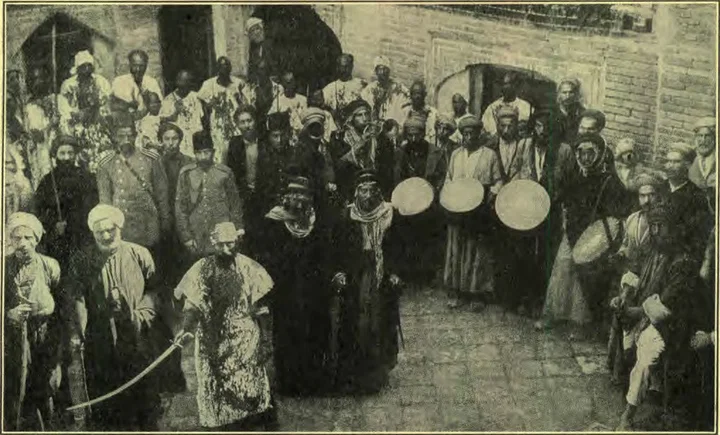
“Situated in a region where there is no stone, and practically no timber, Bagdad was built, like all the cities of the Babylonian plain, of brick and tiles. Its buildings depended for their effect principally on mass and gorgeous coloring. Like old Babylon, also, Bagdad was celebrated throughout the world for its brilliant-colored textile fabrics. So famous was the silk of Bagdad, manufactured in the Attabieh quarter (named after Attab, a contemporary of the Prophet), that the place-name passed over into Spanish, Italian,p. 7 French, and finally into English in the form of ‘tabby,’ as the designation of a rich-colored watered silk. Depending on colored tiles and gorgeous fabrics for their rich effects, nothing of the buildings of the times of Harun-al-Rashid or Mamun, once counted so magnificent, have come down to us. All have perished in the numerous sieges and inundations which have devastated the city.”
The glory of Bagdad long since departed. While the ancient city supported a population of 2,000,000, the present city has a population of less than 200,000.
“The Jews constitute the wealthiest and most intelligent portion of the [present] population. A large part of the foreign trade is in their hands, and at the season of the sheepshearing their agents and representatives are found everywhere among the Bedouins and Madan Arabs of the interior, purchasing the wool and selling various commodities in return. They are the bankers of the country, and it is through their communications that the traveler is able to obtain credit. They are also the dealers in antiquities, both genuine and fraudulent. Next to them in enterprise and prosperity are the Persians. The porters of the town are all Kurds, the rivermen Chaldean Christians. Every nation retains its peculiar dress. The characteristic, but by no means attractive, street dress of the Moslem women of the better class comprises a black horsehair visor completely covering the face and projecting like an enormous beak, the nether extremities being encased in yellow boots reaching to the knee and fully displayed by the method of draping the garments in front.
Though the Turks have long ruled Bagdad, they are not popular among the Arab population.
“The ancient city in its prosperity became a ‘maelstrom of vice, and so weakened by its own excesses that when Hulagu swooped down upon its carousing nobles they fell stupid victims to his Tartar ax.’”
A recent writer in the National Geographic Magazine, said in 1914:
“Modern Bagdad is in safer hands; no dissipated royalty guards its gates. Sober, clear-headed men, drilled in the best schools of modern Europe, able to hold their own anywhere, administer the affairs of this important Turkish province of Bagdad.”
But in these times it is not wise to prophesy too broadly. Bagdad may have seemed able to defend itself against any enemy; but the fact is that on March 12, 1917, it fell into the hands of the British. This meant much to Germany, whose great ambition was to possess a port on the Persian Gulf. The Literary Digest speaks of the loss of Bagdad as the “death stroke to the kaiser’s ambitions.” “It blocks the plan for a German empire in the southeast, and competition with England for the rich trade of the Orient.” Another writer says that Bagdad has tenfold the importance to the world today of Verdun. Both within the last few months have been lost to Germany.
The fall of Bagdad delays at least the execution of the cherished plans for the Berlin-Constantinople-Bagdad railroad, which “with a tunnel under the Bosporus and the Bagdad railway pushed to Busra, one might go from Hamburg, Germany, without change of car, to a deep-water port of the Persian Gulf.” “It is not impossible,” says one, “that the future historian will say that the ‘turning point of the war came not in France, or on the Carpathian front, or at Saloniki, but far away in semidesert Mesopotamia,’” Abraham’s native land. F. D. C.