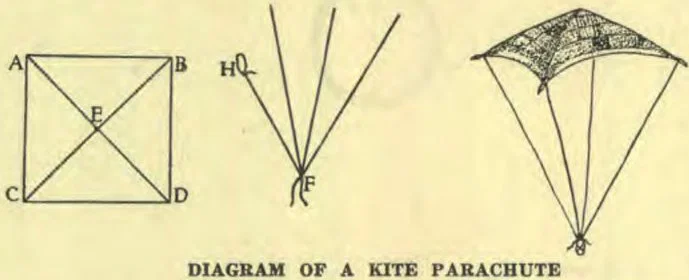
A Kite Parachute
ANY boy who can make and fly a kite, can send up all the parachutes he has the patience to make.
In order to soar steady and far, the parachute must be well balanced and made to exact proportions. Take a piece of newspaper about two feet square, fold and crease it one way diagonally, then unfold it and crease in the other way, as in Fig. 1. Next take two white twine strings of equal length, each about six inches longer than twice the diagonal A D in Fig. 1, and tie them together at their middle with another piece of twine about eight inches long, as in Fig. 2 at F. At each of the four ends tie a slipknot, as at H, and make sure that the ends of the string left over are the same on each knot. Pinch the corners of the paper and pull a knot tight over each corner, as in Fig. 3. Tie a small weight—such as a nail or a stone—to the single string just below F, then spread the parachute out in your hands and let it fall. If the weight is too heavy, the parachute will drop too fast; if too light, the paper will tip over and not stay open. The weight should be just heavy enough to keep the parachute steady. Bend a pin and stick it through the middle of a half-inch square of cardboard. Then stick the pin through the center of the parachute, E, Fig. 1, with the cardboard on the underside of the paper and the hook of the pin above.
Now you are ready to fly your kite. To have sufficient lifting power it should be at least thirty inches tall. Be sure that there are no knots in the string to keep the parachute from climbing. Choose a day with a moderate breeze, and get your kite up as high as you can. Have some one else take the folded parachute, put his arm over the kite string, and slowly bear it down for about fifty feet. Then let him hook the pin over the string, and, still keeping his arm over the string, walk carefully back to you. At that height the wind will soon catch the parachute and carry it up the string.
When it nears the kite, with the end of the string in your hand run very fast about thirty feet toward the kite, which, in consequence, will drop a little. The parachute will spread and lift itself off the string. Do not jerk the string, or the parachute may swing and tangle. Be sure that the pin is not bent too much; if it is, the parachute cannot get away, and will slide into the kite and wreck it. A few trials will show how to set it free.—Youth’s Companion.