ELSA NORTHRUP WARD
ROBERT BROWNING has said, “We’re made so that we love first when we see them painted, things which we passed perhaps a hundred times nor cared to see.” Surely if we should chance to meet this rude country lass in the field or along the road, we should scarcely care to give her a second glance. Her coarse, ill-fitting garments and her big, rough hands and feet are not likely to attract us as we might be attracted by the prettiness of a graceful, daintily gowned maiden in a pleasant rural landscape. But the artist has shown us something about his uncouth country girl that makes her seem beautiful in spite of her rude exterior. It is the girl’s spirit, her ecstasy (which literally means state of being outside oneself), her unconsciousness of self, and complete absorption in the beauty of the lark’s song—a thing so commonplace that no doubt she has heard it years.
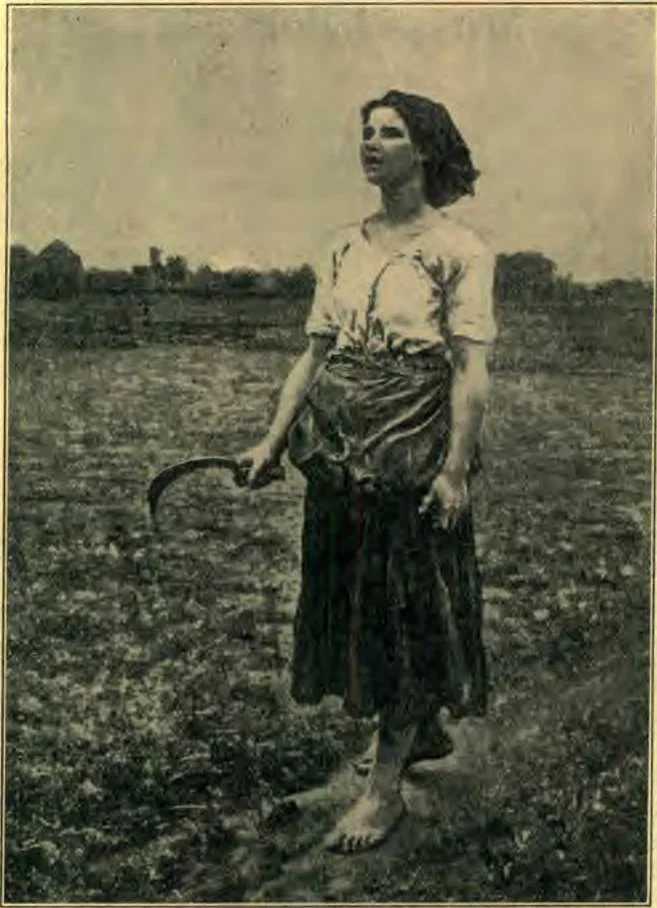
The painted, beruffed, becurled town beauty would no doubt scorn this uncouth country lass, as well as the simple song with which she is so enraptured. With other cheap souls she would probably say, “I’ve heard that song before; let’s have something new.” But the country girl has no such superficial notions of taste or conventionality. Her artistic soul is more stirred and thrilled by the lark’s song every time she hears it. She stands transfixed with strained attention, with bated breath, heel raised in arrested motion, arms and hands tense, as if loath to miss a tone or a trill. Although so young, she has discovered one of the greatest joys of life,—the ability to find beauty and pleasure in common things, a gift that, in the words of Lucy Larcom,
“A mine of gold could not buy: Something the soul of a man to lift From the tiresome earth and make him see How beautiful common things can be; How heaven may be glimpsed through a wayside tree.”
This gift, if developed and cultivated, will fill her toilsome life with happiness and crown her old age with the joys of the spirit that “fade not away;” for, as Keats has beautifully expressed it,
“A thing of beauty is a joy forever: Its loveliness increaseth, It shall never pass into nothingness.”
Aristotle many years ago spoke of the enduring quality of esthetic pleasures. He pointed out that in the enjoyment of them we do not destroy or consume them, as is the case with physical pleasures. To enjoy a luscious peach you must consume and destroy it. If you share it with another, your own enjoyment is decreased. If you indulge too often, your appetite is satiated and you cease to enjoy. The older you grow the less keen is your enjoyment of the pleasures of appetite. Not so with esthetic pleasures, which grow by the using, and increase in inverse proportion to the decrease of the physical appetites. The more often we hear or see a truly beautiful work of art, the more we share with others the spiritual pleasures derived from it, the more delight we shall find in it ourselves. And the more the physical pleasures become dulled with age, the keener will be the joys of the spirit if the sensibilities of the soul have been attuned to the appreciation of them.
Even if our artist never intended to teach such a deep philosophy of life as the old Greek scholar formulated, he has at least painted for us a very charming and interesting scene from a very simple and commonplace subject. The broad expanse of field and effect of atmosphere in the picture are fine. Early morning is suggested not only by the rising sun just peeping above the distant tree tops, but by the dewy mists of the humid morning atmosphere and the caroling birds that may be dimly discerned in the distant sky.