THE MEADOW-LARK
By L. A. Reed
You are no doubt well acquainted with the meadow-lark: it is a bird that has much to say in the spring. Every hour of the day, it would seem, we can hear his long-drawn-out notes. There is in the song an element of cheer, and we feel certain, when we hear it, that the bird must be in a happy frame of mind. We might call him a merry minstrel. As one has said, the song of the meadow-lark, “as he springs from the dew-laden grass, and sails up into the blue sky, is so fresh and pure that it seems to come on the wings of the morning, and gives the deeper beauty of that day in June when heaven would try the earth if it be in tune.”
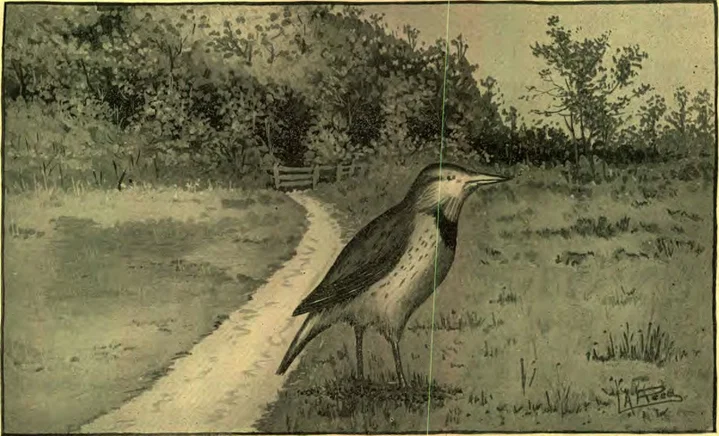
The meadow-lark is so nearly the color of the meadow in which he feeds that it takes a keen eye indeed to make the creature out. His back is dull brown, streaked with black and white; his breast, golden-yellow, with a black crescent.
This bird lives largely upon grasshoppers, May beetles, ants, bugs, caterpillars, etc. He is therefore of great aid to our farmers, and should never be killed wantonly or for food. It has been estimated that the value of the grass crop alone saved by meadow-larks on a township of thirty-six square miles, each month during the grasshopper season, is about twenty-four dollars.
In our picture the bird seems somewhat larger than it really is. Its actual length is about eleven inches. It sometimes remains in the northern States all winter, but is not at all numerous at that season. The meadow-lark is a great walker, and does not fly unless it is necessary. Its nest is built in the ground, in open fields, or meadows, and sometimes in marshes. Its eggs are white, spotted or speckled with reddish-brown. It comes north to us late in March, and leaves late in the fall. Its notes are not the same in all localities. Many bird lovers fancy that it calls, “Spring o’ the y-e-a-r!” but in Illinois it seems to say, “Fee-o-wheedle-dee-dee.”
L. A. REED.