Of all heroic deeds none can compare with the voluntary yielding of a life to save that of another. In the past the apparent apathy of the superstitious Chinese to assist in saving the lives of strangers in peril was due to a belief that to do so would interfere with Fate, that elusive and heartless thing by which the lives of all are ordered, and conflict with which would result in bringing dire calamities upon the head of the would-be rescuer. Even in recent years the government of Hongkong has found it necessary to insert a clause in the junk-clearances issued in that colony, by which the boatmen are bound to assist to the utmost in saving life.
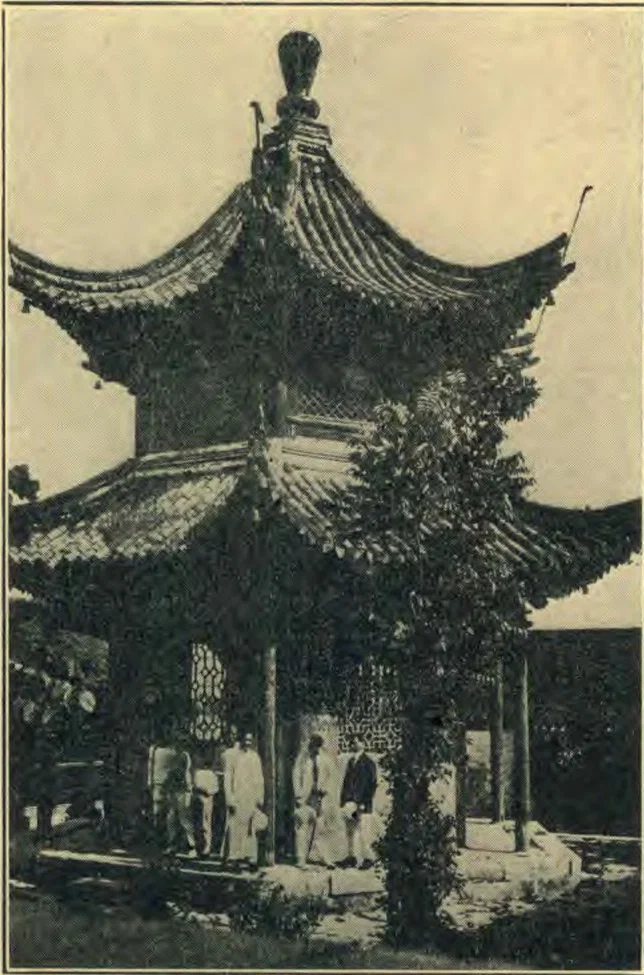
However, Chinese history and tradition have preserved stirring instances of personal sacrifice, especially when the one in danger was a near relative. The paragraphs which follow give an outline of a fascinating story preserved and narrated by the priests in the famous Bell Temple of Nanking.
A little more than five hundred years ago the Yuan dynasty was succeeded by the famous Ming dynasty in China. The first Ming emperor, a wise and efficient ruler, extended the boundaries of the Middle Kingdom to their widest extent, and through his wise policies of government, caused the empire to prosper.
At one time this emperor conceived the desire of having several immense bells made. Accordingly, he ordered from a famous bell maker of Nanking, at that time the nation's capital, three bells, which were to be larger than any bells that had ever been cast in the empire. The bell maker hastened to fulfil his emperor's wishes, but on account of their great size, repeated attempts to turn out perfect bells were fruitless. At last, fearful of the spoiling of his property, or perhaps of the loss of his head, he petitioned the gods for aid in his endeavor. He was advised by the local priests that in a case where the bells were so large the gods would require the sacrifice of one of his daughters for each perfect bell completed.
He returned to his home, prepared again his molds, heated the metal, and at the right moment opened the sluices which carried the glowing stream from the furnace to the first mold. According to tradition,p. 5 which is firmly vouched for by the Chinese to this day, one of his daughters, standing near by watching the fiery liquid with its attendant column of smoke and hissing gases, suddenly leaped to the edge of the mold and cast herself headlong into the molten mass, quickly to be carried by it into the forming bell.
Two more bells of the same size were cast, and in like manner two other daughters of the bell maker voluntarily sacrificed their lives that their father might have success in his endeavor to meet the demands of the emperor.
In later years one of the gigantic bells was carried down the Yangtze River to the sea, there to be cast in as an offering to the gods. The second bell was destroyed during one of China's revolutions. Today, inside the great walls of Nanking stands the Da Djung Ting temple, in the courtyard of which is a bell tower. Here may be seen the third of the large bells which, if we can rely on Chinese tradition, contains a human sacrifice. It is constructed after the peculiar pattern of all Chinese bells, which custom has decreed shall be of uniform width from top to bottom, not increased in size at the lower end, as are those with which we are familiar. Sixteen feet in height, eight feet in diameter, and approximately eight inches in thickness throughout, the mammoth bell testifies that its construction was a difficult and wonderful piece of workmanship.
Of more interest than the bell, perhaps, is a small room in the temple before mentioned. Here are three wax figures, life-size, representing the girls who gave their lives to save their father. They are dressed in royal apparel and have crowns upon their heads. They present a most dignified appearance as they sit before a table upon which is kept an abundant supply of food and fresh fruits. To this room come the Chinese women to bow down before the images and worship the spirits of these who verily lived up to the tradition of filial piety, so dear to the Chinese heart.
To these simple worshipers, and the countless millions in China, who worship they know not what, are we sent to tell the story of the love of God and the great sacrifice of his Son, Jesus Christ; and the part of the story which appeals the most is, “For when we were yet without strength, in due time Christ died for the ungodly. For scarcely for a righteous man will one die: yet peradventure for a good man some would even dare to die. But God commendeth his love toward us, in that, while we were yet sinners, Christ died for us.”
And the gospel is finding a response in the hearts of many of these dear Chinese people, who after long years of serving their wooden gods, are for the first time finding that real joy and peace which comes to those who serve Jehovah, the God of love. Friends, pray earnestly that in the short time remaining, this saving message may be carried to every soul in this dark land who is seeking for light, and that the workers may have divine wisdom and strength to labor in the most effective way. HAROLD L. GRAHAM.