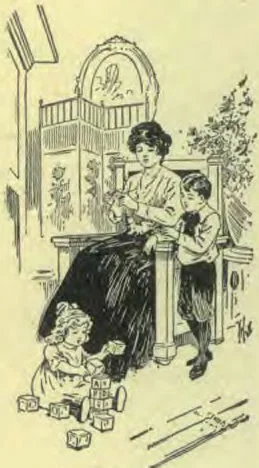
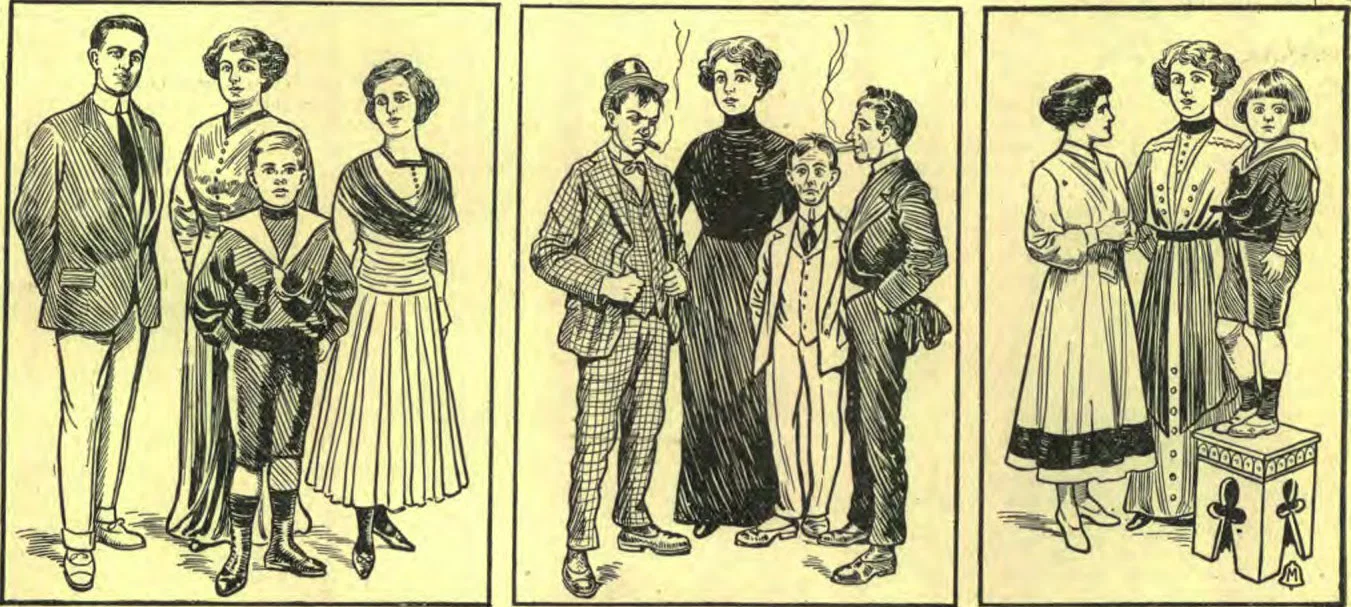
“How much Baby Flo looks like papa, auntie! What makes children look so much like their own people?”
“Why shouldn’t they, Fred? The little oak tree looks like the father oak; the baby fern like the mother fern; and Spotty’s calf just like her. It is a part of our heavenly Father’s plan for all his created beings. The little Eskimo is never like the white baby. It has the characteristics of its parents. The baby vine climbs over the trellis just as did the mother vine. The baby swan sails over the surface of the lake just as gracefully as the parents; but biddy’s chicks show no ability in that line. Why not?—It is all a part of the law of heredity—God’s own handwriting—that the baby shall look and act like its ancestors; that it shall be strong and healthy like its father and mother; or weak and sickly like them.”
Baby Flo
“I should think, auntie, fathers and mothers would be very careful, then, to keep well; for everybody feels sorry for a sick child, like old John’s Bessie, down by the mill.”
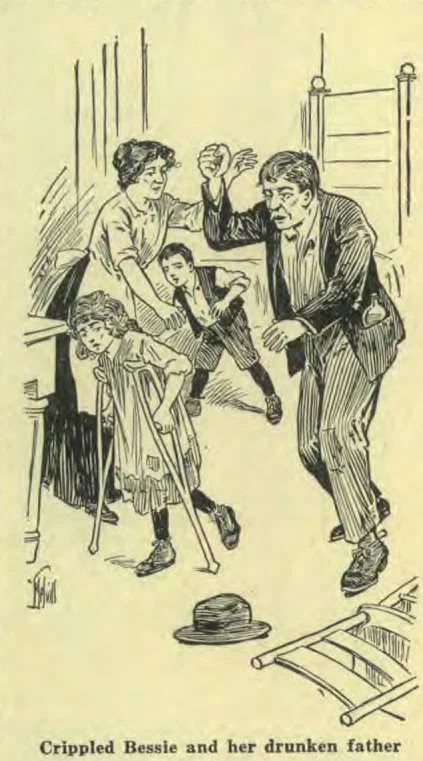
“Yes, I should think so, too. Without doubt little Bessie is sickly and crippled simply because her father is a drunkard. It is a fact, Fred, that the drunkard’s child is more likely than not to be mentally defective, crippled in body, epileptic, tuberculous, or insane. Some of our learned men have proved this to be true.”
“Prof. Charles R. Stockard, of the Cornell University Medical School, New York City, thought that he might learn, from experimenting on guinea pigs, how intemperance on the part of parents would be likely to affect human babies. So he secured sound, healthy pigs, and divided them into two lots. One lot he fed as guinea pigs are usually fed; for the other lot he mixed small quantities of alcohol with the daily food. He did not give them enough to make them drunk. They were never intoxicated, though at times they appeared excited.”
“After a time baby guinea pigs were born to both the temperate and the drinking pigs. Seventeen young were born to the parents that had been fed no alcohol. All these lived and were as chubby, roly-poly pigs as any one would wish for. They were perfectly healthy and normal, just the kind of pigs a self-respecting guinea pig mother would desire.”
“But how about those that had drinking fathers but whose mothers were teetotalers? Of the nineteen baby pigs that came to these, seven were dead when they were born, and seven died soon afterward. The seven that died were epileptic, every one dying in a fit. The five that lived were runts, shy and excitable. Where the mother was fed alcohol and the father was a total abstainer, as every father should be, only two pigs out of sixty-five lived; where both parents had been fed alcohol, only one pig out of fourteen litters lived, and this one died in a fit a week after birth. Since the guinea pig’s general physical nature is much the same as that of man, Professor Stockard’s experiments seem to prove conclusively that parents who drink alcohol are likely to cause great harm to their children.”
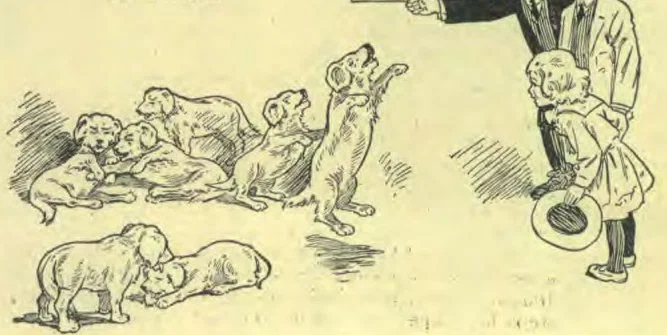
“Another college professor, Dr. Hodge, of Clark University, Worcester, Mass., came to the same conclusion as to the effect of alcohol, from experiments he performed upon seven little black spaniels, the most intelligent breed of dogs to be found in America. Five of the seven, Bum, Tipsy, Frisky, Winnie, and Berry, were given alcoholic drinks with their food. Only Nig and Topsy were total abstainers. Dr. Hodge allowed the school children to come to see his dogs. Nig and Topsy were always ready for a frolic, and would run for hours after balls thrown for them, and were delighted to jump over sticks held several feet from the ground. But Bum and Tipsy were logy, and after a few turns were ready to lie down.”
“From a little machine that Dr. Hodge fastened to the collar of each dog, it was found that the alcoholized dogs did only about half as much running as the temperance dogs, though when first chosen for the alcohol treatment, they were more active than the other dogs. They finally grew to be so ill-natured that the children confined their favors to Nig and Topsy.”
“At one time there was a disease from which many of the dogs in the city suffered. Bum, Tipsy, Frisky, and Winnie came down with it first, and were much sicker than the temperance dogs, which had the disease very mildly. Winnie died of it, and Bum and Tipsy were so sick that for more than two weeks Professor Hodge thought they would not live. For several days both dogs were blind, and they grew exceedingly thin. Tipsy was ever after blind in one eye. Dr. Hodge says that both Bum and Tipsy were as ill as they could possibly be and live, while the dogs that took no alcohol were made simply uncomfortable for a few days. So, naturally, Dr. Hodge concluded that dogs that have alcohol in their food get sick more easily, and stay sick longer, and suffer more, than dogs that do not have it.”
“Bum and Tipsy had several babies born to them; a few of the babies grew up, but never seemed particularly bright. They were not quick to learn tricks, and they made little fuss even when rats ran right over their noses. They were cowards, too. When their master spoke sternly to them, they would howl and yelp so loudly that people passing by thought the poor dogs were being mistreated, although they were always treated most kindly.”
“The other children of Bum and Tipsy were deformed, or for some other reason could not live. In the course of time, when other puppies came, Mrs. Tipsy actually forgot to feed the little creatures when she should, but instead went off by herself where the crying of the hungry babies could not disturb her. Bum, too, was not a very kind parent, for he frequently snapped and snarled when the little fellows begged him to play with them.”
“The temperance family, however, flourished. Nig and Topsy proved excellent parents, and practically all their children were healthy, hearty puppies, which, when they were old enough, were readily sold at good prices.”
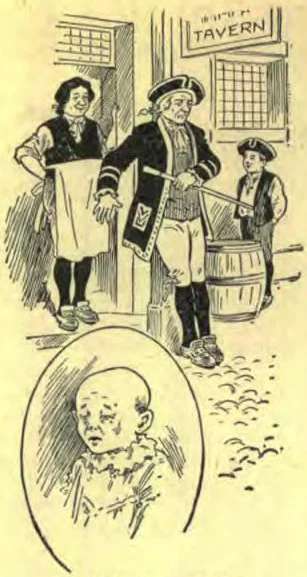
Drink Liable to Ruin the Baby
“Men have also studied the history of alcoholic human families sufficiently to feel certain that alcohol affects the human child as unfavorably as it does the progeny of the lower animals. It is claimed that a baby is made up of its ancestry, one half being contributed by the parents and the other half by its grandparents and great-grandparents. Yet if one of these ancestors has a dominant characteristic, that is, is a great musician, artist, or a criminal or drunkard, this leading characteristic may usurp the proportion that belongs to some other, and the child be affected by this dominant characteristic. He may, for instance, inherit the taste for drink, or be a cripple, epileptic, or defective, as the result of a grandfather’s intemperate life. When you look upon a blind, idiotic, or feeble-minded child, you may know that his trouble has more than likely been caused by alcohol drinking on the part of some of his ancestors.”
Crippled Bessie and her drunken father
“In Bavaria, the greatest beer-drinking country on earth, three hundred out of every one thousand children are born dead. When Sweden was a great drinking country, two hundred out of every one thousand babies died before two years of age. Now only eighty die. If you will study the illustration on the following page, you will see how seriously alcoholic parentage injures babies.”
“Dr. Norman Kerr cites a family in which were first born a son and a daughter. They were excellent specimens of vigorous humanity. After the birth of the daughter, the father fell to drinking heavily. After this, four more children were born, three of whom were complete idiots and the other was defective.”
Nig and Topsy were always ready for a frolic.
“Another eminent physician, Dr. Sullivan, reports a case in which the older children of a family were ordinary, normal human beings, while the younger ones were neurotic, impulsive, and distinctly degenerate. The mother had become a drunkard before the younger children were born.”},{