WHY should Monday be a blue day in the industrial world? It comes after a day of rest, when, from both the physiological and the psychological viewpoint, it should count as one of the best days of the week. Yet the “proverbially small output on Monday has long been a thorn in the side of industry.” The “Monday morning nightmare” of accidents is another thorn that has deeply pierced the industrial body.
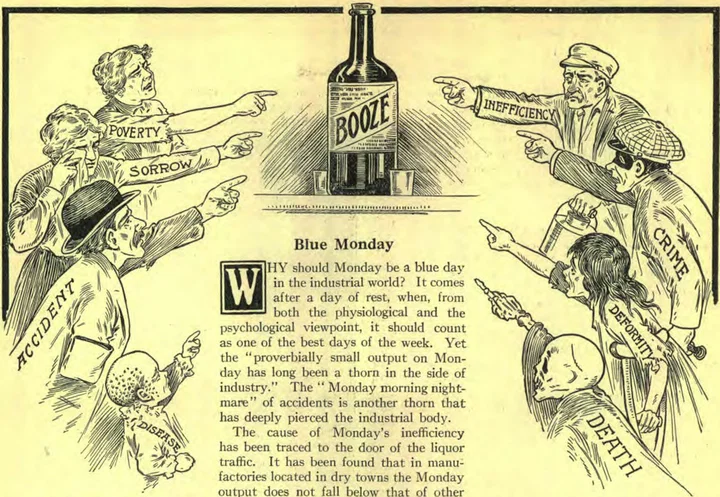
The cause of Monday’s inefficiency has been traced to the door of the liquor traffic. It has been found that in manufactories located in dry towns the Monday output does not fall below that of other days; and also that after prohibition has wrought its work in places where Monday had been a perplexity, that day “soon stepped up with the other days of the week.”
Employers in Seattle, Wash., say that Monday labor has become 50 per cent more efficient than before prohibition was enacted.
A leading Kansas manufacturer says: “Manufactories have no off day in Kansas; the men are as fresh at the beginning of the week as at the close,” an unnecessary statement in any other connection, but a significant one here.
Before Russia’s prohibition of vodka, there were shops that habitually shut down on Monday because so few men were sober enough to be present. These same shops now turn out more work, we are told by Russia’s minister of finance, than they did before the war decimated their working force.
On all ranks of the industrial ladder Monday is the fatal day. In the Raritan Cooper Works of Perth Amboy, N. J., more accidents occur on Monday than on any other day, except the days that follow holidays. The Zurich Trades found that there are three accidents on Monday to two on other days.
These facts point an accusing finger at alcohol. Scientific investigation has demonstrated that alcohol is the “industrial vampire” that is responsible for not only Monday’s increasing fatalities, but for a large share of those of other days. Annually 2,000,000 of our industrial workers are injured and 3,500 killed. Rarely, if ever, is a great mechanical or industrial enterprise completed without some accident. In the construction of the new subway and the new elevated railroad in New York, seven thousand accidents were reported. Insurance adjusters assert that a large percentage of accidents are traceable to mistakes which result from the use of spirits.
American medical directors of three great life-insurance companies estimate that from seven to forty-three per cent of all accidents are due, either directly or indirectly, to alcohol.
The vice president of the J. E. Bolles Iron and Wire Works says that “90 per cent of serious accidents occur among men who drink.” This company has largely eliminated Monday’s blue record by paying off its men on Tuesday instead of Saturday.
Drink and Automobiles
Thirty out of forty automobile accidents investigated by one writer were caused by drink. Three insurance companies claim that 10 per cent of all automobile accidents are due to alcoholic liquors. “If a man takes one drink of liquor,” says Judge Richardson of Los Angeles, “he is not fit to drive a car; if he takes two or three, he wants to step on the throttle and let her out.” He advises that patrolmen be stationed near cafés to prevent persons who have been drinking from acting as chauffeurs. And why not?
Automobile fatalities and injuries at grade crossings are so numerous that the chief claim agent of the Pennsylvania Railroad goes farther than the California judge, and pleads for a law denying a driver’s license to any man who uses liquor.
We are a long way from that Thanksgiving Day in 1895 which saw the first proof of the practicability of the automobile, and a long way, too, from the day that saw the first auto race held in this country, the Chicago race, in which the winning car compassed the fifty-seven-mile route in seven hours, a little more than eight miles an hour. The 1916 winning car ran 350 miles at an average rate of more than 100 miles an hour. The 3,000,000 machines on the road today, with their present speeding capabilities and accident possibilities, present a sufficiently serious problem when guided by clear brains and steady hands; and when otherwise directed, they are a scourge in the earth.
The Ingot, the publication of a copper company’s general safety committee, says: “Cut down the booze, and as surely as day follows night you will cut down the accidents.”
Safety First, as well as every other humanity-serving agency, is against the liquor traffic.
The American Car and Foundry Company says that during the last six months of the open saloons in their town, there averaged one accident to every nine cars built;p. 10 while during a like period after two years of prohibition, the accidents had decreased 74 per cent; or in other words, there had been an increase of 266 per cent in cars built per accident.
Students of industrial statistics estimate that only about one third of our preventable accidents can be stopped by the mechanical guarding of machinery. The remaining two thirds depend upon the man on the job; and he must refrain altogether from the use of alcohol in order to secure absolute release from accidents.
All accidents entail a loss upon society, a waste of wealth, a destruction of productive energy. Then it is a patriotic duty incumbent upon each of us, from “the economic interests involved, as well as from pity for the mutilated of tomorrow,” to do all in our power to banish alcoholic liquor from the industrial world.