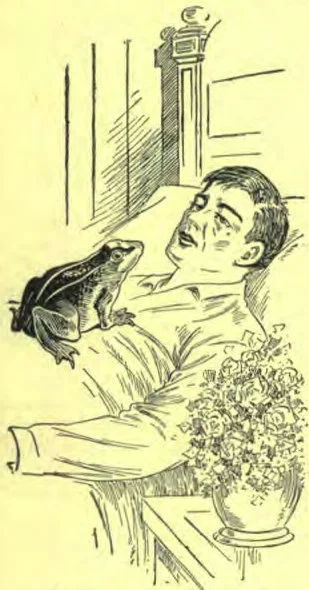
IT is not easy to believe that any of our American people ever looked to the frog as a remedial measure for scarlet fever, measles, and canker rash, much less that they did so in the latter half of the nineteenth century; but according to Home and School this is true, and here is how the little green doctor served his patients:—
“Dr. Frog was taken into a sickroom and made to breathe in a very natural way, close to the face of the patient. He absorbed, so they tell us, the poison and soon began to swell up. When he had taken in so much that it seemed as if he were about to burst, he was taken out of doors and given a cold bath. Thereupon he assumed his natural size, ready to go out on another case.”
“An old paper, dated 1874, a paper noted for its truthfulness, states that a man near Hoosac Tunnel had one of these little green doctors in a spring behind his house, and that this particular frog had such exceptional curative powers that he was in demand for miles around whenever a child came down with a rash that was suspected to be scarlet fever.
“Many a child was reprimanded for killing a frog, because it never could be told when one would be wanted, and the more frogs there were alive the less likelihood there would be of delay.”
Every age has had its absurd and superstitious ideas. The twentieth century, we believe, is emerging into the sunlight of scientific and medical certainty, but it has not freed itself entirely from past absurdities and superstitions. To one familiar with present-day findings of science and medicine, the idea that alcoholic liquor is a benefit to the human organism seems as foolishly pitiable as the idea that the bullfrog could cure scarlet fever, and much more so, for while the frog did the patient no good it did him no harm. Dr. W. G. Halteren summarizes the present medical and scientific status of alcohol as follows:—
“Instead of being a valuable nutrient and tonic, as formerly considered, the facts presented show conclusively that alcohol is a protoplasmic poison, an active depressant, and the legitimate mother of anesthetics.
“Alcohol never stimulated anything or anybody. It always puts to sleep one or more of our faculties. It may put to sleep our sense of decency and our power of restraint, so that we become abnormally lively and vivacious. It may put to sleep our power of muscular control, so that we reel in walking and mumble our words when we try to talk. Finally, it may produce an actual stupor, when the individual, as we say, is ‘dead drunk.’ All these familiar changes are merely stages in one and the same process of stupefying ourselves—of lessening our power to do and to be. As regards the deleterious effect of alcohol, the discussion has practically been closed. The transitory effect alone should be sufficient evidence to condemn it; but that is not all, alcohol increases the blood pressure, robs the tissues of needed oxygen, hardens the arteries, and invites degeneration, decay, and disease. Physiologically, it is no advantage or assistance to the body under any circumstances whatever; nor is it capable of increasing strength or endurance or vitality in any sense, medically or otherwise. Even in so-called moderate doses, alcohol invariably lowers the coefficient of efficiency, retards the mental processes, dulls the keenness of vision and hearing, diminishes the sensitiveness of touch and smell; in a word, it interferes with all physical and mental action, and is thus distinctly a poisonous and habit-producing drug, always dangerous and often deadly.”
In our hospitals its use has decreased seventy-five per cent in the last five years, and it has been entirely omitted from the United States Pharmacopoeia. While the old belief in its efficacy as a medicine dies hard, it is almost dead. A few uninformed mothers may yet act upon the old conception freely dispensed by the brewer, that beer is good for mothers just before and after childbirth. Science has long since completely exploded this idea, showing that one of the worst things a woman can do is to drink alcoholic liquor, though the real effect of the alcohol may not be apparent except in the abnormal liking for intoxicants revealed on the part of the child after manhood is reached. But this may be enough to wreck the life of the child.
The New York Health Department says to mothers, “You can’t drink liquor and have strong babies. Sickening liquor or healthy babies — which? Take your choice.”
According to Drs. Chittenden and Mendel one tablespoonful of whisky reduces the digestive activity more than seventy-five per cent. Dr. Bunge, of Germany, asserts, “When alcohol is taken into the system in any appreciable amount, the digestive process is arrested and fermentation ensues.”
Call in “the little green doctor” if you wish. He cannot harm you, and his croakings may arouse you; but never, under any advice, call in any member of the alcoholic family to minister to your needs. They can do nothing but harm to the delicate human organism. “You don’t need alcohol for health; you don’t need it for strength; you don’t need it for food; you don’t need it for drink. It never does you any good; it always does you harm. Let it alone.”