NOT many weeks ago an old English sailor told me of a method prescribed by his brother for the cure of a cold. “When you begin to catch cold,” he said, “and the nose and throat show signs of irritation, get a jug of whisky; and after hanging your hat on the lower bed post, go to bed, cover up well, and then begin to drink the liquor, continuing at it until you can see two hats, when you’ll find the cold is gone.”
A unique prescription, and just now I am not going to declare in favor of its efficacy or nonefficacy, but I do want to tell you that a man can drink whisky until he can see two hats, and I shall explain how this is done.
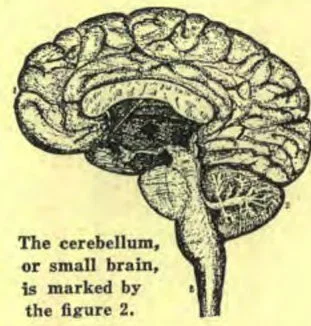
In the lower back part of the head is a small brain called the cerebellum, or control brain. This little brain directs the body’s movements, and keeps it balanced when standing or running. When a boy rides a bicycle, he does not continually think about balancing himself. The little brain attends to the balancing for him. For the same reason a cat needs not to think of maintaining her equilibrium as she leaps to catch a mouse. The cerebellum controls the eye movements, seeing that both sight organs move together.
This ability of the eyes to move together is called coördination. It is most interesting to notice them moving synchronously, as quickly sometimes as shuttles, when your fellow passenger on the train is looking at near objects as the train speeds along. Now if any outside force comes into play, or any loss of control comes in to interfere with a free and natural motor control on the part of the cerebellum, the eyes are thrown out of coördination, and as a consequence, two separate images are pictured in the brain, and we see “double.”
An interesting experiment producing a temporary incoördination is made by gently applying pressure with the finger upon one eyeball when both eyes are open and looking at some small object. Owing to the dislocation, a double picture of the object now comes to view. You have produced a local condition identical with that produced by alcohol when used excessively.
When alcohol is freely taken, the control brain is put to sleep, and partial control of the eye muscles is lost, allowing the muscle to pull the balls to one side at different angles from the median line, when, if the incoördinated eyes attempt to see anything, they see it “double.”
So now you see how it is that a man can see two hats when he drinks the whisky for his cold. It is apparent, also, why it is perilous to be on board a ship plying in rock-bound and narrow channels, when the captain is under the influence of liquor. Looking at the needle of his compass, he may see two needles, and may not know which one to trust for guidance, and, while deciding, his ship goes onto the rocks.
Yes, it is a serious thing to see two things when you should see but one; and wise men and boys steer clear of any habit that makes one lose control over the special senses in times of danger.
EDMUND C. JAEGER.