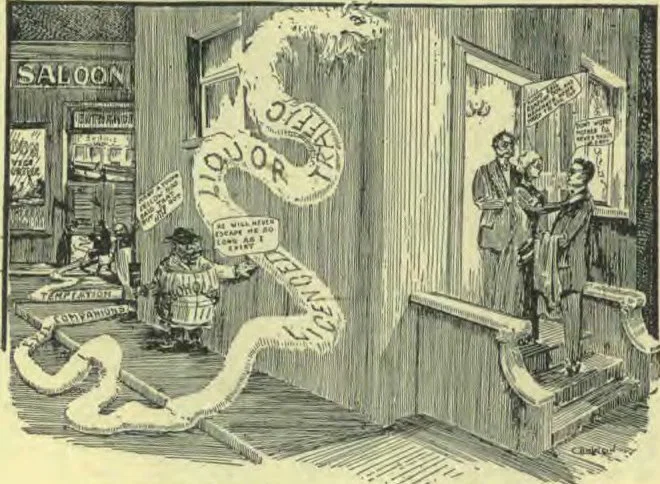
Because scientists have proved alcohol to be a poison, lowering vitality, lessening efficiency, and causing degeneration and destruction of both body and soul.
Because alcohol has no food or medicinal value.
Because even though I myself eschew alcohol, yet if I vote to license the liquor traffic, my vote is an invitation to others to partake of the accursed thing.
Because of the alcohol-wrecked lives all about me.
Because American boys and girls would be ruined by the traffic if it were licensed, that would not be if it were prohibited.
Because it makes orphans of hundreds of thousands of children.
Because our drink bill, which is worse than wasted, would pay a five years’ course of instruction for 2,000,000 children.
Because alcohol is largely responsible for the mentally defective, deformed, epileptic, and insane.
Because it destroys homes, causing indescribable woe and suffering to mothers and children.
Because of the beneficent results shown wherever prohibition has been tried.
Because the Newcastle Courier says of Warsaw, Ind.:—
“Taxes have not been raised, and assessed property valuation shows rapid increase. At least $300,000 has been spent in improvements in the business section, many new buildings taking the place of old ones. Six new factories have located in the city during the last six years of prohibition. Over ten miles of pavement have been laid, at a cost of many thousand dollars, and the property owners have welcomed the expenditure, which during the license period seemed too heavy to be shouldered. The city’s pay roll has had considerable increase each year. The population has increased approximately 1,500 under no-license, banks show heavier deposits, business houses have enjoyed unusual prosperity and have never had fewer unpaid bills. Plans have been made for the erection of public buildings this year which will mean an expenditure of between $250,000 and $300,000.”
Because the vice president of the Aberdeen, S. D., National Bank says:—
“Our city is cleaner, better, and more prosperous than when we had license; homes, mothers, and children are better cared for; merchants report bigger sales and more prompt collections; and savings accounts have been started by those who heretofore, or under the license period, could not even pay for the necessities of life, to say nothing of trying to save. Buildings that were formerly occupied by saloons are now being used for legitimate business, and the demand for both business and dwelling locations is steadily increasing.”
The manager of the Narregang Investment Company says after eighteen months of the dry régime:—
“The call for real estate is greater this spring than for the past five years. One Main Street lot sold this month for $6,000 more than it could have been purchased for when we were wet.”
Because the chief license commissioner, J. N. MacLean, who has taken the records from the five judicial districts of Manitoba and the police department of the city of Winnipeg, says:—
“Drunkenness in Winnipeg has been decreased 80 per cent, and crime throughout the whole province has been reduced 58 per cent.”
Mr. MacLean found that there had been no increase in the amount of liquor sold at the drug stores, exploding the lullaby the liquor interests sang during the campaign:—
“Hush, little drug store, don’t you cry,
You’ll be a barroom by and by.”
The chief of police of Winnipeg says that there are not more than three arrests a day now compared to twenty or thirty per day under the wet régime.
Because under prohibition it cost Alabama $8,975.40 less to feed prisoners confined in Jefferson County jail during the last six months of 1915 than under nonprohibition for the corresponding six months of the previous year, or a saving of $1,495.90 per month.
Because, according to the police inspector of Birmingham, Ala., there were 1,045 fewer arrests in 1915 than in 1914 when the saloon, distillery, bottle-house, and social-club systems were in operation.
Because Birmingham, according to George B. Ward, president of the city commission, says that homicides have been reduced 33 1-3 per cent and suicides 60 per cent; and that the city has never before in its history been so quiet and orderly; that the normal number of prisoners confined within their jail, the handsomest city jail in the South, before prohibition, was 200 and upward. Now the number ranges from 60 to 70.
Because Mr. Ward further says of Birmingham, declared to be the driest city of its size (200,000 inhabitants), that—
“Every passing month demonstrates more clearly that the monetary loss from prohibition is being offset in so many other ways, both direct and indirect, both financially and morally, that the result is startling.”
Because there were only one half as many suicides and murders in Seattle, Wash., in the first six months of 1916 as in the corresponding time of 1915.
Because the editor of the Spokane Daily Chronicle, who thought that the liquor people were right when they said that a prohibitory law would stifle liberty and injure business, and who would not help the drys in their campaign, said after only four months’ trial of prohibition:—
“This paper is ready at ten seconds’ notice to fight its best against any serious effort to repeal or cripple the prohibition law. For four months now, Spokane has honestly tried prohibition; and liquor was prohibited. Not perfectly; but better than speed laws prohibit fast driving or larceny laws prohibit theft. Add to this that unemployment, destitution, and poverty are less than twelve months ago; divorces are fewer; collections are better; dives have closed; white slaves are not to be found; burglaries and holdups have dwindled; the panhandler has vanished; grocers, clothing merchants, and shoe dealers report gains in business, ranging from 5 to 35 per cent; new business blocks are being built; the banks hold millions more in deposits than they held last April; and hotel men, who at that time were near panic over the coming law, are wearing smiles as they turn away surplus guests. The dry way is the way of economy, safety, and righteousness.”
(Continued on page sixteen)1
Fifty Reasons Why I Shall Vote for Prohibition
(Continued from Second Page of Cover)
Because the Spokane prison last March had 41 prisoners to feed instead of 230, as in the previous March; because it had one woman drug fiend instead of 25; because on a certain date it had not one drug or whisky fiend instead of 100 such cases, as on that date a year before.
Because within four months after the simultaneous closing of 305 saloons in Seattle, practically every one of the vacated properties had been occupied by a useful and legitimate industry; and because there were fewer vacant stores in the city than before the dry law went into effect, and rents had not decreased.
Because prohibition when tried, draws to its side intelligent men who strenuously opposed it before it was allowed to prove its virtues. For example, Mayor C. B. Blethen, of Seattle, says:—
His last good-by. To save our youth, kill the liquor monster with the ballot.
“We fought prohibition on economic grounds alone. We believed that in a great seaport city, with a population of upward of 300,000, prohibition would be destructive; that it would bring on economic disaster. We believed that under the license system we had the liquor traffic as well controlled as it could be; we wanted it let alone, and we fought as hard as we could fight. But in spite of all we could do, prohibition carried and went into effect the first of January. We already know that it is a great benefit morally and economically. Its moral effect has been tremendous. We had an average of 2,600 arrests a month for crimes and misdemeanors growing out of liquor drinking. In January we had only 400 arrests, and 60 of these were made January 1, and were the result of hangovers from the old year. That in itself is enough to convince any man with a conscience that prohibition is necessary. There can be no true economy in anything that is immoral.”
“On top of the great moral result we have these economic facts: In the first three weeks of January the savings deposits in the banks of Seattle increased 15 per cent. There was not a grocery store in Seattle that did not show an increase of business in January greater than ever known in any month before in all the history of the city, except in holiday time. In all the large grocery stores the increase was immense. Every dry-goods store, except one, and that I have no figures from, had a wonderful increase in business.
“I wished to know in what class of goods the sales increased so greatly, so I went to all the grocery and dry-goods stores to find out. And to me it is a pitiful thing—and it makes me sorry we did not have prohibition long ago—that the increase in sales in all the dry-goods stores was in wearing apparel of women and children, and in the grocery stores the increase was made up chiefly of fruits and fancy groceries. This proves that it is the women and children who suffer the most from the liquor business, and it is they who receive the greatest benefit from prohibition. Yes, sir, we have found that it is better to buy boots than booze.”
Because many in Des Moines, Iowa, and in Denver, Colo., and in every other new recruit to the prohibition ranks, are learning the way to the bank since saloons have been outlawed. Governor Carlson asserts that “in the Denver Savings Bank, 2,050 new accounts were opened during January, 1916. In Seattle, months before the first year of prohibition closed, 7,165 new savings accounts had been opened.”
Because L. A. Fare, juvenile court judge of Columbiana County, Ohio, has testified that—
“Eighty-three out of every one hundred children brought into the probate court of that county are there because of drink, and that sixty-five per cent of the abnormal and defective children brought into court are there because affected through drink.”
Because post-office receipts in Denver for the month of June, under prohibition, were $18,160.24 more than for the month of June, 1915, under license—an increase of 16.2 per cent. For the first time in Colorado’s history Denver’s post-office receipts have exceeded a million and a half dollars in a year—and the increase has come under prohibition.
Because in no place has prohibition brought the disasters predicted by its enemies, but in every place has demonstrated its efficiency as a true servant.
Because we “face the astounding actuality that if to the annual product of all the lumber mills were added the output of all the coal mines saturated with the petroleum from all the wells, and the entire mass consigned to the flames, still the amount of loss would actually be less than the annual loss due to the liquor traffic.”
Because in Tacoma, Wash., a city of 100,000, there was an unprecedented boom in the sale of children’s shoes after Jan. 1, 1916, and because, according to the mayor, A. V. Fawcett,—
“The city is in better shape economically than it has been for years; workingmen who were looking for work last year are employed; grocers report increase in business; contractors report more building than for the past five years; old shacks are being replaced by modern business houses; vagrancy has decreased 63 per cent, and fighting and disorderly cases 100 per cent.”
Because the mayor of Walla Walla, Wash., said that he had not been called upon to settle a drunken family row since the saloons were abolished, and that bank deposits had increased, arrests decreased, and bills were paid more promptly. Another mayor says that 99 per cent of all cases of trouble brought to his office are due to drink.
Because bakers say they sell more bread and cakes than during the wet régime.
Because the dry régime makes unnecessary the long line of women at the pay window of some industries, waiting to get their husbands’ checks.
Because Governor Alexander of Idaho says:—
“Prohibition is a success. Boise is in better condition financially today than ever before.”
Because for the first time in many years there was not a single criminal case filed in Denver, Colo.; and the Denver Dry Goods Company reported in one month a 30-per-cent increase in its sale over the same month for the past few years.
Because the passengers of the “owl” cars of Denver dropped 40 per cent in the first few months of prohibition. Thirty per cent of the midnight passengers had been intoxicated women and girls.
Because Denver’s largest laundry received 401 new family wash patrons. These families had had their washings done by washerwomen who surrendered their jobs when their husbands brought their pay envelopes home instead of giving them to the saloon keeper.
Because Denver three years ago had 2,653 vacant houses, including apartments. Today it has not 300 houses in good condition for occupancy. From one and one-half to two families are moving into Denver for each one moving away.
Because Denver’s bank clearings in one week of June, 1916, were $15,413,000, an increase of 42.7 per cent over the corresponding week of the previous year under saloons.
Because Crystal Falls, Mich., the county seat of the wettest of the wet counties, was $10,000 in debt when Iron County went dry. Though it had but $7,000 in the treasury, and lost the $12,500 annual license fee, it has paid off all its saloon-accumulated debts; has spent $4,000 for a new fire truck, and has $14,000 in the treasury.
Because the Colorado Motor Company reported a gain of 400 per cent in January, 1916, over January of 1915. Salesmen of all the leading automobile companies report a great gain in sales due to prohibition.
Because commissioner of safety, Alex. Nisbet, of Denver, says:—
“The habitual loafer has disappeared. The crowds that used to hang around the lower end of the city at free-lunch counters are gone. Where, I haven’t the slightest idea. Like last summer’s flies, they just disappeared. Again, the winerooms are no more and the ‘after the theater’ dinners are over.
“When any one uses the word ‘money’ as an argument in the liquor traffic question he loses sight of the real question, for after all it is a question of humanity, and I have come to realize this through twelve years of service while Denver was wet and two and a half months of service as sheriff since the city has been dry.”
Because Portland, Oregon, reports the elimination of the “night rider” and the “joy rider.” In February, 1916, there was only one arrest for operating a machine while intoxicated, while in December, 1915, there were thirteen such cases, and two citizens were killed. Portland also reports the usual prohibition increase in savings, collections, grocery and dry-goods sales.
Because Spokane’s leading daily says that “the records at the county courthouse show that to aid the unemployed it has cost $9,000 less in February, 1916, than it did in the same month of 1915.”
Because Findlay, Ohio, has not had liquor revenue for seven years, yet it has the lowest tax rate of any city in the State.
Because wet Fostoria and dry Findlay, near neighbors, the former, with 9,597 population, showed 375 arrests for drunkenness within a given time; while the latter, with 14,858 population, had only 122.
Because Berkeley, Cal., ten years ago, with a population of 26,000 and saloons, had 310 arrests for the year; while last year with a population of 65,000 and no saloons, there were but 291.
Because in Portland, Oregon, the Workingmen’s Club, maintained by private philanthropy for the unemployed, has closed its doors because the number of unemployed in Portland had become so small that the club’s mission was considered to have been fulfilled. During its career of sixteen months the club furnished 400,000 meals at five cents each, besides food to hundreds of men; and because at the Italian Mission in Denver, where ladies at the Highlands Methodist church have been furnishing free meals for 150 children, under license conditions, “no more free meals are furnished, since the children are getting all the food they need at home.”2
Because prohibition reacts unfavorably upon the houses of ill fame. One madam declared that since the prohibition order went into effect, her income of $4,000 a month had been reduced one half. Others said if they were not permitted to sell liquor, they would have to go out of business.
Because the workman would be benefited by the wiping out of the liquor traffic and its allied industries.
Because cobwebs are hanging from the walls of the Macon, Mo., police court. The city attorney, elected when saloons were running, formerly received in fees from $65 to $75 a month. He says that now he is doing well if he gets $5. The average is $2. He says that he thought they had not tried a case at the courthouse for six or eight months.
Because from extended observations throughout the country, pawnshops, jails, houses of prostitution, gambling dens, and the morgue are the only institutions that show a decrease in patronage through prohibition.
Because whether the workings of prohibition are observed in towns, cities, counties, States, or nations, and whether these are east, west, north, or south, it is found to produce always the same beneficent results, and never any unhappy results.
Because it is time to stop making criminals, paupers, and insane through a traffic fostered by law.
Because “many of our social evils which overshadow the land like so many upas trees, would dwindle away and die if they were not so constantly watered with strong drink.”
Because the Austin Herald of Minnesota says that while its files in other years are full of stories of fights, family quarrels, beating of wives, children going wrong, men being robbed while drunk, since the passing of the saloons it finds little to report in the criminal line. Lawyers of Austin say they have no longer to evict families for nonpayment of rents, and rents that were two and three months behind, are now paid on time.
Because prohibition has changed breweries and distilleries into successful tearooms, ice factories, milk companies, yeast factories, a paint, oil, and varnish company, fruit and by-products company, chemical and soap plant, creamery and produce company, loganberry-juice manufacturer, and into flourishing Y. M. C. A. rooms.
Because saloon men who have been forced into respectable business by prohibition, have become its stanch friends, are happier, and declare they would never enter their old business again.
Because I desire to see men have the opportunity to be and to remain men; because I want women and children to be tenderly and generously cared for; because I want to see, as far as possible, tramps, bums, criminals, paupers, insane, epileptics, and the unemployed eliminated; because I want to see disease and death lessened; because I want to see the moral and social standards raised; because I want to see financial prosperity together with every other laudable kind of prosperity throughout the nation, I shall vote for State-wide and nation-wide prohibition, and so should you. Will you?