A WORKMAN in the Illinois Steel Company accepted a good position in Pittsburgh. Before his departure his fellow workmen gave a banquet in his honor at one of the hotels, with twenty-five foremen and men holding clerical positions as guests. When these men went to the table, there was a cocktail at each plate. When they left the table, there was still a cocktail at each plate, not one having been touched. Why not?—Because the Illinois Steel Company disapproves of its employees’ drinking, and because the men themselves know that even one cocktail is a thing to be avoided.
Laboratory wizards, whom the world honors and must believe, are chiefly responsible for the untasted cocktails. They have given the deathblow to booze in American industry. When a man can count and weigh atoms, when he can mechanically weigh thought, and do the thousand other things that the modern scientist with his delicate instruments can do, men are obliged to sit up and take notice when he begins to experiment on booze.
Alcohol Dulls Sight, Hearing, and Sense of Smell.
Prof. Angelo Mosso with his ergograph, by repeated experiments, has shown conclusively that one glass of Bourdeaux wine or its alcoholic equivalent,—about one-third ounce of alcohol freely diluted with water,—diminished ability to withstand the fatigue of weight lifting amounting to seven and six tenths to eight per cent. His experiments have been duplicated hundreds of times by other European scientists. In every case a definite loss of muscular efficiency was shown.
Dr. Kraepelin, whose experiments have attracted much attention, is regarded as the most eminent living author on mental and nervous diseases. He is professor of mental diseases at the University of Munich. By means of his writing balance, the time required to write a set of characters can be computed with an error of less than one two hundredth of a second. He, too, has made some convincing experiments. Subjects were required to write three stints, each succeeding one requiring greater expenditure of mental energy. The time for the men in their normal condition to perform each task was noted. Then each one was given his allotment of wine. After five minutes the subjects resumed their writing, repeating the previous requirement. It was found that invariably every man slowed up appreciably, there being five and six-tenths per cent loss in quickness on the easiest task, seven per cent on the next harder, and seven and three-tenths per cent on the most difficult. Again and again similar results have been secured.
Dr. Kraepelin also performed experiments testing the effect of alcohol upon the power of association of ideas. The taking of a drink at night resulted in a loss in coördinating power as high in some instances as twenty-seven per cent.
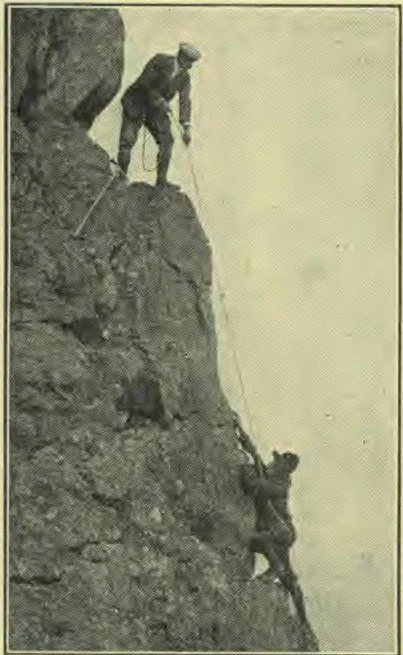
Professor Druig, an expert mountain climber, found that on days when he took two glasses of beer, his instruments showed that he expended fifteen per cent more energy than on the days when he did not drink, and that it took him twenty-one and seven-tenths per cent longer to reach the top of Mt. Bilkencraft, 8,000 feet high. Yet such is the deceptive power of this poison that he felt he worked more easily on alcohol days.
Tests of Swedish marksmanship illustrated the effects of alcohol upon endurance in such repetition work. Upon the alcoholic days the soldiers averaged only three hits out of thirty shots, while on their abstinent days they averaged twenty-three to twenty-six hits out of thirty. They, too, thought they were shooting better after they drank, though their skill and endurance were both greatly lessened by the alcohol.
Cannot Memorize So Quickly
Memory tests showed equally serious indictments against alcohol. Dr. Vogt, of the University of Christiania, in his experiments found that the time required for repetition of twenty-five lines of Homer without mistake averaged 18 per cent longer during the alcoholic period than on the abstinent days. The amount of alcohol that he gave was equal to slightly more than one-half pint of four-per-cent beer.
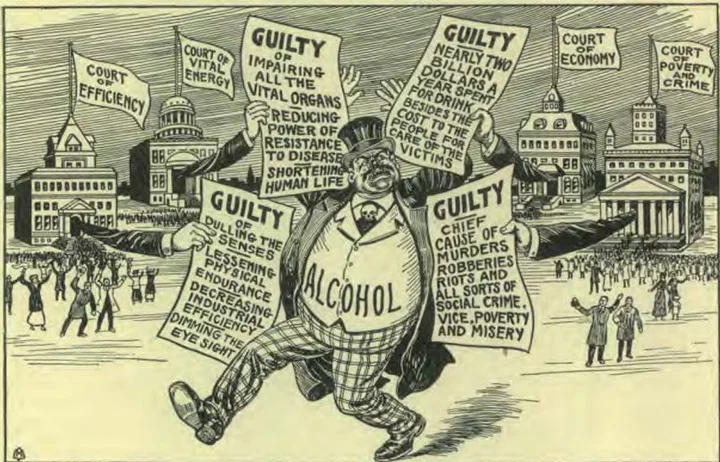
The unfaltering decree of science is that “even one glass of beer daily, decreases a man’s efficiency by an average of seven per cent. In other words, it would require fifteen men, indulging in one glass of beer daily, to do approximately the work which properly should be done by fourteen abstainers. Scientists have found that a drinking man cannot stand extremes of temperature so well, that he cannot hear or see or smell so well, that he cannot lift so much or so often, that he cannot walk so far, dig so much, or carry so enduringly as if he were abstinent.”
These findings of science, with many others of a similar nature, supplemented by personal observations, have made American industry declare almost unanimously against the liquor traffic.
“The great god Industry may not care for the social or moral phase of the drink problem, but when alcohol begins to tease and harass his pet mascot, efficiency, that is quite another matter. Drastic measures must be taken.” And these measures help to bring nearer the day of national prohibition of the liquor traffic.