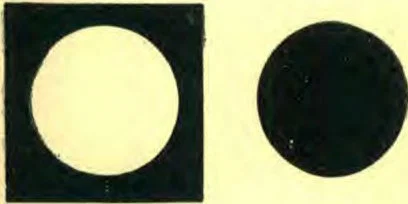
The full moon appears larger when near the horizon than when overhead in the zenith. It is nearly four thousand miles farther away, so should appear smaller, and astronomical measurements give a smaller diameter; but since it appears nearer when just above the horizon because of intervening objects, the mind sees it larger. This is what physicists call an optical illusion. In certain drawings, the farthermost of several figures seems the tallest, but by actual measurement the first or nearest figure is found to exceed in height the farthermost one. This is another optical illusion. The light circle here represented seems larger than the dark one, but the two have the same diameter. Here also the eye deceives us.
In other cases, as well, our sensations may prove unreliable. If a very cold hand is plunged into a vessel of cold water, the water seems to be quite warm, whereas if the hand is very warm when put in, the water seems quite cold. Again, on a cold morning, if a person steps out of bed onto a woolen rug, then onto a piece of oilcloth, the oilcloth seems much colder than the rug, merely because the former, being a better conductor of heat, draws the heat away from the body more rapidly than does the latter.
These illusions are well known, and are accepted universally as physical illusions. There are other sensations known to the scientist to be mere illusions, which are still regarded by some persons as reliable sensations. Such are some of the sensations accompanying the use of alcohol.
Does Alcohol Quicken Brain Action?
For example, some think that alcohol quickens brain action. But very careful experiments to determine the real effect of alcohol on brain action have been performed by scientists and medical men of every civilized nation; and all these have demonstrated the fact that alcohol even in very small doses interferes with the highest use of the brain. One series of experiments was tried upon expert compositors. It was found that the actual loss of working power caused by the small dose of alcohol was nearly nine per cent. However, “the men believed throughout the experiment that they were doing better and quicker work when taking alcohol than when abstaining, although the actual facts were the reverse.”
In the Swedish army a series of important experiments in target practise were made upon a number of picked soldiers and non-commissioned officers. “When alcohol had been given, the result was thirty per cent fewer hits in quick fire, although the men always thought they were shooting faster, whereas actually they shot much more slowly.” When slow aiming was allowed, the difference was even greater, and, as before, against and not in favor of alcohol.
Another investigator studied the duration of the effect of alcohol in light doses, and found that the result lasted all the following day, causing a dulling of mental labor, although the subject was under the impression that his work was as good as usual.
Quality and speed must both have a place in good mental work. The rapid talker is not necessarily the best thinker. The manufacturers of the fountain pen say that when the pen flows too freely, it is a sign that the pen is nearly empty; so the loosened tongue of the imbiber indicates an empty brain, at least one whose higher and more complex processes have been partially paralyzed. To himself the free talker seems more “brilliant,” because he can use words so freely; but it is a sad illusion. Alcohol removes the balance-wheel, as it were, that gives the tongue a steady, dignified, thoughtful action. This allows it to rattle along as it will. Soon “this so-called stage of stimulation develops into noisiness and emotional excitement as the cerebral control becomes increasingly paralyzed,” says Sir Victor Horsley. The next change is the commencement of narcosis; and dulness and heaviness succeed.
Dr. Kraepelin, of the Heidelberg University,
has made extensive experiments to determine the effect of alcohol upon brain action. He found that while the simple, automatic actions of the brain, such as reading aloud, were at first quickened by a small dose of alcohol, even these were rendered less trustworthy and accurate. He also found that processes involving no more complex actions than adding figures rapidly, or of performing problems in mental arithmetic, were hindered by even small doses of alcohol. The result of these experiments came as a surprise to Dr. Kraepelin himself, who had hitherto shared the popular belief that small doses of alcohol quickened the activity of his mind. But when he came to measure with his unerring instruments the exact time occupied, he found to his astonishment that more time was required to perform these operations than when he did not use alcohol, though it seemed to him that the brain was acting more rapidly. Similar experiments were tried upon others, the same results being gained in every instance. And, singularly enough, each one felt, when under the influence of alcohol, that he was doing better and more rapid work, though the tabulated results showed the reverse to be true. Such is ever the delusive effect of alcohol; and the delusion is as real as in those incidents mentioned at the beginning of this article.
This effect is not peculiar to alcohol. “The ordinary anesthetics used in surgery, as chloroform and ether,” says Sir Victor Horsley, “make the patient feel that he possesses great muscular strength, and feels himself to be making powerful efforts, which in reality are not in any way superhuman.”
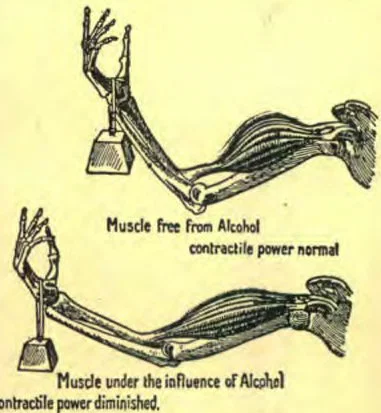
Muscle free from Alcohol
contractile power normal
Muscle under the influence of Alcohol
contractile power diminished.
A man for a time feels warmer in winter after taking a glass of liquor; but a multiplicity of experiments have proved that he only feels warmer, that he is actually colder, and would succumb to severe exposure more quickly than if he had not taken alcohol. This illusory feeling of warmth is no more indicative of an increase of bodily heat than is blushing. The alcohol causes a slight paralysis of the nerves controlling the action of the blood-vessels of the body; and as a result, these dilate, and allow more blood to come to the surface of the body, where it is cooled. The feeling of warmth is due merely to the fact that the skin is made warmer by the increased flow of blood, and the nerves of the skin carry the sensation of warmth to the brain. So well-known is the fact now that alcohol lowers the temperature of the body that lumbermen, explorers, and others who are exposed to extreme cold, regard this narcotic as a deadly foe. Chloroform and ether produce a like effect in lowering bodily temperature.
Another illusion of the alcoholic devotee is that intoxicants do not hurt him physically; and this in face of the fact that his reddened face, coarsened features, unkempt appearance, unsteady gait, and dull eye, all betoken a bodily decay that is a recognized inevitable result of the use of alcohol. The seven diseases that account for more than half of our deaths all find far more victims8proportionately among the intemperate than among abstainers. Tuberculosis ranks first in its death-destroying power, and alcohol is responsible for more than one half of these deaths. The statistics of five New England cities show that eighty per cent of all cases of pneumonia occurred in persons who used spirits.
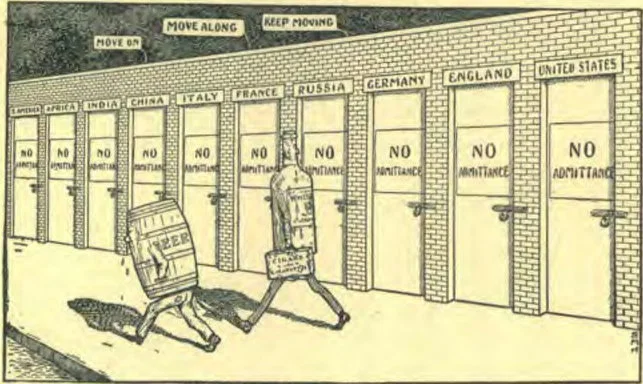
Adapted from cartoon in Brooklyn Daily Eagle
The reason the drunkard is content with his characteristic environment is also due to the delusive and illusive effect of alcohol, which “deadens the power of estimating adverse and disagreeable conditions.” It also annihilates normal parental feelings. Ex-Governor Hanley, of Indiana, says that “in seventy-five per cent of all the cases of child desertion passing through the executive office of the State of Indiana in the four years ending Jan. 11, 1909, parental affection was alienated and the desertion caused through the evil influences and effects of the American saloon.” The cries of hungry children, the pleadings of an abused and neglected wife, the punishment by civil power, the scorn and abuse of neighbors, do not penetrate the consciousness. Alcohol makes the brain impervious to all higher sensibilities. In its final stages of wreckage it seems that nothing but the Spirit of God can penetrate the deadened alcoholic brain, and awaken it to its physical and moral responsibilities. And rarely is this Restorer given an opportunity to exert its healing power upon the unfortunate wreck of a human being.
Our Part
More than half a century ago Wendell Phillips said that the person “who sets on two feet a startling fact and bids it travel from Maine to Georgia, is just as certain that in the end he will change the government as if, to destroy the capitol, he had placed gunpowder under the senate chamber.”
Wendell Phillips knew the influence of a right thought. He helped to start the antislavery idea on its journey, and he watched it make its way to the capital of the country, and finally annihilate slavery.
In recent years well-known scientists and medical experts have given to the world an invaluable amount of scientific data to be used in the campaign against alcoholic slavery. Perhaps nothing has done more to give prestige and potency everywhere to the work of the anti-alcoholists than this scientific data. Let us all, then, do what we can to give these important facts feet, and wings, if need be, that they may quickly make their way from one end of the earth to the other, exploding all false theories of the benefits of alcohol as medicine, beverage, or brain quickener. F. D. C.