D. H. Kress, M. D.
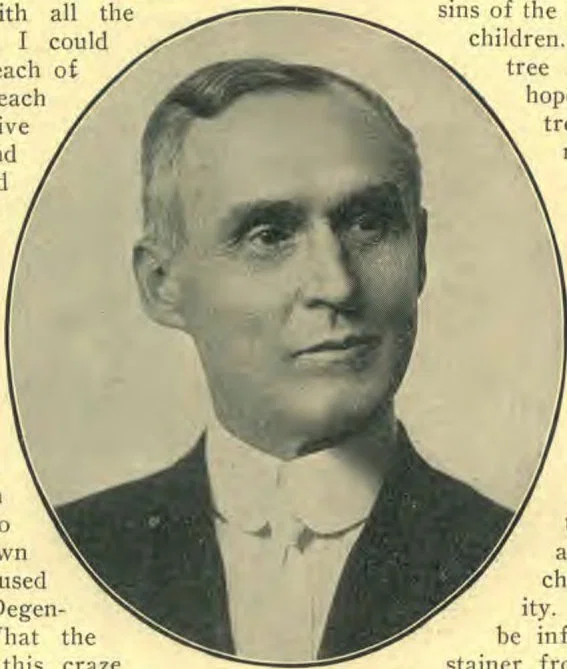
[Dr. Kress’s extended experience as physician and as superintendent of sanitariums in England, Australia, and America, has given him unusual opportunities for observing the effect of tobacco upon the human body.]
THE amount spent in the United States alone for tobacco annually would enable me to provide thirty thousand families each year with all the necessities of life. In addition I could grant an allowance of $5,000 to each of ten thousand other families. To each of ten thousand others I could give $10,000. To each of one thousand other heads of families I could make a Christmas present of $50,000. To each of another thousand I could give $100,000; and, besides, to each of five hundred of my best friends I could make an annual allowance of $1,000,000. After doing all this, I would still have left each year $20,000,000 to bestow on charitable institutions, and at least $10,000,000 to keep the wolf from the door.
Four hundred years ago the use of tobacco was unknown in civilized lands. To-day it is used by men, women, and children. Degeneracy has been the result. What the coming generations will be, if this craze continues to increase as it has in the past, does not present a picture pleasing to contemplate.
Tobacco was early considered a cure for indigestion and dyspepsia. While it removed the unpleasant symptoms associated with dyspepsia, by producing a state of partial anesthesia, or deadening the nerves, it did not cure the dyspeptic, but tended to aggravate the existing condition. When the influence of the nicotine had worn off, naturally the symptoms were found to be worse, and another smoke was demanded. To remain comfortable the dyspeptic discovered it was needful for him to remain under the influence of the nicotine all the time. In this manner the tobacco habit was created and perpetuated, not merely among dyspeptics but among others who desired to feel well, although they were ill.
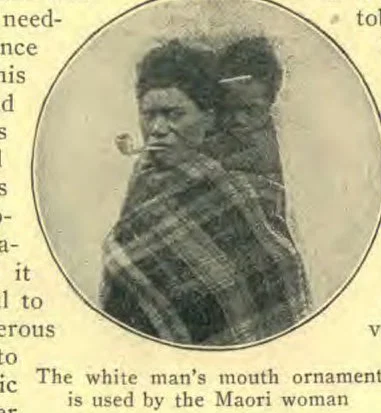
Efforts were made in various countries to suppress the habit as it became more prevalent. James I of England pronounced it “a custom loathsome to the eye, hateful to the nose, harmful to the brain, and dangerous to the lungs,” and urged his people to abandon its use. For years the Catholic Church would not permit its use by her adherents. To-day it is used by priests and kings, by rich and poor, by men and women, by boys and girls. A habit so universal can not but make its impress upon the race.
There are in the United States thirteen millions of children of school age who are physically and mentally defective. The real remedy does not lie in the removal of adenoids, and the patching up of decayed teeth, but in reforms in the future propagators of the race. The sins of the parents have been visited upon the children. It is impossible for a corrupt tree to bring forth good fruit. The hope of the future lies in making the tree good in order that its fruits may be good also. The injurious effects of tobacco on growing life are well understood. For this reason, tobacco in many lands is forbidden the youth. It retards the normal growth and development of tissue. The boy who smokes before he reaches the age of twenty or twenty-two—that is, before he has his growth—will be an inferior man to the one he would have been if he had not used tobacco. Mentally, intellectually, and morally he will be an inferior man. He will lack in chest development and lung capacity. Other things being equal, he will be inferior in every respect to the abstainer from tobacco.
Nicotine, the poison found in tobacco, when taken into the system lessens tissue changes. The worn-out material that should be eliminated and replaced by new and better materials is retained. Normal growth of muscle, nerve, and brain is therefore arrested. Athletes who wish to excel find they must abstain from the use of tobacco altogether, because it weakens and injures that vital organ, the heart. Accountants who are addicted to the use of cigarettes or tobacco in any form, are not as accurate as are the abstainers. Anything that the user of tobacco can do well, he could have done better had he never used it.
The boy, therefore, who wishes to make the most of himself, can not afford to weaken his body and mind by the use of cigarettes. An instructive experiment took place in the United States Naval Academy at Annapolis some years ago. The new superintendent found, on entering upon the duties of his office, that there was a rule against smoking, which was ignored and violated by the students. Believing that a law not enforced was demoralizing, he asked the government for a commission of scientific men to make a careful examination for the purpose of ascertaining whether the rule had adequate grounds for existence. Several of the smokers were put through tests for ascertaining theirp. 21 muscle strength, heart strength, and capacity for study. The same number of non-smokers were subjected to the same tests. The average of the results was greatly in favor of the non-smokers. Tobacco was then withheld from the smokers for a time, and they were tested again. It was found that the muscle strength, the heart strength, and the capacity for study were all increased. As a result of this, the rule against smoking among the younger men of the school was enforced, and remains in force to-day.
Every teacher, and all who have to do with boys, should know these facts, and by precept and example teach them. Our national life is at stake; for the boys of to-day will be the men of to-morrow. Many boys would not use tobacco if they only knew these facts. They begin to use it because they consider it manly. They are taught by example more than by precept.
Tobacco is bad for both old and young. The school board of Chicago, in a medical examination of pupils before allowing them to take part in certain athletic sports, discovered that a large number of the boys were in a physical condition that made violent exercise of any kind dangerous. Twenty-one out of one hundred were found totally unfit to participate in the sport, and all but three suffered from some form of heart-disease. The verdict was that almost to a man they were cigarette smokers.
At the time of the Boer War in Africa, out of nearly twelve thousand men in the Manchester district, England, who considered themselves fit to fight for their country, and appeared for examination, eight thousand were at once rejected; and out of the entire twelve thousand only twelve hundred passed all the tests required by the physicians. The chief cause of their disability proved to be smoking, as boys and young men.
In Germany heart-disease has increased three hundred per cent during the last twenty years. One half of the young men between the ages of eighteen and twenty-one are said to be unfit to bear arms. Beer and tobacco are considered to be the chief causes of this degeneracy.
In America out of sixty-seven applicants who appeared for examination to enter the medical department of the army during the Spanish War, forty-three were rejected, having what the doctors pronounced “tobacco heart.”
This means much when we consider that in these classifications we have represented not the weaklings or degenerates, but the choicest young men these countries could produce.
In recent years there has been a decided increase in the number of sudden deaths from heart failure. There is no doubt that this increase is partially due to the free use of tobacco. Nicotine strikes a direct blow at the heart. It weakens the heart’s action, and in time brings about degenerative changes in its structure and also in the walls of the blood-vessels. The hypertension and arteriosclerosis indicative of degenerative changes, are usually found among users of tobacco.
Flies Die in a Tobacco Show-Case
Tobacco is a deadly poison. Gardeners and keepers of greenhouses destroy grubs and noxious insects with fumes of tobacco. Flies confined in a show-case with cigarettes will die in a few minutes, so deadly does the atmosphere become. Birds and frogs and other small animals die when exposed to the fumes of tobacco in a confined space. Cheese mites, bees, and other insects may be quickly killed by directing upon them a stream of tobacco smoke from an ordinary pipe.
Not only insects, but infants who have but a slight hold on life, and are compelled to inhale the nicotine which is expelled from the lungs and skin of a tobacco-using father, are often seriously injured if not killed by such exposure. Wives who are compelled to sleep in ill-ventilated rooms with tobacco-using husbands also become sickly, as great injury is sustained by the inhalation of tobacco fumes.
In the cigar factories of Vienna, where women are largely employed as workers, the rate of mortality among breast-fed children is eighty-nine per cent when the mother returns to her work soon after confinement, while the average rate of infantile mortality of breast-fed children of the mothers who were not tobacco workers is found to be only thirty-nine per cent.
The evils resulting from the use of tobacco should be determined, not by its effect upon the strong, who are hard to kill, but by its influence upon the weak.
Tobacco shortens life. While occasionally a tobacco user lives to old age, tobacco using and usefulness in old age are rarely associated. It is one thing to really live in old age, and quite another thing to exist merely as an object of charity.
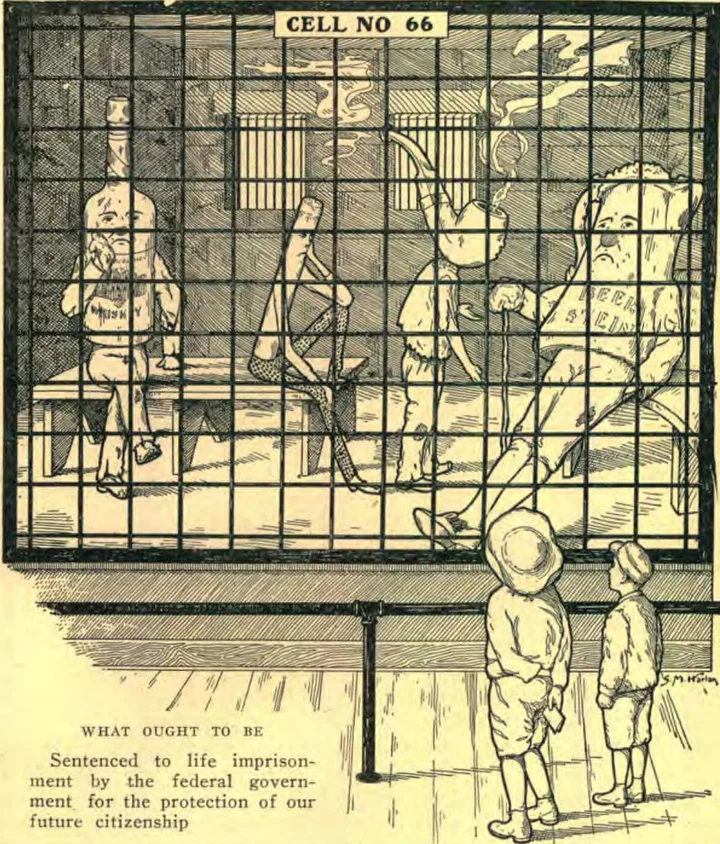
Tobacco destroys the mind. Young men who use tobacco seldom attain to superior scholarship in school, and are unreliable in business. It is said that for a period of fifty years no tobacco user has ever stood at the head of his class in Harvard University, although five out of every six use the weed.
Dr. Solly, of St. Thomas Hospital, England, says: “I have had a large experience in brain disease, and am satisfied that smoking is a most noxious habit. I know of no other cause or agent that so tends to bring on functional diseases, and through these in the end to produce organic diseases of the brain.”
Much has been said in regard to the cigarette. Its chief danger lies, perhaps, in its apparent innocence. As in drinking, many who would not begin with whisky are enticed by beer and wine, because they are milder drinks, so the cigarette, because it is much milder than the pipe, encourages the young and even women to smoke.
That the manufacture and sale of the cigarette should be prohibited by law is now generally recognized.