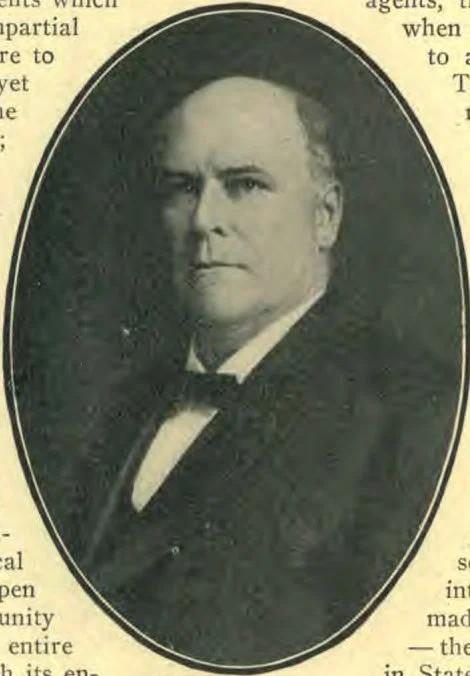
R. B. Glenn
EX-GOVERNOR OF NORTH CAROLINA
HAVING been requested to give my reasons why I believe that State-wide prohibition is the most effective method of curtailing the liquor evil, I desire to make a few statements which I believe will convince any fair, impartial reader that State prohibition does more to prevent the evil than any other plan yet tried. There are three views on the liquor question: First, high license; second, local option; third, State-wide prohibition. Now the one that lessens the drinking habit most must certainly be considered the best. No one will contend truthfully that the open saloon does this, even though operated under high license; for the higher the license, the more strong drink has to be sold in order to make it a paying investment; and therefore the owners of saloons have to make their establishments as attractive as possible in order to insure them enough cash to make their investments pay. The second method, local option, is an improvement on the open saloon, and is to a town or community what State-wide prohibition is to the entire State; and as it abolishes the bar, with its enticements and mixed drinks, and does away with a place where men can meet for social drinking and enjoyment, it does a great deal to promote the cause of temperance, and may be a stepping-stone to final adoption of prohibition in the State. Being confined, however, to a community or a town, which community or town is often surrounded by other counties and cities where the open saloon is still retained, persons from the dry territory easily go or send into the wet section, and bring back their supplies of liquor for personal use in their homes, or for distribution among others. Even the most effective laws—which are not very prevalent in the States—forbidding the shipping from wet territory into a local option community, do not always avail; for the law can be evaded by bringing the liquor in valises, wagons, etc., and when shipped, it is often disguised under another name than that of strong drink. Any thinking person will admit that the farther you remove a temptation from individuals, the easier it is for them to resist that temptation. This is embodied in the prayer of our Master, when he said, “Lead us not into temptation, but deliver us from evil.” A man will not go out of his State, or even solicit a shipment from another State, in order to get strong drink, as quickly as he will go around the corner to an open saloon, or from a dry place to an adjoining wet one. Transportation from State to State has to be made generally over railroads or through steamboat facilities, and has to be handled by various agents, thus making it more conspicuous than when one goes in person or sends by a friend to an adjoining town for a small supply. The officers of the law also can more readily see what is going on when it is done by public transportation than when smuggled in secretly; and no one yet has been found so bold as to want the public to know that he is receiving shipments of liquor, especially when in so doing he is opposing the public sentiment of his State, which has declared for prohibition. In the last two years I have been in thirty-seven different States, and after a thorough and most careful examination, I can truthfully say that in the States that have State-wide prohibition—though there is some violation of the law, and some persons who, by permission of the interstate commerce law, have shipments made to them of liquor from other States—the drink evil is fifty per cent less than in States having high license, and even thirty or forty per cent less than where there is local option. Take, as an example, the State of Kansas. Its governor sees to it that the law is enforced, and with the exception of towns and communities bordering on States where liquor is allowed to be sold, one scarcely sees any indication of liquor selling, and the people are sober and industrious. Take my own State of North Carolina: I know there is not one half the drinking in the State to-day that existed under the old system; and it was amusing when a leader of one of the political parties recently gave as a reason why our State prohibition law should be repealed, that the people who drank were getting tired of having to go all the way to Virginia to get a little booze. The very class that we desire most to protect from the liquor habit, being unable to order, or afford the expense of going after it, are compelled to be temperate; and now we hear less complaint from employers, and from fathers and mothers, of the drinking of their employees and their children.

Let each State where public sentiment is ripe for it, adopt State-wide prohibition, and then let Congress pass a law prohibiting any public utility corporation from hauling liquor into a dry State, and also refuse to license persons in a dry State, and the liquor problem will be on the way to solution; for, unable to spend their moneyp. 27 on strong drink, persons who have hitherto wasted their substance in riotous living will invest it in homes, in stock, in mills, and in other corporations; or put it in clothes for themselves and their families, and in better educating their children. When this is done, the development and upbuilding of these prohibition States will so far exceed that of those where open saloons encourage, and local option only partially forbids, that, to keep up in growth and prosperity, the liquor States will perforce be compelled to adopt similar laws prohibiting the sale and manufacture of liquor in their borders.
To prove this assertion I will give you a brief comparison between the State of New Jersey, which has high license, and not even local option in any county, and the States of Maine and Kansas, both of which have State-wide prohibition:—
| New Jersey | Kansas and Maine | |
|---|---|---|
| The unofficial population for 1910 | 2,404,617 | 2,435,336 |
| Assessed value, real and personal property (1908 / 1909) | $918,418,741 | $2,876,068,999 |
| Valuation per capita | $381 | $1,139 |
| Unmortgaged homes | 661,755 | 192,046 |
| Rented homes | 250,848 | 181,268 |
| Liquor dealers, including druggists | 11,605 | 3,694 |
| U. S. liquor tax | $3,470,644 | $102,508 |
| Convicts in State prison and penitentiary | 1,827 | 1,036 |
| Insane | 6,075 | 3,519 |
| Cost of maintaining insane, 1909 | $1,125,491 | $763,481 |
| Average school attendance | 289,167 | 384,387 |
| Students | 3,214 | 7,604 |
These figures fully explain themselves, and show that in one State the people are spending their money upon the things that perish, while in the other two States they are spending their substance for homes, investments, and deposits in banks. One column also shows increase in poverty, ignorance, and insanity, while the other is a strong argument that prohibition tends to make a State wealthier, healthier, and wiser. With such facts staring us in the face, who can deny that State-wide prohibition is the most effective way for regulating the whisky traffic, and is really a boon to every legitimate interest of the people? Again quoting from the report of F. B. Coburn, secretary of the board of agriculture of Kansas, I desire to add these facts. He says: “After thirty years’ trial, prohibition is so popular in Kansas that no person would dare to advocate its repeal. Twenty-eight poorhouses are without inmates; eighty-seven have no insane inmates; fifty-four have no feeble-minded persons in them; twenty-one counties have no convicts in the penitentiary; thirty-six, no prisoners in the reformatory; fifty-two, no prisoners in jail; and sixteen, without a single person serving any kind of sentence.” The governor confirms this report, and says the people of Kansas were never better clothed, better fed, had finer houses, or larger bank accounts, or were in better health, than they are to-day, and they attribute these great blessings to a very large extent to the effects of State-wide prohibition.
With these facts, then, before us, desiring as we do to save our children from the liquor evil, and to make them more useful citizens, let us use every honorable method to bring about State-wide prohibition in the vari-ous States. This, of course, can not always be accomplished in a day, and local option may be the most effective remedy to bring it to pass; but let us never be satisfied to submit to a high license, or even to local option save as a means to an end, but go forward until State-wide prohibition is accomplished, as it is the best, surest, safest, most effective, and most certain method of stopping and extinguishing an evil that is now destroying the bodies and minds of our people while in this life, and dwarfing the development of souls intended for the enjoyment of life eternal.
Again, unhesitatingly, I authorize you to quote me as saying that State-wide prohibition is the one end for which all true temperance people should contend, as giving the greatest good to the greatest number, the fundamental doctrine of our democratic form of government.