Rum as a Factor in the Border Wars and Conquest of Ohio
By George P. Donehoo
Rum as a Factor in the Border Wars of the Early Days, and Its Influence in the Conquest of Ohio
George P. Donehoo, D. D.
[Mr. Donehoo has done much research work for the Smithsonian Institution, Washington, D. C., and has contributed considerable historical material to various publications.]
The history of the French and Indian war, and the succeeding period of Indian hostility, when western Pennsylvania, Virginia, and Ohio were simply deluged in blood, would read differently had the traffic in rum been eliminated from the problem which the English had to solve. The conquest of the rich region beyond the “endless mountains,” in which there now exists the greatest empire this world has ever known, is one of the romances and one of the tragedies of history. The struggle between the French and the English for the possession of this transmontane empire is one of the most fascinating stories of human history. When the conflict began on the shores of the “beautiful river” in 1753, there were three leading actors in the drama, which was to result in the greatest conquest the Anglo-Saxon race has ever made,—the French, the English, and the Indian.
In the years of strife and bloodshed which followed before this empire was possessed, the Indian held the balance of power. The armies of France and those of Great Britain alike sought the friendship and assistance of these red warriors of the mountains and forests. Had the English treated these proud and haughty warriors with the kindness and respect which had been the custom of the Penns, the Indian as a factor in the solution of the problem would have been eliminated, and the conquest of the Ohio would have been a less bloody one. After the death of William Penn, the policy of the province in dealing with the Delawares was changed. Before these Indians sensed what was being done, they had lost all their lands along the river, which had belonged to their ancestors for generations. They began their migration to the waters of the Susquehanna. They, with the Shawnees, who had come into the province from the South, settled along the shores of the “winding river,” hoping that they might be allowed to live along the beautiful valleys of this forest-enshrouded wilderness, undisturbed by their invaders. But no sooner had they builded their wigwams than they were followed by the Indian traders, who followed them as keenly as ever Indian hunter pursued the trail of the deer, bringing their ponies laden with rum, which was their chief article of trade. The debauchery which they had escaped on the Delaware followed them into their villages on the Susquehanna.
The wise chiefs of the Iroquois, Shawnees, and Delawares petitioned the authorities of the province again and again to put a stop to this trade, which was ruining the women as well as the men of their tribes. They sent envoy after envoy to Philadelphia protesting against the sale of rum. Canassatego, the eloquent Iroquois chieftain, and Shikellimy, the vicegerent at Shamokin, again and again besought the provincial authorities to keep this horde of Indian traders, with their death-dealing rum, away from their settlements. The authorities made a half-hearted effort to put a stop to the sale of rum in the Indian villages, but it had little effect. The traffic in rum went on, with its strifes and bloodshed. The colonial records and archives of Pennsylvania are filled with the accounts of the conflicts of the Indians and the Indian traders because of the quarrels, debauchery, and bloodshed caused by this unrestricted traffic in rum. The Indians were made drunk, and then cheated of their skins and peltries. When they sought revenge for these wrongs, bloodshed resulted, and they were then brought into conflict with the white settlers, who were rapidly pressing into the Susquehanna region. Almost every murder of a white settler of this period was due to a quarrel following a drunken brawl, in which the Indian had been cheated out of his entire year’s store of skins2and peltries. The writer does not know of a single murder which was not so caused, and that after reading the official accounts of every murder of a white settler by an Indian in this period.
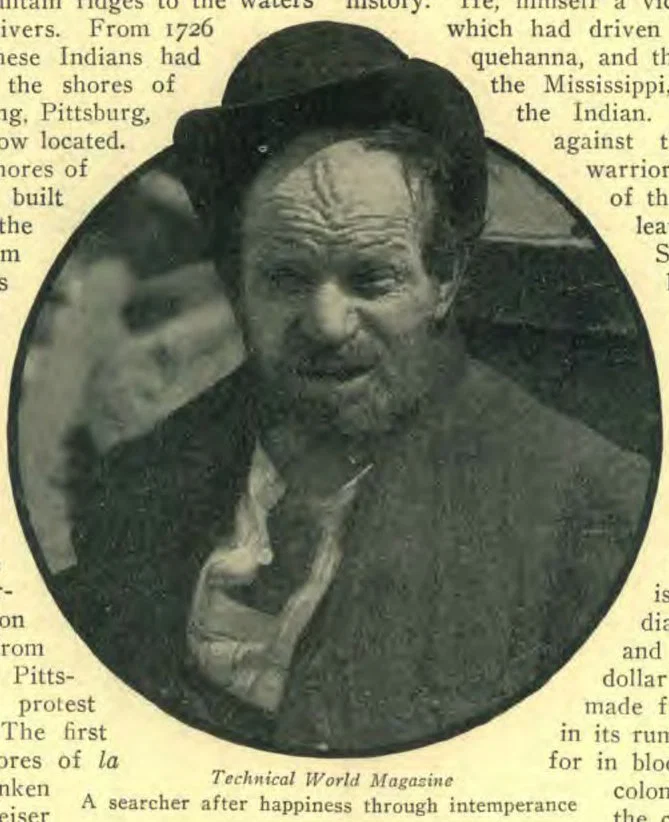
Technical World Magazine
A searcher after happiness through intemperance
When the Shawnee and Delaware along the Susquehanna found out that they could not keep the traders in rum out of their villages, they began to move in large numbers across the great mountain ridges to the waters of the Allegheny and Ohio rivers. From 1726 to 1732 a great many of these Indians had builded their villages along the shores of these streams, where Kittanning, Pittsburg, Beaver, and other cities are now located.
Here, on the forest-bounded shores of the “beautiful river,” they built their wigwams, hoping that the rum trader would leave them alone to paddle their canoes over the waters of what was then a beautiful paradise, and to hunt in the forests, which were filled with game. But the smoke had hardly arisen into the blue sky from their fires before out from the forest trails came the trader with his rum-laden ponies. Then commenced the same history of cheating, quarrels, bloodshed, and murder on the Ohio. The first message from the chief who lived where Pittsburg now stands was a protest against the traffic in rum. The first murder committed on the shores of la belle rivière was due to a drunken debauch. When Conrad Weiser crossed the mountains to the Ohio in 1748, on his way to Logstown, where the first council of the English race was held with the Indians west of the mountains, one of the chief matters spoken of by the representatives of the Indian tribes on the Ohio was the traffic in rum. The French had been brought into trade relations with these Indians, and the English were doing everything in their power to win them back to their allegiance to them. Every effort had been made by the authorities of the province to induce the Delawares and Shawnees to move back to their old homes on the Susquehanna, which they had left to escape the traffic in rum. Mark well what this means. When the struggle between the French and the English for the possession of the Ohio began, the situation was complicated because of the presence of the Delawares and Shawnees, who had been driven from their homes on the Susquehanna chiefly because of the various land sales and the rum traffic. When General Braddock’s ill-fated army was cutting its way through the dark forests and over the great ridges of mountains, these Ohio Indians were nearly all on the side of the French, who would not allow rum to be sold to them. Braddock’s fearful disaster on the banks of the Monongahela was due far more to the abuse and the bloodshed which had resulted from the rum traffic by the Indian traders than to any lack of ability on the part of the sacrificed British general. After Fort Duquesne had finally fallen into the hands of the British, there commenced the struggle for the possession of the land, which the Indian claimed by right of previous conquest and settlement.
The history of this period is one almost unbroken succession of scenes of bloodshed and cruelty. The Indian was fighting for his “home and native land” as truly as did any patriot who fought for his fireside against the invader of it. The chief factor in the fearful scenes of bloodshed which make this period one of the darkest in American history, was the same which had stained the waters of the Susquehanna with blood a generation before. Tedyuskung, the last of the great chiefs of the Delawares, pleading for peace and the rights of his people to live in the land which had belonged to his fathers, is one of the most pathetic pictures in American history. He, himself a victim to the vice of the race which had driven the Delawares to the Susquehanna, and then to the Ohio, and then to the Mississippi, knew what rum meant to the Indian. At last, after a struggle against the stronger race, the red warrior vanished from the waters of the Susquehanna and the Ohio, leaving his beloved vales of Skehandowana and the rich hunting-grounds of the Monongahela to his conqueror, whom he defeated in almost every battle, but to whose rum he bowed his feather-crested head in humiliation and defeat. The story of the border wars of the early days has been repeated in Dakota, in the Lava Beds, in Alaska, and is being repeated in every Indian village of South America and Mexico to-day. For every dollar the Anglo-Saxon race has made from any of the native races in its rum traffic, it has in return paid for in blood. Eliminate rum from the colonial history of America, and the conquest of the Ohio and the Mississippi and the great Northwest would not be written in letters of blood.