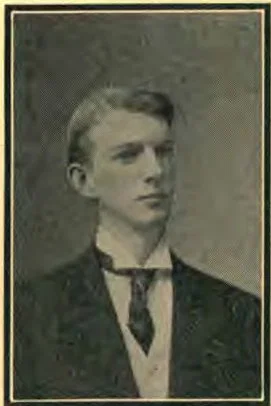
Lewis M. Simes
SOUTHWESTERN COLLEGE, WINFIELD, KANSAS
[The following article is a prize oration, delivered by the author last June in the national oratorical contest of the Intercollegiate Prohibition Association, at Valparaiso, Indiana. Mr. Simes won second place in this contest; but in the central interstate contest of seven States he won first place.]
Evil Disguises Itself as Good
The powers of evil delight to take for their standard an emblem of heaven. The prince of darkness comes “transformed into an angel of light.” In the facts of to-day this truth is confirmed. The liquor traffic hides behind the insignia of truth, and takes personal liberty for its watchword. Therefore, I stand here to-night, not to heap anathemas upon the drunkard, not to proclaim the economic evils of the drink traffic, great as they are, but to tear from this shameless hypocrite of the ages his thin mask of righteousness, and to proclaim him as he is.
Prohibition Consistent According to Law
Consider the status of the liquor traffic before the law. More than half a century ago the saloon forces began to make the hollow plea before the courts of the land that prohibition endangered the freedom of the individual. With pretended patriotism they declared that the abolition of the saloon infringed upon the constitutional privileges of American citizenship. The Supreme Court passed judgment upon these sophistries. It swept them away like cobwebs. Decision after decision was handed down. Finally, in the case of Crowley versus Christensen, the court delivered an opinion, approved by every member of that judicial tribunal, and written in such definite and forceful terms that none could misunderstand its meaning. This decision declared that the retailing of alcoholic liquors is not an inherent right of citizenship, and that the restriction or entire prohibition of the liquor traffic does not infringe upon the liberty of the individual. But the crowning decisions rang out in the court-rooms of this grand old State of Indiana, when Judges Artman and Christian boldly declared that the mere licensing of such a moral ulcer as the liquor traffic is immoral, illegal, and unconstitutional. And God grant that, not only from Indiana’s district court, but from America’s supreme tribunal, shall come the words: From henceforth, O rum king, you are outlawed; no more shall legislatures license your villainies or protect your crime!
Prohibition Consistent According to Principles of Liberty
But some may think that court decisions alone do not prove prohibition consistent with personal freedom. To them I would say, Consider the true nature of liberty itself. What is this freedom we so fondly cherish? Is it the right to do as one pleases, regardless of others’ welfare? Is it the right to break law, to injure property, to destroy life?—No, that is not liberty; that is license. Except a man remove beyond the confines of human habitation, he may not do as he will. As long as men dwell together, so long must each regard the others’ rights. What, then, is true liberty?—True liberty is that sphere of action granted to the individual in the exercise of which he does not infringe upon an equal sphere of action granted to others. Apply this principle to the saloon. True, we are told the law can not say what a man shall drink if no one is harmed thereby. But the fact is, the saloon does harm some one. It seizes the laborer in its greedy clutch and filches his toil-bought gold. It crowds the vacant corridors of poorhouses, prisons, and asylums. It touches pure hearts with its polluted finger—and behold blighted souls! It blows its poisoned breath upon innocent womanhood—and behold dead hopes and ruined hearts! Sin and sorrow follow in its wake. Death and destruction marshal their cohorts upon its track. Then do we infringe upon personal liberty by the prohibition of such a monster? The government infringes upon no constitutional rights when it compels the owner of a powder-mill to conduct his business apart from other buildings: the public safety demands it. The law deprives no man of personal liberty when it prohibits public lotteries: the public morality demands it. The health officer tramples upon no individual freedom when he tacks the smallpox placard upon the disease-infected home: the public health demands it. Then who dares to affirm that the prohibition of the liquor business infringes upon personal liberty? For the liquor traffic is a hundredfold more corrupting than a lottery, a thousand times more deadly than the smallpox, and ten thousand times more dangerous than all the powder-mills in America.
Prohibition Consistent According to Evidence
We have seen the rightful place of the saloon before the law. We have tested its false claims by the true principles of personal freedom. One more step remains. Call forth the witnesses. Let us summon before us those countless thousands who have left this demon’s baleful hand. Go first to the poorhouses. Bring forth the paupers drink has made. They will not be hard to find; for one out of every four of these unfortunates owes his condition to the saloon. Open the iron-bound doors of the asylums. Lead forth those wild-eyed wrecks of humanity placed there for public safety. One out of every four of these, also, comes to witness before us to-night. Summon the patrons of the saloon. They also witness to the slavery of their taskmaster. Unbar the jails, the prisons, and the penitentiaries. Lead forth the murderers and anarchists and criminals of every kind. One out of every three stands before us to declare: The liquor traffic made me what I am; it took my liberty; it stained my hands with human blood. Some there are whom I would summon that can not appear; for death has claimed them. But if I could call back to life George C. Haddock, of Iowa, and Senator Carmack, of Tennessee, those martyrs for the cause of righteousness would stand here to say: The liquor traffic aimed the weapon that took my life. Is not this evidence enough? See this vast array of witnesses who tell of the saloon power’s thralldom and crime. Does it look as if the monster is a defender of liberty? Is it likely that the creator of criminals would defend the loftiest principles of our body politic?—No, a thousand times no. When its own votaries declare it to be a slaveholder, when ten thousand witnesses proclaim it an anarchist, and when the departed dead brand it a defiant murderer, it is time for the jury of American public opinion to pronounce the verdict that this thingp. 18 shall die. But still the liquor dealer makes his hollow, brazen appeal. Still he blasphemes the sacred cause for which our forefathers shed their blood. I have seen the sacred words of Holy Writ flaunted across the pages of a liquor dealers’ paper. I have seen the name of Frances Willard gracing the arguments of a liquor dealers’ plea. Aye, I have seen the actions of the Saviour of mankind interpreted as hostile to prohibition. And when I hear the liquor men boast of love for liberty, as they did but recently in Chicago; when I read of their so-called organizations of freedom, like the Personal Liberty League of Southern Illinois,—when I face these facts, I am led to exclaim, as did Madame Roland, going to her execution, “O Liberty, what crimes are committed in thy name!”
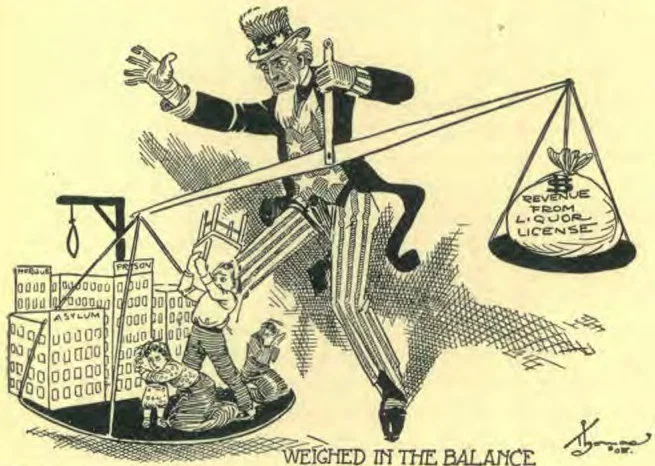
There are forty dollars of economic loss to the country for every dollar of revenue.—Richard Pearson Hobson
Conclusion
Friends of true liberty, we must still fight the defenders of false freedom. Every atom of energy, every power that we possess, must be spent for the conflict. At the battle of Trafalgar, when the sea powers of France and England were marshaled against each other, Lord Nelson issued this famous proclamation, “England expects every man to do his duty.” To-day the defenders of true and false liberty are drawn up in battle array. Hear the command of your leader, O friend of prohibition: The King of heaven expects every man to do his duty. Strike for the land you love. Strike for the untarnished name of American manhood. Strike for the unsullied purity of American womanhood. Strike for the sacred altars of the American home. Strike for the true liberty that was wrought in the battle stains of Concord and Lexington and Bunker Hill. In the name of Almighty God, strike till the rum king turns white with fear; till his cringing henchmen flee. Strike till the liquor traffic falls and dies. And throughout the land there shall be no more a drunkard and no more a legalized saloon. Then, in the light of a larger liberty, freed from the galling bondage of the tyrannical slaveholder of the ages, we shall write in letters of living light: America is free! America is free!