[The following article is an extract from an address given to the St. Louis Medical Society by Dr. L. Bremer, late physician to the St. Vincent's Institution for the Insane at St. Louis, Missouri. The entire address can be obtained in pamphlet form from the Gospel Publicity League, Tremont Temple, Boston, Massachusetts.]
At the outset, without entering into preliminaries and details, I will state that I side with those who, looking at the injurious effects collectively, consider tobacco more harmful than alcohol, from the simple fact that its use is more general, its effects more gradual and less obvious, and that, from a moral point of view, it is in better standing.
The breath of tobacco is held permissible, and will be condoned by all classes; that of alcohol is looked upon as odious, and exposes its bearer in some quarters to social ostracism.
It is this connivance, on the part of public opinion, at this kind of luxus consumption, as it is euphoniously styled by modern physiologists, that fosters its spread, especially among those who can least afford to offer any insult to their nervous systems. And, unfortunately, it is just this class of persons who delude themselves into the belief that tobacco is indispensable to them.
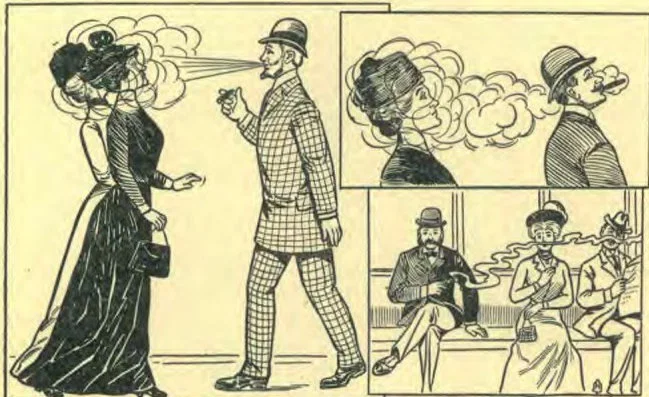
Our ancestors were evidently not so deleteriously affected either by alcohol or tobacco as modern man is, with the strain of the requirements of a more complicated life weighing upon him, and handicapped, as he frequently is, in his nervous and psychical make-up.
Tobacco Leads to Imbecility and Insanity
It may look like overstating and exaggerating things, but I know whereof I speak, when I say that tobacco when habitually used by the young leads to a species of imbecility; that the juvenile smoker will lie, cheat, and steal when he would not had he let tobacco alone. This kind of insanity I have observed in quite a number of cases at the St. Vincent's. The patients presented all the characteristics of young incorrigibles. They had exhausted the indulgence of their parents, who saw no other way to protect them from their insane pranks than to commit them to the institution. Had they been less favorably situated financially, they would have landed at the house of correction or the workhouse.
I do not know whether a lasting improvement was effected in any of them. There was not one among them that was able to comprehend that tobacco was injuring him; they were constantly on the lookout for obtaining it, by begging, stealing, or bribing, and regarded the deprivation of the drug as a punishment. The sense of propriety, the faculty of distinguishing between right and wrong, was lost. The father of one of them, who looked upon his son only as an aggravated case of bad boy, told me that he himself had been smoking ever since his tenth year and it never had affected him. In reality, being only forty-five years old, he was a wreck, physically and mentally, though he came of healthy stock. He could not or would not comprehend that tobacco was gradually undermining his own mind and body, although his wife and his friends knew it.
But it is not only in the young that the use of tobacco is followed with such disastrous effects. Smoking or chewing, when commenced in the period of manhood, and even at the time it generally does least harm, after middle age, will tell on the mind if excessively indulged in. Is it to be wondered at that a drug which has such potent and palpable effects as to produce loss of coordination and unspeakable malaise, and after the organism has become used to it, is capable of setting up the well-known heart disturbances, amblyopia and even amaurosis,—which, in short, possesses the characteristic qualities of a powerful nerve poison,—is it a wonder if such drug, when, in spite of the warnings on the part of various organs, excessively and persistently used, finally produces one or another form of insanity?
It has always seemed to me that whenever tobacco entered at all as a factor in the case of insanity, it was the immediate cause, vivifying, uniting, and condensing, as it were, the dormant morbid elements which predisposed the individual to mental disturbance. Thus I have seen melancholia, more often mania, and very frequently general paresis, hastened and precipitated by the excessive use of tobacco. I know, however, of instances where the last-named disease, or “softening of the brain,” as it is called by the lay public, could not be referred to any other cause but tobacco.
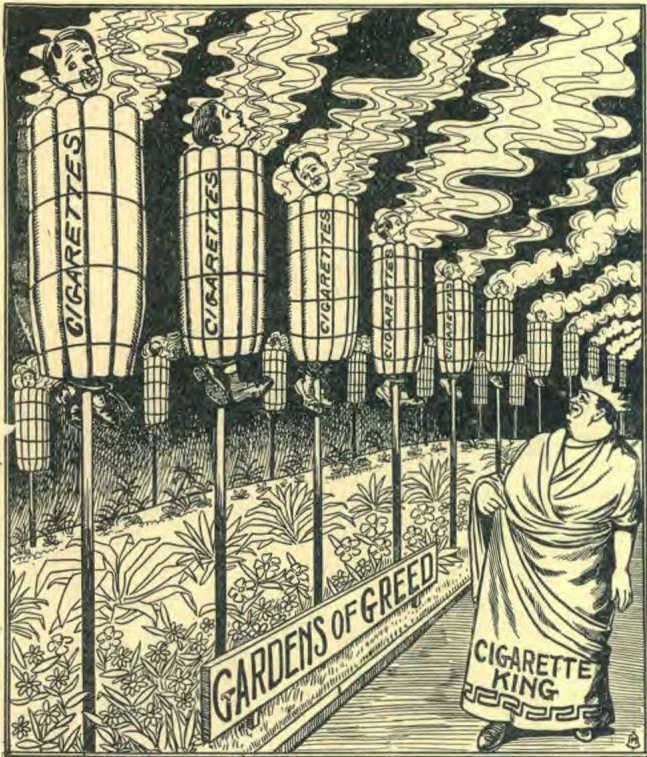
That tobacco really does cause insanity is evidenced by the magic effect seen in some cases after the discontinuance of the drug, when the patient's condition is still such that he is not wholly inaccessible to reason, and has will power enough to abandon the habit. Thus I have seen that beginning melancholia with suicidal impulses, hallucinations of various kinds, forced actions, besides the precursory symptoms of insanity, such as insomnia, crying spells, præcordial anxiety, fears of impending evil, “that something is going to happen,” impotency, vertigo, beginning impairment of memory and judging power, and even the lowering of the moral tone, all of which, and a host of other symptoms, were attributable to chronic tobacco intoxication, disappear after freedom from the habit was established.p. 25
But whenever a case has gotten so far that commitment to an institution has become necessary, the prospects are not so good, because such persons, as a rule, can not be convinced that tobacco is, or has been, the cause of their mental trouble. Their argument is that almost everybody smokes, that all their friends and acquaintances chew or smoke, without showing any symptoms of insanity. The alcoholic insane, when leaving the institution to enter active life again, generally knows and admits that alcohol has been the cause of his mental breakdown. The nicotine victim does not admit anything.
French medical observers are of the opinion that one of the factors causing the depopulation of France is the excessive use of tobacco by its inhabitants; for the offspring of inveterate tobacco consumers is notoriously puny and stunted in stature, and lacks the normal power of resistance, especially on the part of the nervous system. Again, in our country it is a significant fact that an astounding percentage of the candidates for admission to West Point and other military schools are rejected on account of tobacco hearts. From all countries and from all classes of society come reports in increasing numbers of the baneful effects of the tobacco habit.
But the consumption goes on, and will do so until an example is set by those who, above all others, can estimate the disastrous effect of the habit. If—
Teachers, Preachers, and Physicians
would pronounce an anathema against tobacco, and abstain from it themselves, others would follow. But here is the difficulty. It is only exceptionally that a smoking pedagogue, clergyman, or physician can be convinced that he would be a better man physically, intellectually, and morally, if he would give up tobacco. Instances are cited by them of great men, inveterate and excessive tobacco consumers, who left their mark in the history of civilization as savants, artists, etc. They do not consider the possibility that these men accomplished what they did in spite of their habit, and not in consequence of or aided by it.
There is only one way to lessen the evil, and that is by the dissemination of knowledge of the baneful effects of tobacco among the rising generation, initiated and sustained by the three professions mentioned above. Of course they ought to practise first what they are going to preach.