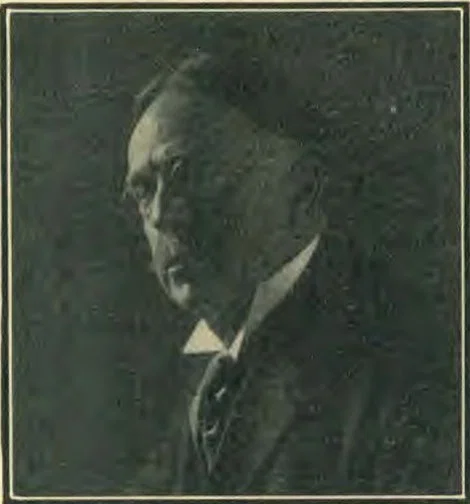
Hon. John G. Woolley
ONE OF THE MOST ACCEPTABLE TEMPERANCE ORATORS OF THE DAY
As the fires of the human body are in the muscles, so the fires of the body politic are in that mighty network of applied morality that we call, in a word, business; and this shows why philanthropy, however broad and deep, bears mostly disappointment until it works its way into the shafts of competition.
The temperance movement, now so imminent and compelling, began in terms of fear and pity; and, for all the logic, loyalty, and labor it employed, and the sporadic betterment it wrought in individuals and homes and towns, the balance of account stuck like a leach to the wrong side of the social ledger. The light of its arguments was clear, but not impressive. “Quit the drink,” it said to the drunkard; “it tends to poverty, sickness, degradation, and domestic discord.” But the infatuated devotee only muttered, “They have stricken me, and I was not sick; they have beaten me, but I felt it not; I will seek it yet again.”
“Sign the pledge of total abstinence,” it said to lusty youth. “‘Wine is a mocker;’ it will ensnare you; it may make you a drunkard.” But “the glory of young men is their strength,” and the young man answered: “Not me. I am too sound and proud and strong to go that way.”
Of all the fuel energy consumed in the initial period of the great reform, perhaps not less than ninety-five per cent went up the smokestack; but the good fraction of power was enough to keep the keel of progress up into the wind. Some debauchers reformed. Some young men took warning. Parents and priests began to notice, learn, and teach. Flocks of children — thickets of twigs in the forest of humanity — were bent so that their maturity was inclined to total abstinence. But the great body of society showed no interest; and the degrading business held its cruel sway. The medical profession kept the liquor side, and statesmanship was silent.
A Small, Sure Gain
Yet there was a small, sure gain of position. Farmers began to see that the jug in the fence corner slowed the harvesting. Builders took notice how the black bottle scored in accidents, when the swaying bents were raised. Factories began to recognize the heavy tare of boozy holidays upon their labor cost. Here and there antagonism to the traffic organized feebly, but on the blindly wicked basis of its sharing profits with the public. And money talked so fluently that for many years the rising tide of temperance sentiment rolled back and downward in a treacherous undertow of license legislation, in which the weak were swept away by thousands, while the liquor trade grew rich and powerful and insolent by the terrible wreckage.
Then came Neal Dow, and, later, Frances Willard, and an epoch of organization, interrupted by the Civil War and the reconstruction period. And the scouts and prophets of the movement came together and let up the banners of a compact army of invasion. Medical science saluted the colors ungraciously, after the manner of hard-headed doctors in presence of their ancient blunders suddenly exposed. Practical politics, in legislatures, uncovered in presence of deputations of unfranchised womanhood, and lit the beacons of abstinence in the public schools. But this was altogether, or nearly altogether, on the negative score of inebriety. Alcoholic drink tends to excess; therefore eschew it; that was the argument.
Meanwhile, boys and girls who learned at school that alcohol was a poison, dangerous even as a drug, were taught by home example that it was an almost universal remedy. The school taught boys that drink meant peril of drunkenness; while the habit of fathers and visitors swerved the teaching in most attractive and convincing ways. Progress never ceased; but it was deadly slow on the surface. Society drank more and more. The slums sank deeper and deeper into the coma of despair. The per capita consumption of the drink increased. The liquor business grew in impudence and power like a forest of green bay-trees. But a mighty change of position was taking place, that would convert the rebellion into successful revolution.
Out of the Valley and Upon the Heights
Not to follow tediously the blazed trees through the wilderness of agitation, we find ourselves to-day advanced from the valley of the shadow of defending against drunkenness, to the high plateau of economic fitness. Not failure but efficiency is our major premise now. The guns of argument train no more on loss, at the edge of the target, but on the bull’s-eye of profit. The drunkard’s story of redemption has not lost its interest or its power; but men of science have become the chief trophies of the agitation. The argument now is: “CUT OUT THE DRINK. EVEN IN MODERATION IT BEARS DISEASE, AND LETS YOU DOWN THE SCALE OF FITNESS IN THESE DAYS OF STRENUOUS COMPETITION, WHEN SUCCESS TURNS ON HAIR-LINE MARGINS OF ABILITY.”
Chas. W. Eliot, for instance, long president of Harvard College, and accustomed for a lifetime to the temperate use of wine, steps to the front of the movement with a message on moderation, backed by all the bayonets of science, which neither youth nor age will venture to gainsay. “It is well known,” he says, “that alcohol, even if moderately used, does not quicken the action of the mind or enable one to support mental labor. We have had a great deal of German investigation and some American investigation in psychological laboratories in that direction, and the results are perfectly plain, and they are all one. The effect of alcohol on the time reaction of the human being has been studied carefully, tested in hundreds of thousands of cases, and there is no question about the ill effect of alcohol even in very moderate doses on the time reaction. That means that alcohol in moderate doses diminishes the efficiency of the working man in most instances, and makes him incapable of doing his best in the work of the day.”
This, I think, is the present message of the great reform: If you would be sufficient unto your day in this great age of the world, avoid the drink. Even a little alcohol as a beverage means to be a little less a man. So the high appeal at last goes to the whole range of manhood, and its corollary grips the throat of the infamous liquor business. Everywhere the signs are eloquent of trouble for the trade that robs all trade. The doctor and the grocer and the butcher are tired of writing in their books the bad accounts of drunkards’ families, while the liquor dealer sells his wretched merchandise for cash. Politicians begin to loathe and fear the dirty, insolentp. 29 fellowship of the liquor traffic. Half of the population of the nation is nominally, and with increasing actuality, under prohibition. It is the beginning of the end; and the lesson borne in to us by all the symptoms of the struggle is, Keep sweet; keep together; keep right on.