W. S. CHAPMAN
LAPLAND is peculiarly situated, geographically, and from an examination of an atlas map of Russia in Europe, it is puzzling to trace its actual boundaries. However, this article is not concerned so much regarding the boundary lines of this country as it is in describing the people, their homes, customs, and industries.
Suffice it, therefore, to say that, technically, Lapland has its four divisions: Russian Lapland, with an area of about 13,000 square miles; Swedish Lapland, with 10,500; Finnish, with 6,000; and Norwegian, with 3,500; in all, about 33,000 square miles.
In length, Lapland begins at the head of the Gulf of Bothnia, and extends far north to the Arctic Ocean, terminating in the extremity of land called the North Cape. In Norway and Sweden the Lapps are found as far south as 62°, but are few in number, the great bulk of the people being located above 65° and upward to Vardo situated on the Arctic Ocean.
Spread over such a territory, extending almost from the temperate zone even into the arctic circle, it is natural to expect to find marked differences in the appearances, lives, and occupations of the Lapps peopling so widely separated regions. For instance, the Russian-Arctic Lapp met with in Vardo,—where the sole occupation is fishing, and where everything and everybody smells of fish, and even the cows are fed on fish,—is a whaler and a deep-sea fisherman. He differs, however, from the lake fisherman of the interior, upon whom the traveler will come camped beside a beauty-lake of which the country boasts its hundreds. The only outward resemblance between the Arctic and woodland fishermen lies in the matter of dirt, filth seeming to be prominent features in both the people and their homes.
Then there are the Mountain Lapps, roaming the forests of northern Norway and Sweden, men who will come under no law, wanderers and pilferers, who pester the Scandinavian farmers, shooting their deer, milking their cows, and occasionally raiding their homes, carrying off a rifle or other property which attracts them. Process by law being impracticable, as the lawless ones move rapidly, here today and gone tomorrow, their trail growing green with grass behind them, the matter is generally compromised by the organization of a pursuing party of hunters. A few rifle shots put some of the trespassers, at least, where they will cease to trouble further.
But these characters do not represent the Lapp proper. No finer people live anywhere than the true Lapp, who is upright, honest, and lovable in character. The Swedish and Norwegian Lapps are Lutherans, with a deep reverence for God and everything connected with religion; hospitable to a fault; a people who would rather die than knowingly commit wrong. Such is the Lapp when not corrupted by Western civilization.
The Lapps have never been united into a nation. The Norwegians and the Swedes formerly held them in bondage as serfs, and even today, though under Russia’s fostering care they have increased numerically, they are still looked upon by the government much as we regard our Indians or native Alaskans.
One great cause of this lack of unity has been the migratory life of the people. As a body they are wanderers, not from choice, but necessity. They have always been herders and hunters, living on their deer. These are generally kept in small herds because of the difficulty of obtaining feed, and so the people always live in small camp communities. Their legends reach back far beyond the rise of the Roman Empire; but as they have no written history, no books, no monuments, no kings or royalty, they do not understand what patriotism means, or comprehend the necessity for wars, so have always been easily subjugated. They are a people of small stature, the average height ofp. 4 the men being from four feet five inches to five feet.
However, all Laplanders belong to “parishes” established by the government, where they pay taxes and tithe, and where they report annually for registration and assessment; but the greater portion of the people, being herders, spend their entire life caring for their reindeer. These deer feed on a peculiar moss called yellow moss, on which they must be allowed to browse, as they will not eat gathered and dried moss unless trained to do so. This is a difficult task, and not practicable except for a few deer in a bunch.
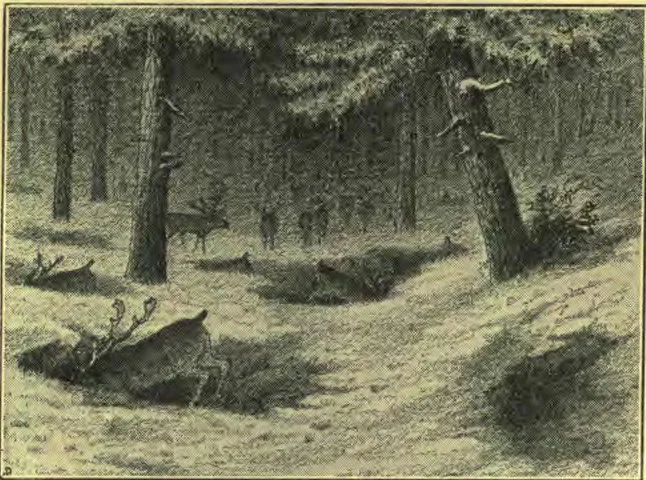
This moss is a very sensitive plant, and once browsed over, even for only three weeks, it must then be given years of rest—from five to ten—before the deer can be permitted to feed upon it again, or it will die and not reappear for a generation at the least. So the herder is forced to change his location each year, often wandering far for new pasture. For his own sustenance his beasts must live, and to find food for them compels the herder often to wander over miles of desolate territory. He is compelled also to seek territory where in winter the snow does not fall too heavily, as the deer must dig down into it to find the moss which is their food. It is a strange sight, the feeding of hundreds of these animals, often almost completely hidden from sight under the snow.
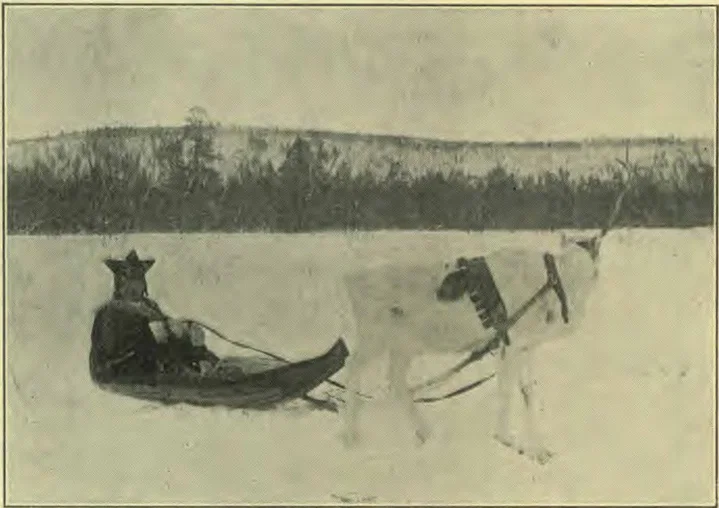
Lapland is largely made up of lakes, marshes, and swamps. In summer there is no other possible way of traveling through the greater portion of the country except on foot. In a few districts reindeer can be used as pack animals, but usually supplies must be transported on the backs of men. In winter, however, when all is frozen and covered with thick ice, traveling is done by sleighs, and regular routes are established by the government, where relays of deer can always be had, and in some places horses may be obtained. A few short lines of railroad reach into the interior from the borders connecting with navigable streams, but in general, the methods of travel in Arctic Lapland remain about as they have been for generations.
To the other many disadvantages and discomforts of summer traveling in Lapland, must be added the terrible plagues of mosquitoes, dragon flies, great bluebottle flies, and horseflies. These are present in millions, and it is not possible to protect the person from their attacks, clothing being but a small defense, especially against the bluebottle flies.