Penang
Who knows where it is?—I did not until the morning of this last January 25, when on board the “Arratoon Apcar,” bound from Calcutta to Hong-kong, we steamed into its harbor. If your atlas is handy, you can find it on the west coast of the Malay Peninsula. For nine days we had been out from Calcutta,—only thirteen hundred miles,—but we had been running very leisurely on account of plague restrictions, which forbade any vessel of that line, leaving Calcutta, to land passengers at any port for nine whole days. Two of these days had been spent on the muddy Hughli, and the other seven on the beautiful blue waters of Bengal Bay, bluer than which our eyes never saw; delightfully calm, too, it had been all the way, and with a pleasant company of home-returning missionaries and American tourists, we had enjoyed the journey very much.
For a day or two the monotony of sea and sky had been broken now and then by little islands along the horizon. The Andamon group we had passed on our right, the southernmost of which is a penal colony for all India. Very pleasant, ever-green islands they are, there in the blue sea,—so pleasant that oftentimes the prisoners choose to remain after their term has expired.
Notwithstanding these occasional “breakers,” we were delighted that early morning with our first glimpse of Penang Island. I did not know that it was an island, and was consequently surprised at seeing it off to our right, our ship having changed her course during the night, and run up around into the narrow strait between the mainland and the island, which makes a very good harbor. The real name of the harbor is Georgetown, but being the principal point of interest about the little island, it all goes by the name of Penang.
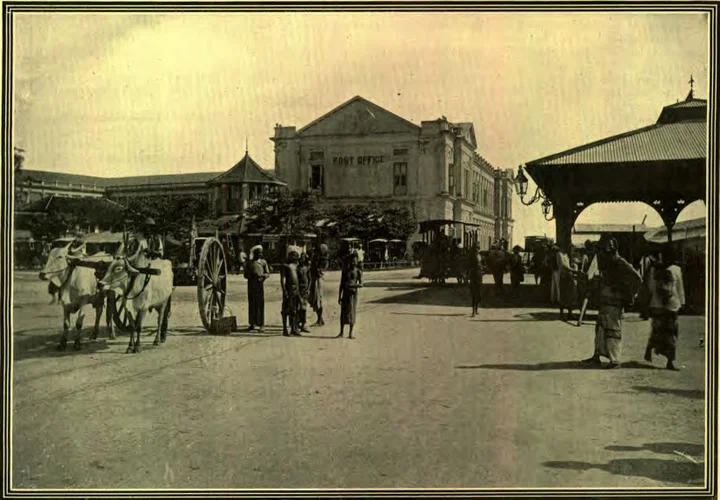
It seemed good to set our feet on land again, but as we directed our steps toward the post-office, we were surrounded by jinrikishas, pulled by hardy Chinamen, who seemed to think our feet ought not to set on land, but the rather step into their vehicles. This we did, and had a pleasant ride all about town. Bayard Taylor called Penang “the most beautiful island in the world,” and it is indeed a lovely spot.
The ’rikisha men are muscular fellows indeed. They will trot off at a lively rate, any time of day, with two good-sized persons in their carriage . Their hearts and lungs, however, do not usually endure more than five or six years of such service.
Although within six degrees of the equator, with an average temperature of eighty degrees, this island is crowned with a hill two thousand seven hundred feet high, which furnishes a fine resort for the European inhabitants when they wish to escape the heat.
About one hundred years ago Penang was ceded to the British by the sultan of Kedah. During the reign of the East India Company, it was the seat of a presidency government, and was a peer of Bengal and Bombay. Although it has fallen from this height, it holds rank to-day as quite an important shipping-station. Its principal exports are tin and pepper. Of the former our ship took on one hundred and twenty tons.
The inhabitants are mostly of the Malay type. As we rode about through the streets of the town, we thought, Surely there are some hearts among these who long to know more truth. Who will tell them about Jesus and his coming?—Some one will. Who will it be?
Mrs. J. S. Place.