THE Philippine Islands lie about six hundred and fifty miles from the coast of China, with the China Sea washing their shores on the west and the Pacific Ocean dashing against their eastern shores. The distance from San Francisco to Manila, the capital of the islands, is a little more than seven thousand miles.
About three thousand islands comprise the group, having an area of little less than one hundred and fifteen thousand square miles, equal to the combined area of the six New England States and New York. Only 342 of these islands are inhabited.
Luzon, Mindanao, Samar, Negros, Panay, Mindoro, Leyte, and Cebú are the principal islands of this group. The first two named are nearly as large as all the rest of the group combined.
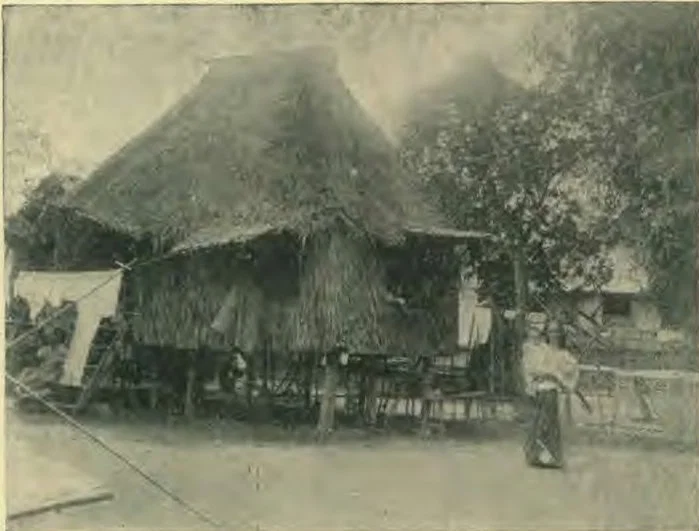
The chief products are hemp, sugar, rice, coffee, and tobacco. Many tropical fruits, as bananas, oranges, and pineapples, are grown in abundance. Mahogany, cedar, ebony, and bamboo trees grow in the islands. It is not unusual to see the foundation pillars of a native house built of solid mahogany or some other expensive wood.
The policy adopted under Spanish domination held in check all progress in the islands, and their resources were therefore not well developed. American enterprise will soon make the land yield a great increase in production.
The Climate
The climate is a continual summer, the thermometer ranging between 60° and 100° F. According to Nelson’s Encyclopedia the highest temperature ever recorded in Manila was 100° F. There are three seasons in the year, the first cool and dry, lasting from November to March; the second hot, but still dry until June, when the wet season begins, and lasts until November. During the rainy season the weather is disagreeable; rain falls daily, and the intense dampness causes bedding, clothing, and even woodwork to mold.
The People
The islands are inhabited by several races of people. The Negritos (little Negroes) live in the forests, and are no doubt descendants of the original inhabitants. There are about thirty thousand of them. They are timid, and remind one of rabbits, as they scurry away at the approach of a stranger. It is seldom that groups of them can be found together. They live largely on game, and the flesh of the monkey, of which they are very fond. This they obtain by the skilful use of bow and arrow. Since the beginning of the centuries of Spanish rule, this people has changed the least of any race, not having amalgamated with any other people. They have never been conquered; yet if unmolested, they are peaceable. They caused the United States army very little trouble during the insurrection. They are savages of the primitive sort, building no houses, and finding their sleeping places by the roots of large trees.
The Igorrotes inhabit the mountains of northern Luzon. There are several tribes of them, each tribe having its own dialect. I spent about one year among them, and became quite familiar with their customs. They are known as “head-hunters.” In one year nearly one hundred Christianized Filipinos lost their heads at the hands of these savages. Their dress consists of a breechcloth only. I was never able to learn their religious belief, but on several occasions, about sunrise, I saw them down along the bank of a stream, gesticulating toward the sun. I surmised from this that they worship the sun. G. Waldo Brown, in his book, “The Pearl of the Orient,” says: “They [the Igorrotes] are pagans of a fanatical type, but conceal their gods and graven idols in the caverns of the mountains.”
The Roman Catholic priests told me it was impossible to reach them with Christianity. This may be true, as far as Catholicism is concerned, but the Word of God teaches that every nation, tongue, and people shall hear the everlasting gospel, and the Igorrotes must be included in this prophecy.
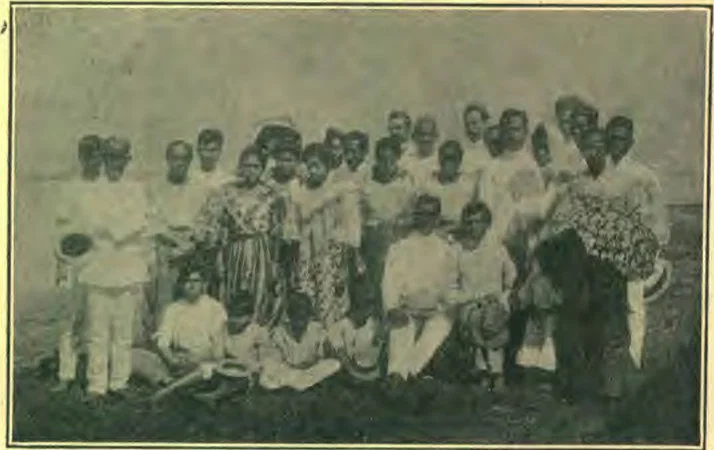
The Tagalogs, who also live on the island of Luzon, especially around Manila, are of medium height, are copper-colored, and have pleasant features, black eyes, delicate hands and feet, and coarse black hair. They are the most civilized and hospitable of all the Filipinos. They are very intelligent and quick to learn.p. 7
Our workers in the Philippines have found this to be true, and the Tagalogs are proving a great help in spreading the third angel’s message.
Altogether there are between thirty and forty dialects spoken. When I was there, Spanish was the official language, but no doubt English is taking the place of Spanish with the younger generation.
The average Filipino is a matter-of-fact person. He must always know the why of everything. He is sensitive, but courageous. He will wait indefinitely to avenge a wrong. The Filipinos are fond of music, every town having its band composed of from half a dozen to a dozen pieces. I believe they play mostly by ear, as I do not recall ever having seen music while they were playing. They are imitative. To illustrate: When the United States soldiers landed in the islands, a song entitled, “A Hot Time in the Old Town Tonight,” was very popular, and our regimental band often played it. Imagine our amusement to see a funeral procession going to the cemetery to the tune of “A Hot Time in the Old Town Tonight.”
Their Needs
Owing to the treatment they have received from the Spanish officials and the insincerity of the officials of the religion administered to them by the Roman Catholic Church, the Filipinos themselves have become insincere. What they need is the real gospel of Jesus Christ and a friendly hand placed upon their shoulder, and to be called “my brother,” instead of being threatened with purgatory or other relics of the Inquisition. The public school system conducted by the United States government has done much to uplift these people.
The majority of the Filipinos have no respect for the Roman Catholic religion. The following excerpts from Dr. A. J. Brown’s book, “The New Era in the Philippines,” illustrate this fact:—
“Wherever I went, the testimony of those familiar with the facts was that beyond a comparatively small number, ‘chiefly women and old people,’ the attendance on Roman Catholic churches is largely confined to those who come not from ‘profound attachment for their church,’ but from superstitious fear that the priests would otherwise keep them out of Paradise. High Filipino officials seldom attend. A president whom I met, laughed at a priest who furiously threatened him with excommunication because he would not contribute any more funds to the church. In another town that I visited, the priest ordered the president to prevent the Protestant missionaries from preaching in the market place. When the president not only declined to prevent them but actually encouraged them, the angry priest tried to bring him to terms by refusing to allow his dead parent to be buried in the cemetery, whereupon the president compelled the ecclesiastic to officiate under an armed guard. Both these priests were Filipinos, so that no anti-Spanish feeling was involved.”
“The Rev. Frederick Jansen, of Cebú, received a message from a town on the island of Leyte, which had never been visited by a Protestant missionary, urging him to send a Protestant preacher, the messengers saying, ‘Romanism hardly dare lift her head there, and the priests do not venture out after six o’clock in the evening. But the people, who have thrown off Romanism, are reading the Bible and asking for Protestant missionaries.’ The justice of the peace and his friend begged for immediate help, saying, ‘We are not priest-ridden in Leyte. Do come, and you will see great and immediate results here.’”
From the reports received from our workers in the Philippines, we learn that hundreds of the natives are accepting the third angel’s message and are proving most loyal. They will be sincere when they realize that the gospel we are preaching to them is not a sham, but is the revelation of the love of God to the human family, telling of Christ’s soon coming to gather his people to the heavenly home, where sin and suffering will no longer be known.
On Sabbath, March 25, opportunity will be given us to help this needy field in a material way.
Let us plan to sacrifice and give to our utmost, that the work in these islands may be forwarded, and that many other tribes may hear the glad news of the gospel during this year.
EDWARD QUINN, JR.