During a violent summer thunderstorm a bolt of lightning struck the oil-soaked ground near the Potrero del Llano No. 4 oil well near Tampico, Mexico, the greatest oil well in the world. For more than four months, the resulting conflagration resisted all efforts to subdue it. The flames, covering an area of more than a city block, swept over the mouth of the great well, but thanks to the concrete cap covering the orifice, the main body of oil did not ignite.
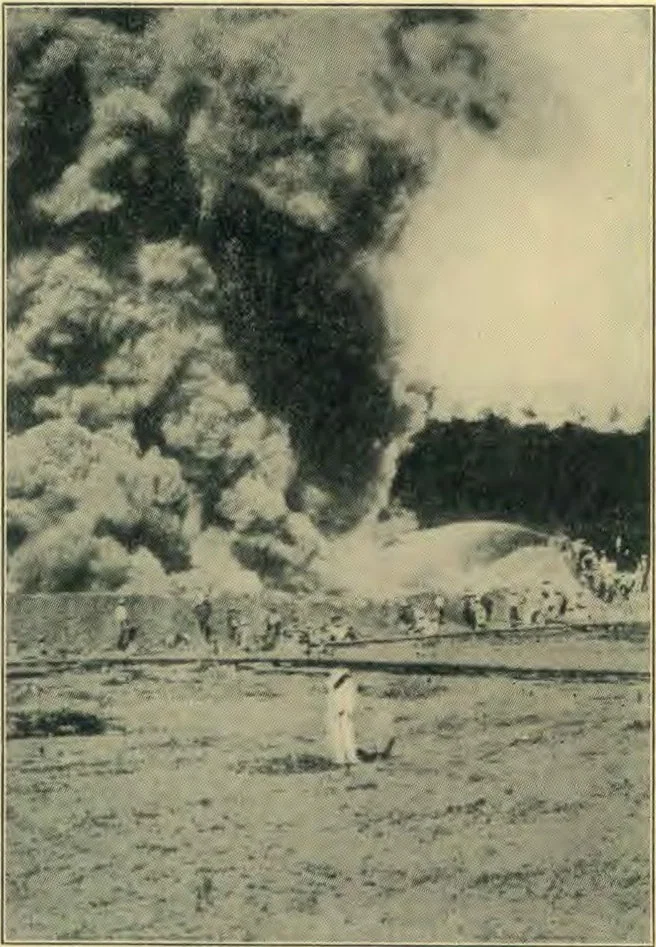
Upon the first outbreak of the flames, it was thought that the main well was doomed, as well as a great lake of oil near by, containing nearly two million barrels. Twenty-five hundred men were summoned to the work of fighting the flames, and apparatus which had been successfully used at other fires of the same nature was brought to the spot. This great force of workmen labored ceaselessly day and night until the fire was conquered, four and one-half months later.
The first precaution against the spread of the flames was the erection of a retaining wall of sand and dirt which completely encircled the burning area. The earth itself seemed ablaze, for the oil continued to seep through the soaked ground and furnished new fuel for the flames. The fire mounted hundreds of feet into the air, and at night a red canopy covered the sky, visible for many miles. Thousands of spectators watched the work.
A great battery of steam boilers arrived at the spot, and pipes were led to the fire. The laborers worked under continuous streams of water from fire hose, for the heat was so great that without soaking themselves in water, their clothing would have burst into flames. Those playing the streams upon the workers had to direct the hose while crouching behind shields to protect themselves from the heat.
Weeks lengthened into months, and still the fire burned fiercely. Much to the surprise of experts, the great well, although in the center of the conflagration, did not add its huge flow of oil to the blaze. One of the most remarkable features of the fire was the fact that during the time the fire was burning, the managers were able to draw twenty-five thousand barrels of oil daily from the well through the main flow line from the gate valve, which was well protected by concrete.
After attempting nearly every known method of subduing the flames, the engineers in charge set the laborers at work gradually pushing the retaining walls in toward the center of the blaze. Because of the intense heat this was done under the greatest difficulty. The circumference of the wall was gradually lessened, thus slowly reducing the area of the blaze.
Pipes were led to the bottom of the blazing area, and oil was drawn as fast as possible from the seepage. As it was not fit for commercial use, this was pumped to a safe spot nearly five miles distant from the blaze proper, and then burned, making in itself a huge conflagration.
Finally the sand walls had been pushed in so far that the blaze was confined to a relatively small area, and everything was made ready for a last effort, greater than all previous attempts. Tons of chemicals were piled near the scene, and thousands of feet of extra steam pipes were laid from the boilers and pumps. In the first days of the new year, the attempt was made. Chemicals were heaped into the fire area, and boilers and pumps poured a deluge of water and steam upon the stubborn flames. For hours this frenzied work continued, the result trembling in the balance. At last the ingenuity of man conquered the stubborn forces of nature, and the fire was out.
It seemed almost hopeless to attempt to calculate the damage done by that bolt of lightning. The estimated production of the great well was one hundred and fifty thousand barrels of high-grade oil a day, yet for more than four months but twenty-five thousand barrels a day were drawn. Thousands of dollars were expended upon equipment for the fire fighters, and other thousands went for chemicals which were fed to the flames.
The fire was watched with great interest by the oil trade of the world, who recalled another record-breaking fire which occurred several years ago not far from the Potrero del Llano conflagration. The Dos Bocas gusher, one of the largest in the world at that time, caught fire before being capped. For nearly a year the fire raged, and subsided only when it had consumed all the oil in the fertile pocket which it had tapped. At the present time it produces only salt water and gas.— A. G. Fasbinder, in Popular Science Monthly.