The Bay of Fundy probably derives its name from the Latin word funda, meaning “deep.” It lies between New Brunswick on the north and Nova Scotia on the south. It is known to nearly every one because of its high tides—the highest in the world. The bay is about seventy miles in width at the entrance, and converges to thirty about one hundred and fifty miles above, where it divides into two arms, known as Minas Basin and Chignecto Bay, with their tributaries.
Tides rise and fall twice every twenty-four hours and fifty minutes. The highest tides occur at each new and full moon: these are called spring-tides, and often rise to the almost fabulous height of seventy feet. Spring-tides also ebb very much lower than do other tides. Neap-tides do not ebb so low nor flood so high, not more than half the extremes of spring-tides.
Why the tide should rise to such a great height in this bay seems to be a phenomenon of nature with no satisfactory explanation. A number of theories are advanced, but the one most generally accepted is that the length of the bay has constantly convergent shores. The tide is very swift, flowing seven knots an hour.
The ancients reasoned that the earth respired twice a day. At each inhalation the tide would flood, and at each exhalation it would ebb. Had they visited the Bay of Fundy, they might have concluded that old Mother Earth was practicing the latest respiratory movements to develop her lungs.
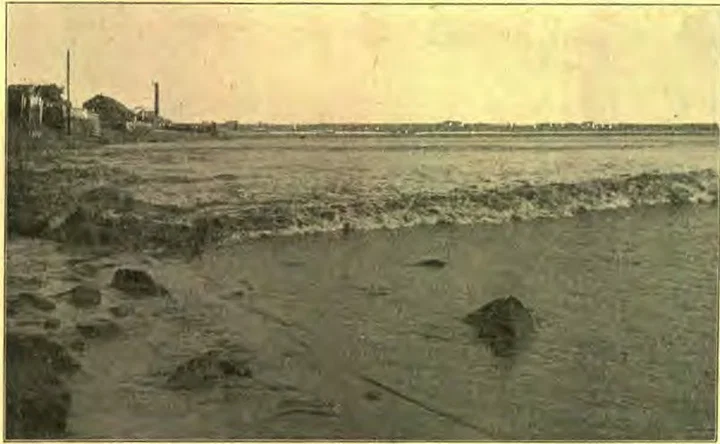
Most of the Fundy shores are very high and rocky, but around the tributaries at the head of the bay the shores are rarely precipitous, but predominant in broad, flat lands, reaching far back inland along the streams.
The greater portion of these lands was formerly submerged by the sea at high tide, but man has now reclaimed thousands of acres of this beautiful marsh-land from the sea by means of heavy dykes, and converted it into luxuriant meadows, dotted over with barns. Longfellow wrote of it:—
“Bursting with hay were the barns, themselves a village. . . Dykes, that the hands of the farmers had raised with labor incessant, Shut out the turbulent tides; but at stated seasons the flood-gates Opened, and welcomed the sea to wander at will o’er the meadows.”
Occasionally the farmers do let the water in through the dykes, because the rich alluvium (marsh mud) deposited by the waters greatly enriches the land. Sometimes the “turbulent tide” under high wind plows through the dykes, and floods miles of meadow and field. The past season the tide broke through just at haying time, and thousands of tons of hay and other crops were destroyed. In winter, when the farmer has more leisure, he goes out with his team beyond the dykes at ebb-tide, and hauls the rich alluvium from the flats to the upland.
Philosophy teaches that “water seeks its level,” but in the Bay of Fundy and its tributaries, water apparently ignores this rule and flows up-hill. It is not easy to describe the feeling that steals over one who witnesses this phenomenon for the first time. He looks out in the morning, and beholds a wonderful scene. The river which, the night before, was rippling lazily along, with the appearance of any other stream, except for its deep, declining banks and far-receding bed, is now surprisingly changed. It is rushing furiously up-stream, seven knots an hour, growing deeper and wider continually until it has risen forty or fifty feet, and ships under full sail ride gallantly by. For a moment one can scarcely believe his senses; he almost thinks the world has turned upside down. He exclaims, “Great things doeth He, which we can not comprehend!”
On account of these giant tides, many otherwise insignificant streams are made navigable for several miles inland. Ships can ascend these streams only at flood-tide, when the small creeks become large and deep rivers, with the current flowing swiftly toward the source. If vessels fail to reach their destination before the tide ebbs, which often occurs, they must then cast anchor, or they will be carried back to sea by the swift returning tide. Unless a vessel is specially built to lie on the bottom of the river, long lines must be fastened to the mast-head, as the flood ebbs away, and the other end taken ashore and made fast by iron bars driven down, to prevent the ship from capsizing when she settles on her keel in the river’s bed on “dry land.” When a person sees a ship lying, a helpless monster, in the bed of a stream, far from her home on the restless sea, it seems to touch a chord of sympathy in one’s heart. Soon, with unerring accuracy, the flood-tide returns, reversing the river, relieving the patient monster, and again the “ship’s afloat.”
As the water converges toward the head of the bay, it rises higher than it does lower down, and the water is forced up the rivers with great power. A grand and impressive sight may be seen at Moncton, New Brunswick, twenty-five miles up the river, at the first approach of the flood-tide. It is a tidal wave, called the “Bore.” It can be heard roaring and plowing up the river long before it comes in sight. A white, rollingp. 124 wall of water, sometimes ten feet high, dashes up the river and stretches far across its bed. What was just before a small stream scarcely ten rods wide, is now more than a mile in width, bearing steamboat, ship, and barge upon its waters.
A man visiting from the West, unacquainted with the tides, on seeing the “bore” fiercely sweeping up the river, cried out to his friends with him, in great excitement, “Oh, what a mighty flood! and without a drop of rain, too! Yes, and it’s coming wrong side up! What an awful cloud-burst there must have been below!”
At the mouth of the River St. John, 450 miles in length, is formed an estuary full of grandeur. One attraction is a curious fall about thirty feet high at low (tide) water; but as the Fundy flood-tide returns rushing up the river, it soon reverses the stream, and the water falls up-stream instead of down.
At high (tide) water no trace of the fall is seen, and then the river presents a scene of busy traffic. Waiting steamboats, ships, woodboats, rafts of logs and lumber, now go sailing by as if no fall were ever there. Soon the tide ebbs away, and the fall again appears, guarding the river, seaward, from friend or foe with all security as before.
Truly, wonderful are the paths of God.
GEO. E. LANGDON.
Halifax, Nova Scotia.